Ballast Water Management Convention: The Complete Compliance Guide (D-1, D-2, BWTS, and 2026 Updates)


Quick Answer: The Ballast Water Management (BWM) Convention is the IMO treaty governing the control of harmful aquatic organisms in ships' ballast water. Adopted in 2004, in force from 8 September 2017. Since 8 September 2024, all applicable vessels must meet the D-2 ballast water treatment standard, requiring an approved Ballast Water Treatment System (BWTS) onboard.
Australia's biosecurity data for the twelve-month period ending November 2024 tells a clear story. Of 12,987 port biosecurity inspections, nearly 30% found ballast water management non-compliance. Of those non-compliance cases, 70% came down to two causes: crew unfamiliarity with the Ballast Water Management Plan and poor maintenance of the installed treatment system.
The September 2024 D-2 deadline was the most significant compliance milestone in the BWM Convention's history. It closed the transitional period under which vessels could still operate using ballast water exchange alone, and made ballast water treatment mandatory for every applicable ship in international trade. Most operators had been preparing for years. Some had not. And even many who had installed approved systems found that installation was only the beginning, the operational compliance requirements that follow are where the failures accumulate.
From September to November 2025, Port State Control authorities under the Paris and Tokyo MOUs are running a Concentrated Inspection Campaign (CIC) targeting BWM compliance across the global fleet, with the Riyadh, Indian Ocean, Mediterranean, Black Sea, and Viña del Mar Agreement MOUs also participating. The USCG recorded a 6% increase in BWM-related deficiencies in 2024 and is expected to intensify enforcement further.
This guide covers the BWM Convention from its environmental basis through its two regulatory standards, the treatment technologies that satisfy D-2, the critical USCG vs. IMO type approval distinction that catches operators trading to the US, challenging water quality operations, the 2025 PSC campaign, and the P&I insurance position when things go wrong.
Who this guide is for: Ship operators, Masters, chief officers, DPA and fleet managers, P&I correspondents, vetting inspectors, and compliance officers.
Why Ballast Water Is an Environmental Problem
Ballast water is seawater taken aboard a vessel to maintain stability, trim, and structural integrity during a voyage, particularly when carrying reduced cargo or sailing in ballast. A fully loaded Capesize bulk carrier needs no ballast. The same vessel sailing empty from a discharge port to a load port may take on 50,000 to 80,000 tonnes of seawater ballast to achieve the draft and metacentric height required for safe passage.
The environmental problem is not the water. It is what lives in it.
When a vessel loads ballast at a port, it draws in the local marine ecosystem: zooplankton, phytoplankton, fish larvae, invertebrate juveniles, bacteria, pathogens, and sediment. These organisms survive in ballast tanks, some for weeks, and are discharged at the next port into a completely different marine environment. If the destination ecosystem lacks natural predators for the introduced species, populations can grow unchecked.
The IMO has documented hundreds of invasive species introductions attributable to ballast water discharge. The economic and ecological damage is well-established:
The zebra mussel (Dreissena polymorpha), native to the Caspian Sea region, was introduced to the North American Great Lakes through ballast water discharge in the 1980s. It spread across the Great Lakes system and connected waterways, clogging water intake pipes for municipal water systems and power plants, displacing native mussel species, and altering the food web. Damage estimates have reached billions of US dollars.
The European green crab (Carcinus maenas) has established invasive populations on the US West Coast, disrupting native crustacean and shellfish ecosystems. The Asian shore crab (Hemigrapsus sanguineus) has spread through European estuaries. Cholera outbreaks in South American ports in the early 1990s were linked to ballast water discharge carrying Vibrio cholerae.
Voluntary guidelines produced by IMO in the 1990s were insufficient. The ecosystem damage continued. The binding treaty that resulted, the BWM Convention, took years to negotiate, longer to ratify, and even longer to fully enforce. The D-2 universal mandatory date of September 2024 represents the end of a 20-year regulatory journey from the original 2004 adoption.
What Is the BWM Convention?
The International Convention for the Control and Management of Ships' Ballast Water and Sediments was adopted at an IMO diplomatic conference in London on 13 February 2004. It is commonly referred to as the BWM Convention.
The convention's objective is to prevent, minimise, and ultimately eliminate the transfer of harmful aquatic organisms and pathogens through the control and management of ships' ballast water and sediments.
Entry into force
The convention required ratification by 30 states representing at least 35% of world merchant shipping tonnage. This threshold proved difficult to reach, the process took 13 years. The BWM Convention entered into force on 8 September 2017, after Finland's ratification in September 2016 pushed the tonnage threshold over 35%.
Scope
The convention applies to all ships of 400 GT and above engaged in international voyages. It also applies, with modifications, to:
Ships of less than 400 GT engaged in international voyages (simplified requirements apply)
Floating platforms, floating storage units (FSUs), and floating production storage and offloading (FPSO) units
Exemptions exist for vessels trading exclusively in domestic waters (unless the coastal state requires compliance), vessels operating in areas beyond the geographic scope of the convention, and ships not designed or constructed to carry ballast water.
Key documents required
Every vessel subject to the convention must carry:
An International Ballast Water Management Certificate (IBWMC), issued by the flag state or recognised organisation following satisfactory survey
A ship-specific Ballast Water Management Plan (BWMP), approved by the flag state or recognised organisation
A Ballast Water Record Book (BWRB), recording all ballast water operations
Regulatory structure
The convention is structured around Regulations A through G. The key compliance regulations are:
Regulation A-1 (Definitions)
Regulation B-1 (Ballast Water Management Plan)
Regulation B-3 (Ballast Water Management for Ships)
Regulation B-5 (Sediment Management for Ships)
Regulation D-1 (Ballast Water Exchange Standard)
Regulation D-2 (Ballast Water Performance Standard)
The MEPC (Marine Environment Protection Committee) manages amendments and supporting guidelines. As of 2025, relevant recent resolutions include MEPC.372(80) on electronic BWRB, MEPC.373(80) on BWRB format amendments, and MEPC.387(81) on interim guidance for challenging water quality conditions.
Regulation D-1: Ballast Water Exchange Standard
D-1 was the BWM Convention's transitional standard, always intended as an interim measure until universal D-2 implementation became technically feasible.
What D-1 requires
Ballast water exchange means replacing coastal or port water with open-ocean water while the vessel is at sea. The rationale: open-ocean organisms are generally not adapted to coastal or freshwater environments, so even if they survive transit in the ballast tanks, they are unlikely to establish invasive populations when discharged at a coastal port.
The convention requires exchange to be conducted:
At least 200 nautical miles from the nearest land
In water at least 200 metres in depth
Where these conditions cannot be met due to voyage constraints, exchange must be conducted as far from the nearest land as practicable, at a minimum of 50 nautical miles from nearest land in water at least 200 metres deep.
Three exchange methods
The sequential method empties each ballast tank and refills it with open-ocean water. It is the most common method because it achieves the most reliable 95% volumetric exchange and is straightforward to execute and document. The limitation is that it requires substantial free-board reserve during the emptying phase.
The flow-through method pumps open-ocean water into the tank while the tank remains full, allowing the overflow to exit. To achieve the required 95% exchange, the vessel must pump through three times the tank volume. It avoids the free-board issue but consumes significantly more time and pump capacity.
The dilution method pumps in new water from the top while simultaneously discharging from the bottom, maintaining tank level throughout. It achieves similar results to flow-through with better control over trim and stability.
Why D-1 was always transitional
The scientific community consistently argued that D-1 exchange is imperfect. Organisms can survive in sediments at the bottom of tanks through multiple exchange cycles. Some organisms tolerate a wide salinity range (euryhaline species), meaning open-ocean water does not eliminate them. And the requirement to exchange far from land introduces a weather window constraint, vessels in rough conditions cannot safely conduct exchange operations, creating real operational limitations in the North Atlantic and Southern Ocean.
D-1 provided a practical pathway to compliance while treatment technology matured. From 8 September 2024, it is no longer a standalone compliance option. All applicable vessels must now operate under D-2.
Regulation D-2: Ballast Water Performance Standard
D-2 is the permanent compliance standard. It requires that discharged ballast water must not exceed defined biological concentration limits, regardless of how that result is achieved.
The three discharge thresholds
These are the D-2 discharge standards every applicable vessel must now meet:
Organism Category | Maximum Viable Concentration |
Organisms ≥ 50 micrometres (minimum dimension) | Less than 10 per m³ |
Organisms ≥ 10 micrometres but < 50 micrometres | Less than 10 per mL |
Toxicogenic Vibrio cholerae | Less than 1 cfu per 100 mL |
Escherichia coli | Less than 250 cfu per 100 mL |
Intestinal Enterococci | Less than 100 cfu per 100 mL |
The size-based thresholds address the majority of harmful aquatic organisms, zooplankton, phytoplankton, fish larvae, that represent the primary vector for invasive species introduction. The pathogen thresholds address public health risks from microbial contamination of port waters.
Achieving D-2 compliance in practice
Meeting these thresholds requires active treatment of ballast water, physical, chemical, or biological processes that kill or render harmless the organisms present. Exchange alone does not reliably achieve D-2 standards, which is why the convention mandates installation of an approved Ballast Water Treatment System (BWTS) for all vessels subject to D-2.
The Experience-Building Phase (EBP)
From 2019 to 2024, IMO conducted an Experience-Building Phase (EBP) to gather data on how BWTS installations were performing in real operational conditions, as opposed to the laboratory conditions under which type approval was granted. The EBP data, reviewed at MEPC 83 in 2024, showed that while most systems performed adequately under normal conditions, a significant proportion had operational issues in challenging water quality conditions. The EBP review is ongoing, and the data may inform future revisions to D-2 thresholds or testing protocols in subsequent MEPC cycles.
Ballast Water Treatment Systems: Technology Types

Choosing a BWTS is the most consequential single compliance decision most operators face. The wrong choice for a vessel's trading pattern, particularly if the vessel calls at US ports or trades through turbid river ports, creates operational problems that cannot be easily resolved without reinstalling a different system.
UV Systems
UV treatment works by exposing ballast water to ultraviolet light at wavelengths that damage the DNA of living organisms, preventing reproduction. In practice, most UV systems incorporate a physical filtration stage as pre-treatment, typically a self-cleaning filter removing particles above 20 to 50 micrometres, followed by a UV irradiation chamber.
UV systems hold approximately 84 to 89% market share in new BWTS installations in Australia and the US, the highest of any technology type. Their appeal is straightforward: no chemical storage, no hazardous substance handling, no neutralisation requirement on discharge, and no active substance approval complexity. A UV system that works within its design parameters is operationally clean.
The critical limitation is turbidity. UV treatment efficiency depends on the UV transmittance (UVT) of the water being treated. In clear ocean water with high UVT, the system performs to specification. In turbid water, river ports, estuaries, ports with high suspended sediment, UVT falls and the UV dose reaching organisms may be insufficient for D-2 compliance. This is the challenging water quality (CWQ) problem, and it is more prevalent than most BWTS selection decisions account for.
UV systems also have lamp replacement and sleeve cleaning maintenance requirements. UV lamps degrade over time and must be replaced on manufacturer-specified schedules. USCG-certified UV systems typically have 15 to 20% higher maintenance costs than equivalent non-USCG systems due to stricter documentation standards.
Electrochlorination Systems
Electrochlorination (EC) treatment generates sodium hypochlorite (active chlorine) by electrolysing the ballast water itself as it enters the treatment unit. The generated chlorine kills or inactivates organisms throughout the tank holding period. Before discharge, the total residual oxidant (TRO) must be verified to have fallen below safe levels, or an active neutralisation step must be applied.
EC systems perform well in turbid water conditions where UV systems struggle, the chlorination chemistry is largely independent of water clarity. This makes EC systems attractive for vessels trading heavily in river ports, delta ports, and other CWQ environments.
The operational complexity comes from the TRO management requirement. TRO sensors must be maintained and calibrated. If the TRO sensor fails or is miscalibrated, the system may report a false compliance reading, or may hold ballast water unnecessarily past its scheduled discharge time. Australia's inspection data specifically cited TRO sensor failures as one of the primary equipment-related non-compliance causes. The deliberate alteration of alarm parameters, also cited, suggests that some crew were disabling TRO alerts rather than addressing underlying sensor issues.
EC systems require active substance approval under the IMO G9 pathway, in addition to the standard BWMS Code type approval.
Chemical Injection Systems
Chemical injection systems dose ballast water with pre-stored biocides, chlorine dioxide, peracetic acid, or other approved active substances, rather than generating the active substance onboard. They function effectively across a wide range of water quality conditions.
The operational constraints are chemical storage (requiring designated hazardous material storage spaces), supply chain management for chemical replenishment at ports, and the active substance approval requirements under IMO G9. Some chemical systems also require neutralisation before discharge.
For tankers and vessels where chemical handling regulations already govern large parts of operations, the incremental complexity of a chemical injection BWTS is lower than it would be for a bulk carrier crew unfamiliar with chemical handling procedures.
Hybrid and Emerging Technologies
Several systems combine UV with EC or other active substance components to address a single technology's CWQ limitations. A UV+EC hybrid can operate in UV mode for clear water conditions and switch to electrochlorination mode when turbidity increases, giving the vessel full-trading-range coverage without installing two separate systems.
Ozone-based and cavitation-based systems represent earlier-generation approaches that remain in service on some vessels but have seen limited new uptake as UV and EC technologies matured. The BWMS Code (Resolution MEPC.300(72)) replaced the earlier G8 guidelines and tightened type approval testing requirements, which affected some older system designs.
The key approval pathway distinction: systems using no active substances (G8/BWMS Code) require only the standard type approval process. Systems using active substances (G9) require additional review of the active substance's environmental and human health profile before the complete system receives type approval. G9 systems have a longer and more complex approval pathway.
IMO Type Approval vs. USCG Type Approval: The Critical Difference
This distinction causes more operational compliance problems than any other single aspect of BWTS selection. It needs to be understood before any vessel trades to US ports, not after the system is installed.
The core issue
The United States is not a signatory to the BWM Convention. It has its own national ballast water management regulations under 33 CFR Part 151 Subpart D, enforced by the US Coast Guard (USCG). The USCG maintains a separate type approval process for BWTS, separate from the IMO BWMS Code / G8 / G9 process. The two approval lists are not equivalent.
As of late 2024, approximately 30 systems held USCG type approval, compared to over 65 systems with IMO type approval. A vessel that installs an IMO-approved but non-USCG-approved BWTS can operate that system in compliance with the BWM Convention in almost every port in the world, except in US territorial waters.
Practical consequence
A vessel with only an IMO-approved system that enters US waters faces two options for ballast water discharge: use an USCG-approved Alternate Management System (AMS) designation as a temporary measure, or do not discharge ballast water at all (discharge to a reception facility, retain in tanks, or ballast from the US and discharge elsewhere).
Alternate Management System (AMS)
The USCG created the AMS pathway to address the transition period during which most IMO-approved systems did not yet hold USCG approval. A vessel can apply for AMS designation for its IMO-approved system, which grants a 5-year grace period from the vessel's first US port call to install a USCG-approved system. AMS does not mean the vessel is exempt from US BWM requirements, it means the vessel is operating under a time-limited transitional authorisation.
The AMS grace period has been expiring for many vessels that received early designations. Operators who received AMS designations in 2017 and 2018 on the assumption that USCG approval would follow soon after have in some cases found their grace periods expiring before a USCG-approved alternative was available or installed.
Decision framework for vessel operators
If a vessel trades to the US at any frequency, even occasionally, the only sustainable long-term compliance position is an USCG-approved BWTS. Installing an IMO-only-approved system and relying on AMS creates a countdown that eventually requires reinstallation. The incremental cost difference between USCG-approved and non-USCG-approved systems at the initial installation stage is substantially lower than a forced retrofit under time pressure.
The USCG type approval list is published on the USCG Marine Safety Center website and is updated as new systems receive approval. The class society advising on BWTS selection should be consulted to confirm current USCG approval status before any purchase decision.
Challenging Water Quality: The Operational Problem Most Guides Ignore
Challenging water quality (CWQ) is not an edge case. It is a routine condition at many of the world's busiest bulk cargo ports, and it is the primary cause of treatment system performance failures in the EBP data.
What CWQ means
CWQ describes conditions where the salinity, turbidity, temperature, or other physical and chemical characteristics of the water at a port fall outside the parameters under which a vessel's BWTS was type-approved and rated to perform. The critical parameters are:
Turbidity: High suspended sediment loads reduce UV transmittance, degrading UV system performance. River delta ports in China, India, and Southeast Asia routinely present high-turbidity conditions.
Salinity: Brackish or freshwater environments, the Baltic Sea, major river ports, the Great Lakes, present salinity levels far below the oceanic salinities used in most type approval testing. Some organisms tested against at oceanic salinity have different survival profiles in low-salinity conditions.
Temperature: Extreme cold (Arctic and sub-Arctic ports) affects chemical reaction rates in EC and chemical injection systems.
Total organic carbon (TOC): High TOC levels in port water can consume chlorine generated by EC systems before it reaches organisms.
IMO guidance: MEPC.387(81)
At MEPC 81 in April 2024, IMO adopted interim guidance on the application of the BWM Convention to ships operating in challenging water quality conditions (Resolution MEPC.387(81)). This guidance provides a framework for:
Identifying CWQ conditions before ballast water uptake
Documenting the CWQ situation in the Ballast Water Record Book
Assessing whether the installed BWTS can achieve D-2 performance under the conditions
Deciding whether to proceed with treatment, switch treatment modes (for hybrid systems), perform ballast water exchange instead, or apply a bypass procedure with port authority notification
The bypass procedure
When CWQ conditions make D-2 treatment unachievable with the installed system, the convention and the MEPC.387(81) guidance allow a bypass procedure, but with specific conditions. The Master must:
Assess that CWQ conditions genuinely prevent effective treatment
Document the conditions and the assessment in the BWRB
Notify the port authority before or immediately upon arrival that a bypass condition exists
Either conduct ballast water exchange if practicable, or retain the ballast water and not discharge it at the affected port
Bypass is not a routine operational shortcut. It is a protocol for genuine CWQ emergencies with documentation and notification obligations that must be followed precisely. A vessel that bypasses treatment without following this protocol, and PSC finds evidence of unrecorded bypass in the BWTS operating logs, is in a significantly worse compliance position than one that followed the procedure.
Most common CWQ problem areas
Chinese river and delta ports, Tianjin, Nanjing, and ports along the Yangtze River system, present persistently high turbidity conditions that challenge UV system performance. Vessels regularly calling at these ports with UV-only systems need a documented CWQ protocol and, ideally, an EC backup capability or a hybrid system.
The Baltic Sea presents low-salinity conditions. The North Sea and Baltic approaches where salinity transitions from oceanic to brackish require BWTS performance assessment across the salinity range the vessel will encounter. The Baltic conventions also have additional sensitivity to invasive species introduction given the semi-enclosed nature of the sea.
Tropical port waters with high biological load and suspended organics can challenge both UV (turbidity effect) and EC (chlorine demand from TOC) systems simultaneously.
The Ballast Water Management Plan
The Ballast Water Management Plan (BWMP) is a vessel-specific document required under Regulation B-1 for all ships of 400 GT and above subject to the convention. It must be approved by the flag state administration or a recognised organisation acting on its behalf.
Required contents
A complete BWMP must include:
Safety procedures for all ballast water operations, including procedures for the uptake, exchange, treatment, and discharge of ballast water
Detailed description of the ballast water exchange and/or treatment procedures
Procedures for the discharge of ballast water to reception facilities
Sediment management and disposal procedures
Designation of the officer responsible for BWM operations onboard
Reporting procedures for suspected non-compliance, equipment failures, and CWQ events
Training and familiarisation procedures for officers and crew
The most common PSC deficiency
The single most frequent BWMP-related PSC deficiency is straightforward: the plan has not been updated to reflect the vessel's installed BWTS. Many vessels that completed BWTS installation ahead of the September 2024 deadline had their surveys done but failed to have the BWMP formally amended and re-approved to describe the new system's operation. The BWMP still describes the D-1 exchange procedure as the primary compliance method. The PSC inspector finds a BWTS installed onboard, an IBWMC reflecting D-2 compliance, and a BWMP that contradicts both.
This is preventable. The BWMP amendment and re-approval should be on the BWTS installation project checklist as a required deliverable before the vessel sails.
Crew familiarity
Australia's inspection data placed crew unfamiliarity with the BWMP as one of the two primary non-compliance causes. This is not a document-only failure, it reflects a training gap. Officers and crew must be able to describe the vessel's BWM procedures, identify the responsible officer, and operate the BWTS in accordance with the plan. The 2025 CIC questionnaire specifically includes a crew familiarisation check.
The Ballast Water Record Book and eBWRB
Every ballast water operation must be recorded in the Ballast Water Record Book (BWRB). The record provides the evidentiary chain that PSC inspectors, flag state surveyors, and in US waters, USCG boarding officers, will review to verify compliance.
What must be recorded
Each entry must capture the date, time, and location of the operation; the volume of ballast water involved; whether treatment, exchange, or another procedure was applied; the operational status of the BWTS during the operation; and the name and signature of the responsible officer.
For D-2 treatment operations, the record should include the BWTS operating parameters during the operation, UV intensity, TRO level, flow rate, either by direct entry or by reference to the BWTS electronic log where integrated.
Format changes: February 2025
MEPC.373(80) introduced amendments to the BWRB format that entered into force on 1 February 2025. Vessels must use the revised format from that date. Vessels still using the pre-February 2025 format after the transition date have an out-of-date BWRB, a straightforward deficiency in any inspection.
Electronic BWRB: October 2025
From 1 October 2025, MEPC.372(80) allows vessels to maintain the BWRB in electronic format. Vessels opting for an eBWRB must carry a declaration confirming the system complies with IMO standards. The eBWRB can be integrated with BWTS IoT sensor data, automatically logging flow rates, UV intensity, and TRO levels alongside the manual record entries, which reduces transcription errors and provides a more complete operational picture for compliance verification.
Common BWRB deficiencies
In the 2025 CIC, PSC officers will be reviewing BWRB entries for completeness, accuracy, and consistency with the BWTS operating logs. The most common deficiencies found in PSC data:
Missing entries for ballast water operations
Timestamps that do not match the vessel's navigation log
BWTS operating status recorded as "operational" for periods when the BWTS maintenance log shows the system was offline
Entries signed by officers who were off-watch during the recorded operation
Sediment Management
Sediment management is the aspect of BWM Convention compliance that receives the least attention in most operational guides, and the most attention from PSC inspectors who actually conduct physical tank inspections.
What ballast tank sediments are
Over time, ballast tanks accumulate sediment: a mixture of organic matter, silt, biological material, and the remains of organisms that died during transit. This sediment is not inert, it can harbour viable organisms, including pathogens, in conditions that protect them from treatment processes applied to the water column. A vessel that successfully treats its ballast water but accumulates heavy sediment in ballast tanks may still transfer harmful organisms when sediment is disturbed during ballast operations.
Regulation B-5 requirements
Regulation B-5 requires vessels to remove and dispose of sediment from all spaces on board designed to carry ballast water, in accordance with the vessel's BWMP sediment management procedures. Disposal must be at a port reception facility where available.
The reception facility problem
Port reception facilities for ballast water sediment are not universally available. MARPOL port reception facility requirements are better established than BWM Convention sediment disposal facilities. Operators trading to ports without available reception facilities must document their sediment management situation and plan disposal at the next port where facilities are available.
Inspection approach
A PSC inspector who suspects sediment non-compliance may request access to a ballast tank for physical inspection. Tank condition, visible sediment accumulation, evidence of biological material, is observable. Vessels that have not conducted sediment management at appropriate intervals will have visible evidence of this in the tank condition.
The convention does not specify a mandatory sediment removal frequency. The BWMP sediment management section should specify the vessel-specific intervals and procedures, and these should reflect the actual ballast water operating pattern and tank condition monitoring results.
PSC Inspections and the 2025 Concentrated Inspection Campaign
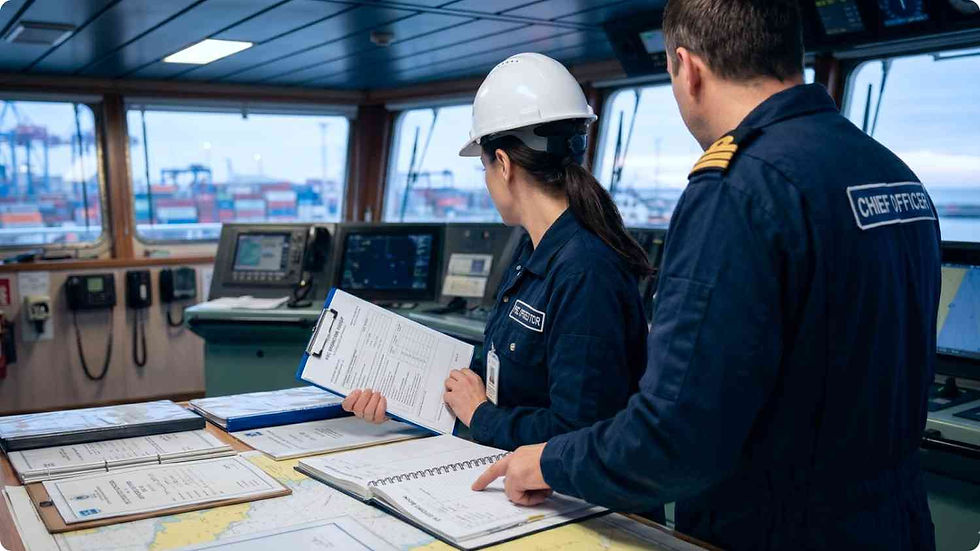
The Paris and Tokyo MOUs announced a Concentrated Inspection Campaign on BWM systems running from 1 September to 30 November 2025. The Riyadh MOU, Indian Ocean MOU, Mediterranean MOU, Black Sea MOU, and Viña del Mar Agreement have confirmed participation. The USCG, while not confirmed as a formal CIC participant as of the August 2025 Gard advisory, is expected to intensify its BWM focus independently.
What the CIC questionnaire covers
Each vessel will undergo one CIC inspection during the campaign period. The pre-defined questionnaire, published by the Paris and Tokyo MOUs and available via the INTERTANKO link, covers:
Valid certification, IBWMC current and correctly endorsed
BWMP approval status and currency, updated to reflect installed system
Crew familiarisation, officers able to describe BWM procedures and operate BWTS
BWTS approval, system onboard matches the type-approved system on the certificate
BWTS operation, system operational logs reviewed; evidence of proper operation
BWRB records, complete, accurate, consistent with operating logs
Sediment management, BWMP sediment section complete, evidence of compliance
Valid exemptions, documented if applicable
What Australia's data tells us about compliance patterns
The MEPC 83/4/14 submission from Australia provides the most granular operational compliance dataset available. The specific non-compliance patterns identified in Australia's 2023-2024 inspection cycle:
Deliberate alterations to BWTS alarm parameters by crew, disabling or widening alarm thresholds to reduce the frequency of system shutdowns during treatment operations
Ignoring alarms during ballast water uptake or discharge, treatment system raising alerts during operations, crew proceeding without investigating or rectifying
TRO sensor failures, particularly in EC-type systems, where the TRO reading is the primary compliance indicator for each discharge operation
Software deficiencies, BWTS software allowing continued operation during equipment faults in ways not consistent with the approved system design
Improper operation, incorrect sequencing of treatment stages, insufficient holding times, operation outside design flow rate parameters
The alarm tampering finding is particularly serious from a compliance perspective. Crew members who adjust alarm parameters to reduce operational interruptions are not resolving an underlying equipment or design problem, they are hiding it from the system's own safety monitoring. PSC inspectors who find evidence of alarm parameter changes outside the manufacturer's approved settings will treat this as a deliberate compliance violation, not a maintenance deficiency.
USCG: increasing enforcement
The USCG recorded a 6% increase in BWM-related deficiencies in 2024, the first full year after universal D-2 mandatory compliance. The increase reflects both genuine non-compliance and the USCG's intensified boarding focus. In US waters, USCG boarding officers check:
Ballast Water Reporting Forms submitted before port entry
BWRB completeness and accuracy
BWTS operational status
AMS designation status and expiry date (where applicable)
Evidence of ballast water discharge in no-discharge zones (Great Lakes, specified rivers)
The USCG has prosecuted operators for falsified BWRB entries. BWM Convention compliance in the US involves potential criminal liability, not just administrative penalties.
USCG Enforcement and US-Specific Requirements
US regulation of ballast water sits under 33 CFR Part 151 Subpart D, enforced by the USCG. The key elements that differ from pure BWM Convention compliance:
Pre-arrival reporting
Vessels must submit a Ballast Water Reporting Form to the USCG before entering US waters. The form records the source of ballast water aboard, where it was taken on, and what management procedures were applied. This form is reviewed by USCG boarding teams and must be consistent with the vessel's BWRB and BWTS operating logs.
No-discharge zones
Certain US waters are designated as no-discharge zones: the Great Lakes and their connecting waterways, the Hudson River above the George Washington Bridge, and specified other areas. In these zones, no ballast water discharge is permitted regardless of treatment status. Vessels must either retain ballast water or exchange it more than 200 nautical miles from the zone before entry.
Criminal enforcement record
The USCG has a documented record of prosecuting BWRB falsification. Cases involving deliberate entry of false treatment records, recording D-2 treatment that was not actually conducted, have resulted in substantial fines and, in some cases, criminal charges against individual officers. The evidentiary standard in USCG enforcement is the internal BWTS operating log, which records actual system operation independently of manual BWRB entries. When the BWTS log and the BWRB do not match, the discrepancy is difficult to explain innocently.
Pre-arrival checklist for US port calls
Before entering US waters, operators should verify:
USCG-approved BWTS is installed and operational, OR AMS designation is current and not expired
Ballast Water Reporting Form completed and submitted
BWRB current and complete for all operations since last US port call
No ballast water to be discharged in designated no-discharge zones
BWTS operating logs available for USCG review
P&I Insurance and the BWM Convention
When cover applies
P&I clubs cover third-party liability for pollution arising from ballast water discharge, for example, a claim from a coastal state that invasive species introduced by a vessel's ballast discharge caused measurable damage to commercial fisheries or aquaculture operations. This type of claim is rare in practice but represents genuine potential exposure as environmental liability law develops.
BWTS failure at sea, where the system malfunctions during a voyage and the vessel is unable to treat ballast water for a port call, is covered as a vessel casualty contingency for notification purposes. P&I clubs expect prompt notification when a compliance-critical system fails.
When cover does not apply
Deliberate discharge of untreated ballast water in breach of the convention, whether achieved through bypass without proper protocol, alarm tampering, or BWRB falsification, places the claim in the category of wilful misconduct or deliberate pollution. P&I clubs have consistently held that wilful violations of environmental conventions fall outside coverage. An operator whose BWTS was found to have deliberately disabled alarm parameters, and whose subsequent ballast discharge caused environmental damage, faces P&I coverage denial.
The bypass situation
When CWQ conditions require bypass, the procedure under MEPC.387(81), documented assessment, BWRB entry, port authority notification, provides the evidentiary record that the bypass was operationally compelled rather than chosen for convenience. Operators who follow this procedure protect both their compliance position and their P&I coverage. Operators who bypass without documentation have neither.
Gard's published guidance on BWM system failures advises prompt club notification and documentation of the failure mode, the circumstances, and the corrective action taken. The club's advice on port authority notification and flag state reporting obligations should be sought before decisions are made about whether and how to discharge ballast water with a failed or compromised BWTS.
Charter Party and Vetting Implications
Time charter allocation of costs
Under a time charter, the commercial question of who bears the cost of BWTS maintenance, chemical replenishment, and repair is typically resolved by the charter party terms. Standard BIMCO time charter clauses generally assign vessel maintenance costs, including installed equipment, to the owner, and trading costs (bunkers, port charges, cargo handling) to the charterer. BWTS maintenance and consumables (UV lamp replacement, neutralisation chemicals for EC systems) are maintenance costs falling on the owner.
When a BWTS requires unscheduled repair during a time charter, interrupting operations, the resulting off-hire and repair cost is a shipowner exposure. Operators managing time-chartered fleets need BWTS reliability built into their preventive maintenance programme to avoid off-hire disputes.
Voyage charter
Under a voyage charter, the Master's obligation to comply with environmental regulations is absolute and independent of freight. The charterer does not bear responsibility for BWMP compliance or BWTS operation, these fall on the vessel operator. A voyage charter disrupted because a PSC inspection found BWM non-compliance and detained the vessel creates both a financial loss and a demurrage dispute between shipowner and charterer, with outcome depending on the specific charter party terms and the cause of non-compliance.
Vetting: RightShip and SIRE
RightShip vetting questionnaires include sections on BWM Convention compliance, specifically: BWTS installation status, IBWMC currency, BWMP approval, BWRB completeness, and evidence of officer training. A vessel that failed a PSC inspection for BWM-related deficiencies will have that record visible in its Equasis profile and accessible to RightShip inspectors. Repeated BWM deficiencies affect a vessel's RightShip rating.
SIRE (the OCIMF Ship Inspection Report programme, used primarily for tankers) and CDI (Chemical Distribution Institute, for chemical tankers) both include BWM questions. Oil major and chemical major charterers who rely on SIRE/CDI reports for vessel pre-fixture vetting will factor BWM compliance status into their approval decisions.
Frequently Asked Questions
When did the D-2 standard become mandatory for all vessels?
8 September 2024. From that date, all vessels subject to the BWM Convention must comply with the D-2 ballast water performance standard, requiring an approved BWTS onboard. The transitional D-1 ballast water exchange standard is no longer a standalone compliance option for vessels capable of installing and operating a treatment system.
What is the difference between D-1 and D-2?
D-1 (ballast water exchange) requires vessels to replace their ballast water with open-ocean water while at sea, at least 200 nm from land in water at least 200 metres deep. D-2 (ballast water performance standard) requires treated discharge to meet specific biological concentration limits, achieved through installation and operation of an approved BWTS. D-2 replaced D-1 as the universal standard from September 2024.
Does a vessel need both an IMO-approved and USCG-approved BWTS?
For vessels trading to US ports, yes. The US is not a signatory to the BWM Convention and maintains its own BWTS type approval list. A system with only IMO type approval cannot legally discharge ballast water in US territorial waters. The USCG Alternate Management System (AMS) designation provides a temporary 5-year grace period, but vessels that regularly trade to the US need a USCG-approved system as a long-term compliance solution.
What is challenging water quality (CWQ) and how should it be handled?
CWQ describes ports and waters where salinity, turbidity, temperature, or other conditions fall outside the parameters under which a vessel's BWTS was type-approved to perform. IMO MEPC.387(81) provides interim guidance. When CWQ conditions make D-2 treatment unachievable, the Master must document the conditions in the BWRB, notify the port authority, and either perform ballast water exchange or retain ballast water rather than discharge untreated. Bypass without this protocol is non-compliant.
What must a Ballast Water Management Plan contain?
A ship-specific BWMP must include: safety procedures for all ballast operations; detailed exchange and/or treatment procedures specific to the vessel's installed system; sediment management and disposal procedures; procedures for discharge to reception facilities; designation of the responsible officer; reporting procedures for failures and CWQ events; and crew training and familiarisation procedures. It must be approved by the flag state or recognised organisation and updated whenever equipment changes.
What are the most common BWM deficiencies found in PSC inspections?
Based on Australia's 2023-2024 biosecurity inspection data and Paris/Tokyo MOU records: BWMP not updated to reflect installed BWTS; BWRB entries missing or inconsistent with BWTS operating logs; crew unfamiliarity with BWMP procedures; TRO sensor failures in EC-type systems; deliberate alteration of BWTS alarm parameters; and improper system operation (incorrect flow rates, insufficient holding times).
What is the electronic Ballast Water Record Book (eBWRB)?
From 1 October 2025, MEPC.372(80) allows vessels to maintain the BWRB in electronic format. Vessels using an eBWRB must carry a declaration confirming IMO compliance. Electronic systems can integrate with BWTS IoT sensors, automatically logging treatment parameters alongside manual record entries. The eBWRB does not reduce the legal obligation to maintain complete and accurate records, it changes only the medium.
What happens if a BWTS fails at sea?
The Master must document the failure in the BWRB and voyage log. P&I club notification is advisable. The vessel's options for the next port call depend on whether D-1 exchange can be conducted en route. If the system cannot be repaired before arrival, the Master must notify the port authority of the compliance situation on arrival. PSC inspectors will examine the documentation of the failure and the corrective action taken. A documented genuine equipment failure, handled transparently with proper records, is treated differently from evidence of deliberate non-operation.
What is the Concentrated Inspection Campaign (CIC) on BWM in 2025?
From 1 September to 30 November 2025, Port State Control authorities under the Paris and Tokyo MOUs, plus the Riyadh, Indian Ocean, Mediterranean, Black Sea, and Viña del Mar Agreement MOUs, are conducting a joint CIC targeting BWM compliance. Each vessel will undergo one CIC inspection. The questionnaire covers certification, BWMP currency, crew familiarity, BWTS approval and operation, BWRB records, sediment management, and exemptions.
Does ballast water management apply to vessels under 400 GT?
The full convention requirements apply to vessels of 400 GT and above in international trade. Vessels below 400 GT are subject to simplified requirements, which may vary by flag state. Floating platforms, FSUs, and FPSOs have specific provisions under the convention that differ from standard ship requirements. Vessels trading exclusively in domestic waters are generally exempt unless the coastal state has imposed compliance requirements.
What are the consequences of BWM non-compliance at a PSC inspection?
Consequences range from a recorded deficiency (no detention) for minor documentation issues, through detention until the deficiency is rectified, to flag state referral for serious or repeated violations. In US waters, USCG enforcement can include criminal charges for deliberate falsification of BWRB records. P&I coverage may be affected if non-compliance reflects wilful misconduct.
How does sediment management fit into BWM compliance?
Regulation B-5 requires vessels to manage and dispose of ballast tank sediment at port reception facilities where available. Sediment can harbour viable organisms even when the water column has been treated. The BWMP must include vessel-specific sediment management procedures. PSC inspectors may physically inspect ballast tanks for sediment accumulation, particularly where BWRB records indicate infrequent sediment management.
Glossary
Active Substance: A chemical or organism used in a BWTS to treat ballast water. Systems using active substances require IMO G9 approval in addition to BWMS Code type approval.
AMS (Alternate Management System): A USCG designation allowing vessels with IMO-approved but non-USCG-approved BWTS to operate in US waters for up to 5 years from first US port call while seeking USCG approval.
Ballast Water: Seawater taken aboard a vessel to maintain stability, trim, and structural integrity during voyages in reduced or no-cargo condition.
Ballast Water Exchange (BWE): The D-1 method of replacing coastal/port ballast water with open-ocean water while at sea, at least 200 nm from land in water at least 200 m deep.
Ballast Water Management Plan (BWMP): A vessel-specific document required under Regulation B-1 detailing all ballast water operations, procedures, responsible officers, and emergency protocols. Must be flag-state approved.
Ballast Water Record Book (BWRB): The shipboard log recording every ballast water uptake, exchange, treatment, and discharge operation. Mandatory for all applicable vessels.
BWMS Code (Resolution MEPC.300(72)): The Code for Approval of Ballast Water Management Systems. Sets type approval testing requirements for BWTS. Replaced the earlier G8 guidelines in 2018.
BWTS (Ballast Water Treatment System): Equipment installed onboard a vessel to treat ballast water to D-2 discharge standards, using UV irradiation, electrochlorination, chemical injection, or other approved methods.
CIC (Concentrated Inspection Campaign): A joint enforcement initiative by PSC MOU authorities focusing on a specific compliance area across the global fleet for a defined period. The 2025 CIC targets BWM compliance.
CWQ (Challenging Water Quality): Conditions at a port or anchorage where water salinity, turbidity, temperature, or other parameters fall outside the performance envelope of the vessel's installed BWTS.
D-1 Standard: The BWM Convention's ballast water exchange standard. Required vessels to exchange ballast water at sea. Replaced as the universal compliance standard by D-2 from 8 September 2024.
D-2 Standard: The BWM Convention's ballast water performance standard. Requires discharged ballast water to meet specific biological concentration limits, achieved through BWTS installation and operation. Mandatory for all applicable vessels from 8 September 2024.
eBWRB (Electronic Ballast Water Record Book): An electronic format for the BWRB, permitted from 1 October 2025 under MEPC.372(80). May integrate with BWTS sensor data for automated logging.
EBP (Experience-Building Phase): An IMO data collection period (2019-2024) gathering performance data on installed BWTS under real operational conditions to inform potential future revisions to D-2 standards or testing protocols.
Electrochlorination (EC): A BWTS technology that generates sodium hypochlorite by electrolyzing ballast water. Effective in turbid CWQ conditions where UV systems underperform.
IBWMC (International Ballast Water Management Certificate): The certificate issued to applicable vessels following satisfactory survey confirming compliance with the BWM Convention.
IMO (International Maritime Organization): The UN specialised agency responsible for developing international maritime safety and environmental standards, including the BWM Convention.
Invasive Species: Non-native organisms introduced to a new environment where they have no natural predators, allowing populations to grow unchecked and damage native ecosystems.
MEPC (Marine Environment Protection Committee): The IMO committee responsible for environmental convention amendments and guidelines, including the BWM Convention.
Neutralisation: The process of destroying or reducing residual active substance (chlorine, TRO) in treated ballast water before discharge, required by many EC and chemical injection systems.
TRO (Total Residual Oxidant): A measurement of residual oxidising chemicals (primarily chlorine compounds) in treated ballast water. A critical compliance parameter for EC-type BWTS.
Type Approval: Certification that a specific BWTS design meets the required performance standards under defined test conditions. IMO type approval and USCG type approval are separate processes with separate approved lists.
USCG (US Coast Guard): The US federal agency responsible for marine safety and environmental enforcement in US waters. Maintains separate BWTS type approval requirements from IMO under 33 CFR Part 151.
UV (Ultraviolet) Treatment: A BWTS technology using UV irradiation to damage organism DNA, preventing reproduction. Dominant technology by market share. Performance depends on water UV transmittance.
UVT (UV Transmittance): A measure of how much UV light passes through a water sample. High turbidity reduces UVT, degrading UV BWTS performance in CWQ conditions.
Viable Organism: An organism capable of reproduction. The D-2 standard is expressed in terms of viable organism concentration, not total organism count.
About the Author
Capt. Anuj Chopra ExC FNI FICS holds an Extra Master Certificate of Competency and is a Fellow of the Nautical Institute and a Fellow of the Institute of Chartered Shipbrokers. He served as VP Americas at RightShip, where he led vetting assessments across the Americas region and worked directly with major charterers, port authorities, and national maritime administrations on environmental compliance and operational risk. He serves as Director, Strategy and Sustainability at Shipfinex FZCO, where he leads regulatory compliance strategy, maritime risk assessment, and sustainability positioning.
References
International Maritime Organization. International Convention for the Control and Management of Ships' Ballast Water and Sediments (BWM Convention), 2004. London: IMO.
International Maritime Organization. Interim guidance on the application of the BWM Convention to ships operating in challenging water quality conditions (MEPC.387(81)). London: IMO, 2024.
International Maritime Organization. Guidelines for the use of electronic record books under the BWM Convention (MEPC.372(80)). London: IMO, 2023.
International Maritime Organization. Amendments to the BWM Convention (MEPC.373(80)), BWRB format. London: IMO, 2023.
Gard. Ballast water management, regulations are tightening. Gard Insights, September 2023.
Gard. Ballast water management on the PSC agenda. Gard Insights, August 2025.
Australia (MEPC 83/4/14). Experience gained during biosecurity inspections related to ballast water management. IMO MEPC 83, 2024.
Paris MOU / Tokyo MOU. 2025 Concentrated Inspection Campaign on Ballast Water Management, Questionnaire. 2025.
US Coast Guard. Ballast Water Management Regulations, 33 CFR Part 151 Subpart D. Washington, DC: USCG.
US Coast Guard Marine Safety Center. Type-Approved Ballast Water Management Systems List. Washington, DC: USCG.
DNV. Ballast water management: type-approved, USCG-compliant treatment systems now widely available. Oslo: DNV.
BIMCO. Ballast Water Management, Guidance for Shipowners and Operators. Copenhagen: BIMCO.
Compliance Disclaimer: Shipfinex FZCO operates under a VARA In-Principle Approval (IPA/26/01/002) issued by the Virtual Assets Regulatory Authority, Dubai. The information in this article is published for general maritime industry education and does not constitute legal advice, regulatory guidance, or a solicitation to invest in any financial product. Readers should consult qualified legal and compliance professionals for advice applicable to their specific circumstances. Nothing in this article constitutes an offer or invitation to deal in virtual assets or securities.


Capt. Anuj Chopra
Advisor / Contributing Author
Capt. Anuj Chopra ExC FNI FICS is a maritime industry executive with over 40 years of experience. As former VP Americas at RightShip and co-founder of ESGplus LLC, he specialises in maritime risk, ESG, and environmental compliance. He is an Adjunct Professor at the University of Houston and Fellow of both The Nautical Institute and the Institute of Chartered Shipbrokers.


