ERC-3643: The Token Standard for Compliance Explained

Updated: Aug 21

Table of Contents
Key Takeaways
ERC-3643 is the only officially accepted Ethereum standard for security tokens, designed specifically for the tokenization of regulated, real-world assets.
The standard builds KYC, AML, and transfer restrictions directly into the token through a modular smart contract architecture, preventing unauthorized transfers automatically at the protocol level.
Over $32 billion in real-world assets have been tokenized using ERC-3643 across 180+ jurisdictions, with DTCC, Franklin Templeton, and Apex Group among institutional adopters.
An ISO standardization initiative is underway that could make ERC-3643 the global reference standard for compliant token issuance.
For tokenized ship ownership, ERC-3643 provides the compliance infrastructure that allows fractional ownership to function within applicable regulatory frameworks.
Blockchain and crypto carry a great deal of technical noise. Most professionals who encounter the term ERC-3643 assume it is relevant only to developers or cryptocurrency traders. It is not.
ERC-3643 is the technical standard that makes it legally possible to hold a fraction of a real-world asset, a ship, a building, a bond, on a blockchain, without violating securities law. It is the compliance layer that separates legitimate, regulated tokenization from uncontrolled speculation.
For anyone seeking to understand how asset tokenization functions within a regulated framework, ERC-3643 is the correct starting point. This article covers what it is, how it functions, who uses it, and what it means for real-world asset ownership in 2026.
Quick Facts: ERC-3643 at a Glance
Details | |
Full name | ERC-3643 (also known as T-REX: Token for Regulated EXchanges) |
Created by | Tokeny Solutions (Luxembourg) |
Blockchain | Ethereum (EVM-compatible) |
Formally adopted | 2023 as official Ethereum Improvement Proposal |
Governed by | ERC-3643 Association |
Assets tokenized to date | Over $32 billion (as of late 2025) |
Jurisdictions covered | 180+ |
ISO standardization | Initiative underway (ISO TC 307 / TC 68) |
Key institutional adopters | DTCC, Invesco, Apex Group |
Core function | Compliance-enforced token transfers via KYC/AML at the protocol level |
What Is ERC-3643?
ERC-3643 is a token standard on the Ethereum blockchain designed specifically for the issuance and management of regulated, real-world assets. It defines a set of smart contract rules that govern how tokens are created, transferred, and managed, with compliance built directly into the token itself.
A token standard is a shared rulebook that any developer or platform can follow when creating a digital asset. The most widely known standard is ERC-20, which powers most cryptocurrencies and stablecoins. ERC-3643 extends ERC-20 and adds a critical layer: it prevents a token from being transferred unless both the sender and receiver have completed verified identity checks and the transfer meets all applicable regulatory conditions.
The result is a digital asset that behaves like a regulated security rather than a freely tradeable cryptocurrency. The token itself enforces compliance. It does not rely on a separate back-end system or a manual compliance review for each transaction.
ERC-3643 does not just record ownership. It actively prevents unauthorized ownership.
The Origin of ERC-3643: From T-REX to ISO Candidate
ERC-3643 began as T-REX, Token for Regulated Exchanges, a protocol developed by Tokeny Solutions, a Luxembourg-based company specializing in compliant tokenization infrastructure. Tokeny created T-REX to address a specific gap: securities law requires issuers to know exactly who holds their instruments at all times, but most blockchain token standards allowed anonymous or pseudonymous transfers.
Tokeny put T-REX into production use across multiple regulated asset issuances before submitting it as an Ethereum Improvement Proposal (EIP). The standard was formally accepted as ERC-3643 in 2023, making it the only officially ratified Ethereum standard specifically designed for security tokens. This sequence matters: ERC-3643 was tested at institutional scale before ratification, not ratified speculatively.
Governance then passed to the ERC-3643 Association, a non-profit body that now includes institutional members such as DTCC, Apex Group, and Invesco. DTCC, which processed $3 quadrillion in securities transactions in 2023, joined the ERC-3643 Association in March 2025 and committed to integrating the standard into its ComposerX tokenization platform.
What Others Miss: The ISO Dimension
Most articles covering ERC-3643 focus on its Ethereum roots. What they overlook is its trajectory toward becoming an international ISO standard. The Spanish national correspondent committee of ISO TC 307, in coordination with ISO TC 68, has submitted a New Work Item Proposal to formalize ERC-3643 as a global standard. Partners include ANNA, INATBA, and CEN/CENELEC.
If adopted, ERC-3643 would become the recognized global reference for tokenized securities, a development with significant implications for every jurisdiction developing a tokenization regulatory framework.
How ERC-3643 Works: The Architecture Explained Simply

ERC-3643 achieves compliance through a modular architecture, a set of separate but connected smart contracts that each handle one specific function. Understanding the four main components clarifies what the standard actually does in practice.
ONCHAINID: The Identity Layer
Every participant in an ERC-3643 system carries an ONCHAINID. This is a smart contract that stores verified claims about that participant: that they have completed KYC, that they reside in an eligible jurisdiction, that they meet investor suitability requirements.
ONCHAINID does not store personal data directly on the blockchain. It stores cryptographic references, essentially digital fingerprints that confirm a claim is valid without revealing the underlying personal data. A licensed KYC provider issues the claim. The identity contract records that the claim exists and who issued it. In plain terms: the system knows you are verified without recording your passport number on a public ledger.
The Identity Registry: The Verified Participant List
The Identity Registry holds the list of all approved participants for a given token. Before any token transfers to a new holder, the system checks whether that holder's ONCHAINID appears in the registry and whether all required claims are still valid. If they are not, the transfer fails automatically at the smart contract level. No human intervention is required.
The Compliance Module: The Rule Engine
The Compliance Module holds the specific rules that govern a token. These may include maximum holder limits per jurisdiction, transfer lock-up periods, minimum holding sizes, or country-specific restrictions. The module checks every proposed transfer against these rules before allowing it to proceed.
The modular design means rules can be updated without redeploying the entire token contract, a practical advantage when regulations change.
Forced Transfer and Recovery: The Safety Valve
ERC-3643 includes a forced transfer function that allows authorized agents, typically the issuer, to move tokens in specific circumstances, such as recovering tokens when a holder loses access to their wallet. Every forced transfer carries a transparent on-chain record. This function addresses a real structural limitation of blockchain: legitimate recovery is now possible without compromising system integrity.
ERC-3643 vs ERC-20: Key Differences

Dimension | ERC-20 | ERC-3643 |
Transfer control | Unrestricted: anyone can send to any address | Restricted: transfers blocked unless both parties are verified |
Identity requirement | None | Mandatory (via ONCHAINID) |
KYC/AML enforcement | None: handled off-chain | Enforced at the smart contract level |
Jurisdiction restrictions | None | Configurable per token |
Suitable for securities | No | Yes |
Recovery function | None | Yes (forced transfer with on-chain audit trail) |
Backward compatibility | Native | ERC-20 compatible: existing tools work |
Regulatory status | Utility token standard | Security token standard |
ERC-20 was designed for open, permissionless finance. ERC-3643 was designed for regulated, permissioned finance. The two serve different markets and are not in competition. ERC-20 is appropriate for fungible utility tokens; ERC-3643 is appropriate for any token representing a regulated asset.
Who Uses ERC-3643? Real-World Adoption in 2025 and 2026
The institutional adoption of ERC-3643 accelerated sharply in 2024 and 2025. More than $32 billion in real-world assets have been tokenized using the standard across more than 180 jurisdictions.
Key adoption milestones:
DTCC (USA): In March 2025, the largest US securities clearinghouse joined the ERC-3643 Association and committed to integrating the standard into its ComposerX tokenization platform. In his July 2025 speech on American leadership in digital finance, SEC Chairman Paul Atkins cited ERC-3643 by name as an example of a token standard that incorporates compliance features, under a proposed innovation exemption framework.
SEC no-action letter to DTC (December 2025): The SEC's Division of Trading and Markets issued a no-action letter to the Depository Trust Company (DTC) on December 11, 2025, permitting a three-year pilot for tokenizing DTC-custodied securities on supported blockchains. The letter explicitly identifies ERC-3643 as a "compliance-aware" protocol and names it as one of the approved tokenization standards for the pilot.
Franklin Templeton: Has tokenized money market funds using ERC-3643-compliant infrastructure under MAS Project Guardian in Singapore.
Apex Group and Invesco: Both are members of the ERC-3643 Association, using the standard for fund tokenization across institutional client portfolios.
How ERC-3643 Applies to Shipping Asset Tokenization
Ships generate predictable income through charter contracts. When a platform tokenizes a ship, the token standard determines whether that tokenization is legally compliant or not.
An ERC-3643 implementation for a tokenized vessel follows this sequence. The ship is held in a Special Purpose Vehicle (SPV). The platform mints tokens representing beneficial ownership of the SPV. Each token is issued under the ERC-3643 standard. The token can only be held by a buyer who has completed the platform's KYC process and whose ONCHAINID has been approved by the Identity Registry. Unverified wallets are rejected at the smart contract level before a transaction is even attempted.
When the ship generates charter earnings, the distribution follows the same on-chain logic. The smart contract calculates each token holder's proportional share and executes the payment automatically, with a full transparent record on-chain. If a token holder fails a periodic compliance check, the token cannot be transferred until the issue is resolved. The compliance layer is built into the asset itself, not handled by a back-end system that could fail or be bypassed.
For regulated platforms operating under frameworks such as VARA (Dubai) or MAS licensing (Singapore), ERC-3643 provides the technical infrastructure that aligns with regulatory requirements for KYC verification, transfer restrictions, and ownership transparency.
Regulatory Landscape: India and Global
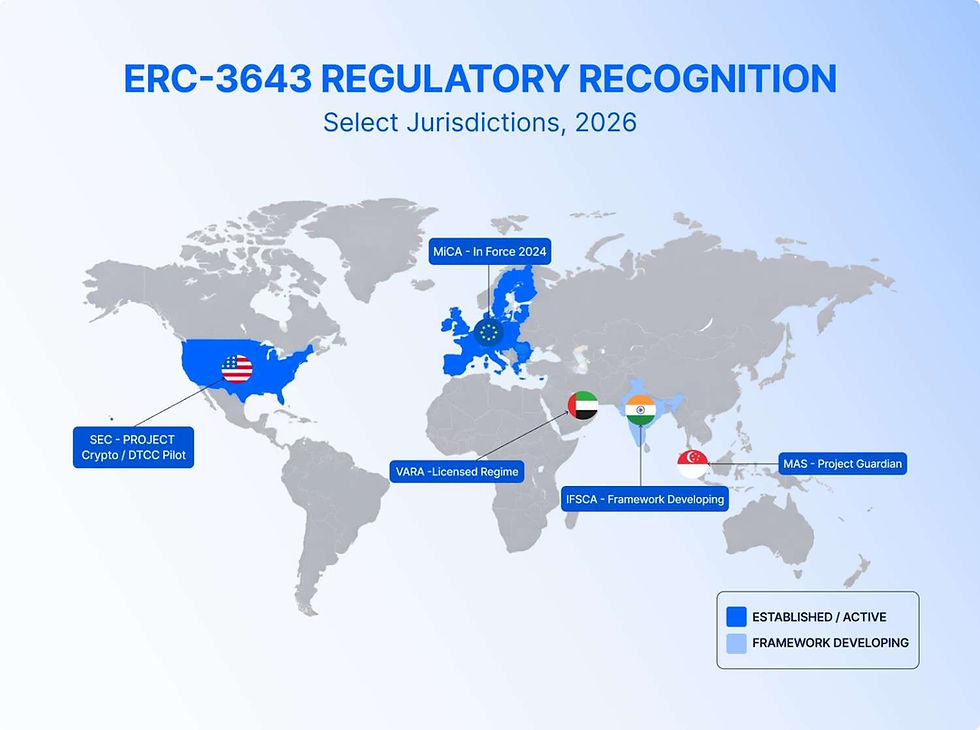
ERC-3643's design aligns closely with the direction that securities regulators are taking on tokenization worldwide.
USA: In his July 2025 speech, SEC Chairman Paul Atkins referenced ERC-3643 by name as an example of a compliant token standard. The December 2025 no-action letter to DTC identifies ERC-3643 as a "compliance-aware" protocol, naming it alongside permissioned blockchain standards approved for the three-year tokenization pilot.
Singapore: MAS Project Guardian has used ERC-3643 infrastructure across multiple pilots, including the Franklin Templeton money market fund trial and fixed income tokenization exercises with DBS Bank and JP Morgan.
European Union: MiCA, effective from 2024, requires issuers of certain token types to maintain records of token holders and enforce transfer restrictions. These are requirements that ERC-3643 satisfies at the technical level natively.
UAE: VARA's licensing regime for virtual asset service providers requires KYC verification, transfer restrictions, and ownership transparency from licensed platforms, all of which ERC-3643 enforces at the protocol level.
India: Asset tokenization regulation remains at an early stage. SEBI has acknowledged tokenization in consultation papers, and IFSCA at GIFT City is developing a framework for tokenized securities. Platforms offering tokenized assets to Indian investors typically operate through VARA-licensed or MAS-licensed structures, using ERC-3643 to meet the compliance requirements of those jurisdictions.
The ISO standardization initiative, if successful, would make ERC-3643 the globally recognized baseline for compliant token issuance, a development that would accelerate regulatory acceptance across jurisdictions including India.
Common Misconceptions
ERC-3643 is only for crypto developers.
ERC-3643 is a technical standard, but its implications are financial and legal. Anyone who holds a tokenized real-world asset is likely holding a token that operates under ERC-3643 rules. Understanding the standard means understanding the compliance protections built into the asset.
ERC-3643 tokens are anonymous like cryptocurrency.
The opposite is true. ERC-3643 requires verified identity for every token holder. The standard specifically prevents anonymous or pseudonymous ownership of regulated assets. Every holder has a confirmed identity, recorded via ONCHAINID, before they can receive a token.
Compliance can be added to any token after issuance.
Compliance must be built into the token standard at the point of issuance. Retrofitting compliance features onto an ERC-20 token after issuance is legally and technically complex. ERC-3643 tokens are compliance-native from day one.
ERC-3643 means the asset is unregulated because it is on a blockchain.
ERC-3643 tokens that confer economic rights are securities in most jurisdictions. The blockchain infrastructure does not change the regulatory classification. The standard enforces compliance; it does not create an exemption from it.
ERC-3643 and ERC-20 are alternatives to choose between.
They serve different purposes. Most platform infrastructure and wallets that support ERC-20 also support ERC-3643 because ERC-3643 is backward compatible with ERC-20. A platform can use both standards for different asset types.
Conclusion
ERC-3643 is not a cryptocurrency product. It is a compliance framework built on blockchain infrastructure, one that allows regulated assets to be issued, transferred, and managed in full alignment with securities law.
For anyone seeking to understand how real-world asset tokenization works in a regulated environment, ERC-3643 is the foundational standard. It answers the question every regulator, issuer, and aspiring owner should ask: how do you ensure that only the right people hold a regulated digital asset? The answer is built into the standard itself.
The trajectory of ERC-3643 in 2025 and 2026 tells its own story. The SEC names it in official speeches. DTC embeds it into its tokenization pilot. DTCC integrates it into ComposerX. MAS builds on it in Project Guardian. An ISO standardization process is advancing. This is not a developer experiment. It is the emerging technical backbone of compliant tokenized finance, and institutions are building on it now.
Risk Disclosure: This article is for informational purposes only and does not constitute financial, legal, or investment advice. Tokenized assets involve risk, including the risk of total loss. Regulatory treatment varies by jurisdiction. Consult a qualified professional before making any financial decision.
Frequently Asked Questions
Is ERC-3643 the same as ERC-20?
No. ERC-20 is a permissionless standard suitable for cryptocurrencies and utility tokens. ERC-3643 extends ERC-20 and adds mandatory identity verification and compliance logic. ERC-3643 tokens are backward compatible with ERC-20 tools but carry additional restrictions that make them suitable for regulated securities.
Tokeny Solutions, a Luxembourg-based tokenization infrastructure company, created the original T-REX protocol. It was submitted as an Ethereum Improvement Proposal and formally accepted as ERC-3643 in 2023. The ERC-3643 Association now governs it.
How does ERC-3643 enforce KYC?
Each token holder must have an ONCHAINID, a smart contract that stores verified identity claims issued by an authorized KYC provider. Before any token transfer executes, the blockchain checks whether both the sender and receiver have valid ONCHAINID credentials that meet the token's compliance requirements. If either party fails the check, the transfer is rejected automatically.
Can ERC-3643 be used on blockchains other than Ethereum?
Yes. ERC-3643 runs on any EVM-compatible chain, including Avalanche, Polygon, and others. DTCC's own tokenization pilots have used multiple EVM-compatible networks. The standard is not limited to Ethereum mainnet.
Is ERC-3643 legally recognized by regulators?
The standard has been named by SEC Chairman Paul Atkins as an example of a compliant token standard, identified as "compliance-aware" in the SEC's December 2025 no-action letter to DTC, adopted by DTCC, and referenced in Singapore's MAS Project Guardian. An initiative to achieve ISO recognition is underway.
Can ERC-3643 tokens be traded on a public exchange?
ERC-3643 tokens can be listed on regulated digital asset exchanges that accept permissioned tokens. Trading is restricted to verified holders who meet the token's compliance requirements. The token standard handles eligibility checks automatically. An unverified buyer's transaction is rejected at the smart contract level, before any trade is executed.
What is ONCHAINID?
ONCHAINID is the decentralized identity framework that ERC-3643 uses to manage token holder verification. It is a smart contract linked to a wallet address that stores cryptographic references to verified claims, such as completed KYC, jurisdiction, or accreditation status, without storing personal data directly on the blockchain.


Sparsh Tiwari
Maritime Technical Strategist
Sparsh Tiwari is a seasoned technology expert at ShipFinex, leveraging his deep expertise in maritime commerce, blockchain technology, and Web3. He provides strategic insights into RWA tokenization and digital finance, helping navigate the evolving synergy between technological innovation and traditional industries.