Maritime Arbitration and Dispute Resolution Trends

Updated: May 13

When a charter party dispute arises between a ship owner in Greece and a charterer in Singapore over a vessel operating between Brazil and China, which country's courts have jurisdiction? How are proceedings conducted when parties are spread across continents? What happens when an arbitration award needs enforcement in a jurisdiction with no connection to the original dispute?
These questions illustrate why maritime arbitration has evolved as the preferred dispute resolution mechanism for the shipping industry. Unlike most businesses that operate within defined jurisdictions, maritime commerce is inherently international, with vessels, parties, cargo, and operations spanning multiple legal systems. Traditional court litigation struggles with this complexity, while arbitration provides flexible, expert, and internationally enforceable dispute resolution.
As we progress through 2026, maritime arbitration continues evolving in response to technological advances, changing commercial practices, environmental concerns, and emerging markets. Understanding these trends is essential for ship owners, charterers, cargo interests, and anyone involved in maritime commerce as these developments affect contract negotiation, risk management, and dispute resolution strategies.
The Enduring Preference for Arbitration Over Litigation
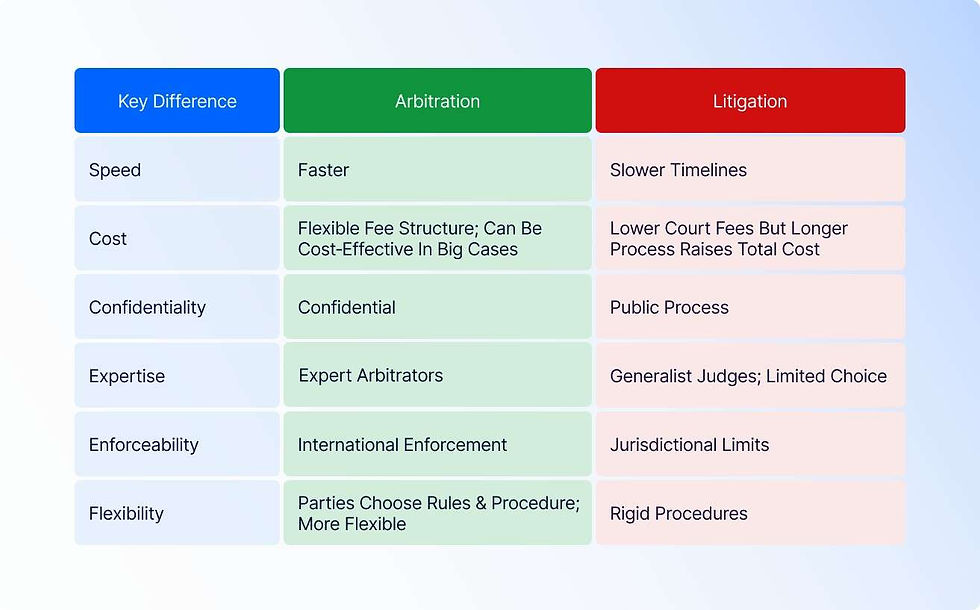
Maritime arbitration's dominance in shipping disputes isn't coincidental. It reflects fundamental advantages that align with maritime commerce's international nature and commercial realities. When disputes arise, parties typically prefer arbitration over litigation for reasons that have only strengthened with time.
The ability to select arbitrators with specific maritime expertise represents perhaps the most significant advantage. Maritime disputes often involve complex technical issues about vessel operations, charter party interpretation, cargo handling, or maritime law principles. Arbitrators can be chosen specifically for their experience with the particular dispute type, whether bulk carrier operations, container shipping, or specialized vessel charters. This expertise results in better-informed decisions and reduces the need for extensive expert testimony explaining basic industry practices (1).
Confidentiality protects commercial interests in ways public litigation cannot. Maritime disputes often involve sensitive information about charter rates, operational costs, customer relationships, or business strategies. Arbitration proceedings and awards typically remain confidential, preventing competitors from accessing valuable commercial intelligence. For ship owners and operators competing in transparent markets where reputation matters significantly, confidentiality provides crucial protection.
International enforceability through the New York Convention on the Recognition and Enforcement of Foreign Arbitral Awards provides perhaps arbitration's greatest practical advantage. With over 160 signatory countries, arbitration awards can be enforced across most major shipping jurisdictions far more reliably than court judgments which face complex recognition and enforcement procedures varying by jurisdiction. When enforcement might be necessary in multiple countries where a ship calls, cargo is delivered, or parties hold assets, this international enforceability proves invaluable (2).
Flexibility in procedures allows arbitration to be tailored to specific disputes. Unlike litigation's rigid procedural rules, arbitration parties can agree on hearing locations, timelines, evidence rules, and document production requirements suited to their particular situation. A straightforward charter party dispute might be resolved through documents-only arbitration without in-person hearings, while a complex collision case might require extensive technical evidence and expert testimony. This flexibility improves efficiency and reduces costs.
Speed and efficiency, while not guaranteed, typically favor arbitration over multi-jurisdictional litigation. Court cases can extend for years through multiple levels of appeals, while arbitration usually reaches final awards more quickly. For commercial parties needing resolution to move forward with business relationships or asset deployment, this timelier resolution has significant value.
Institutional Arbitration Gaining Ground Over Ad Hoc Proceedings
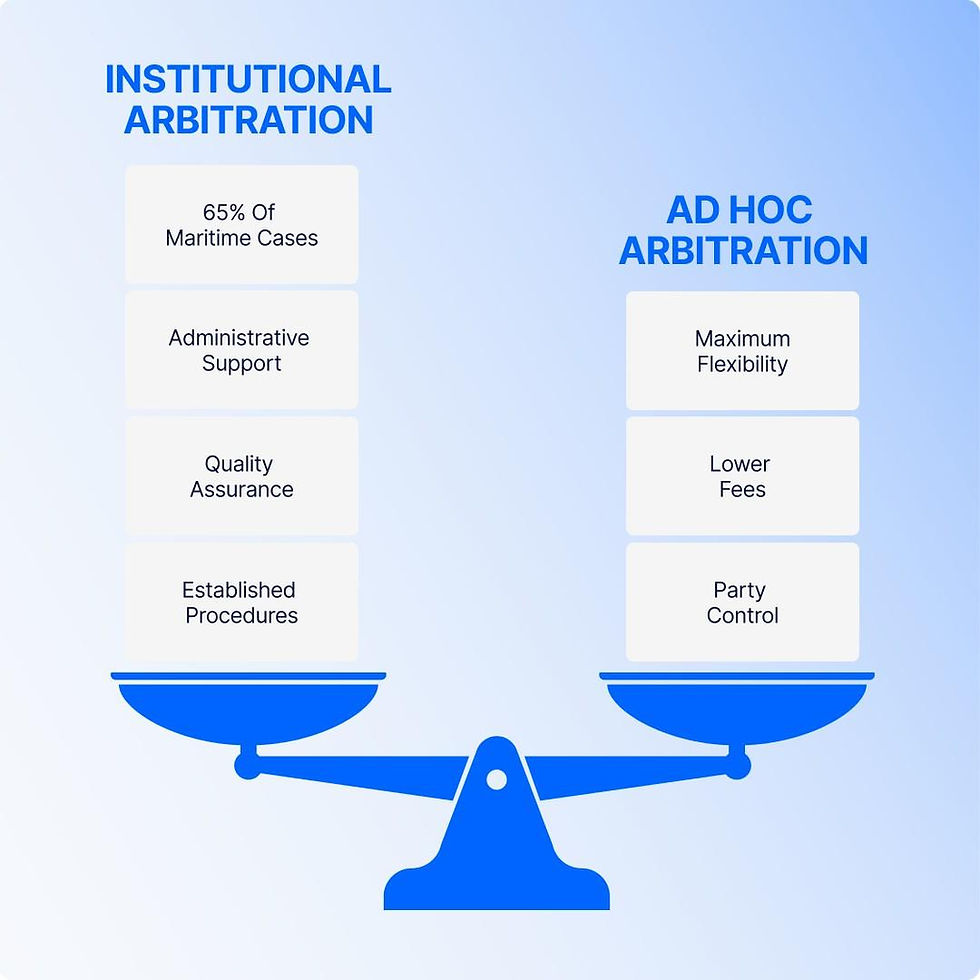
A notable trend in maritime arbitration involves the shift toward institutional arbitration administered by established arbitration centers rather than ad hoc arbitration conducted independently by parties and arbitrators. While ad hoc arbitration offers maximum flexibility and can be less expensive, institutional arbitration provides administrative support, established rules, and quality oversight increasingly valued in complex maritime disputes.
Major maritime arbitration institutions have modernized their rules and services to better serve shipping disputes. The London Maritime Arbitrators Association, while maintaining its traditional ad hoc framework, has enhanced support services and guidance. The Singapore International Arbitration Centre has developed specific expertise in maritime and shipping disputes, attracting significant regional caseload. The Hong Kong International Arbitration Centre similarly positions itself as a maritime arbitration hub for Asia-Pacific disputes (3).
The advantages driving this institutional preference include administrative support managing case logistics, established procedural rules providing predictability, appointment services when parties can't agree on arbitrators, scrutiny of awards before issuance catching potential errors, and enhanced enforceability in some jurisdictions that view institutional awards more favorably. For ship owners and charterers, particularly those less experienced with arbitration, institutional frameworks provide structure and support that reduces risks of procedural missteps.
Costs remain a consideration, as institutional arbitration includes administrative fees beyond arbitrator compensation. However, many parties conclude that these additional costs are justified by improved efficiency, reduced disputes about procedure, and enhanced award quality. The calculation varies based on dispute size and complexity, but the trend toward institutional arbitration continues strengthening particularly for larger, more complex disputes.
Emerging Maritime Arbitration Seats and Market Diversification

While London historically dominated maritime arbitration and remains the leading seat, significant diversification has occurred as new arbitration centers develop maritime expertise and attract regional disputes. This geographic diversification reflects both the growth of shipping activity in Asia, the Middle East, and other regions, and deliberate efforts by arbitration institutions to build maritime capabilities.
Singapore has emerged as the premier maritime arbitration center in Asia, supported by strong legal infrastructure, pro-arbitration judiciary, modern arbitration legislation aligned with international standards, and strategic positioning as a major shipping and trading hub. The Singapore International Arbitration Centre handles substantial maritime caseload, and Singapore law governs increasing numbers of charter parties and shipping contracts particularly for intra-Asian trade (4).
Dubai is rapidly developing as a maritime arbitration center, leveraging its position as a major port and shipping hub, its Dubai International Arbitration Centre with dedicated maritime expertise, and pro-business legal framework attractive to international parties. The establishment of specialized maritime courts and commitment to enforcing arbitration awards enhances Dubai's appeal particularly for disputes involving Middle Eastern, African, or South Asian parties.
New York maintains its position as the primary maritime arbitration seat in the Americas, with the Society of Maritime Arbitrators providing specialized expertise and the strong legal framework of New York state supporting arbitration. For disputes involving American parties or touching on U.S. trade routes, New York arbitration remains highly attractive.
This diversification provides practical benefits for ship owners and charterers. Regional arbitration centers reduce travel costs and time zone complications for parties in those regions. Local expertise develops regarding regional trading patterns, practices, and regulations. Competition among arbitration centers encourages improved services, efficiency, and cost-effectiveness. The availability of multiple high-quality arbitration seats allows parties to select locations best suited to their specific disputes and circumstances.
Technology Transformation: Virtual Hearings and Digital Tools
Technology adoption accelerated dramatically through 2020-2021 necessitated by pandemic restrictions but has continued evolving as participants recognize lasting benefits. Virtual hearings, once considered inferior substitutes for in-person proceedings, have become accepted and often preferred methods for conducting maritime arbitrations.
Video conference platforms enable hearings with participants across continents without travel costs or time. For maritime disputes where parties, arbitrators, and witnesses might be scattered across five or six countries, virtual hearings reduce costs by hundreds of thousands of dollars compared to flying everyone to a single location. Time savings prove equally valuable, as hearings can be scheduled more quickly when travel logistics don't constrain availability.
Document management systems have revolutionized evidence handling in maritime arbitrations which traditionally involved massive paper bundles of charter parties, bills of lading, email correspondence, and supporting documentation. Digital platforms enable secure document sharing, version control, searchable repositories, and organized presentation of evidence. Arbitrators and parties can efficiently review and reference relevant documents during hearings rather than shuffling through physical files (5).
Blockchain applications are emerging in maritime dispute resolution for authenticating documents and evidence, creating tamper-proof records of transactions and communications, and potentially enabling smart contracts that automate dispute resolution for routine issues. While still developing, blockchain technology's potential to enhance evidence reliability and streamline certain dispute types attracts significant interest.
Artificial intelligence tools assist with document review and analysis in complex disputes involving thousands of documents. AI can identify relevant communications, flag potential evidence, and analyze patterns across large document sets more efficiently than manual review. While not replacing human judgment, these tools enhance efficiency particularly in discovery-intensive maritime disputes.
The adoption of technology in maritime arbitration democratizes access to some extent. Smaller ship owners or charterers who might have been deterred by travel costs and logistical complexity of traditional arbitration can participate more easily in virtual proceedings. Technology also enables arbitrators to serve cases across more geographies without constant international travel, potentially expanding the available pool of qualified maritime arbitrators.
Sustainability and Environmental Considerations
As environmental regulations reshape maritime operations, sustainability considerations increasingly appear in maritime disputes and arbitration practice. Disputes arise over environmental compliance requirements, carbon emissions allocations, sustainable fuel surcharges, and green technology implementation. Arbitrators must navigate evolving environmental regulations while interpreting charter parties and contracts drafted before current sustainability focus emerged.
Environmental claims form a growing category of maritime disputes including emissions violations, pollution incidents, ballast water management failures, and environmental compliance costs allocation between owners and charterers. Traditional charter party terms often don't clearly address these modern environmental issues, requiring arbitrators to interpret agreements in light of current regulatory frameworks and industry practices.
Arbitration clauses increasingly incorporate sustainability principles including carbon-neutral hearing procedures, virtual hearings to reduce travel emissions, paperless proceedings minimizing physical document production, and consideration of environmental factors in dispute resolution. Some arbitration institutions have adopted environmental policies and encourage parties to consider sustainability in arbitration conduct.
The maritime industry's transition to decarbonization will generate disputes over alternative fuel surcharges, retrofit cost allocations, speed restrictions for emissions compliance, and carbon pricing impacts. Arbitrators will need to develop expertise in these emerging areas to resolve disputes fairly and efficiently. The intersection of established maritime law principles with new environmental regulations creates complex interpretive challenges that arbitration is well-positioned to address through expert arbitrators and flexible procedures.
Cross-Border Enforcement and Recognition Challenges
While the New York Convention provides a strong framework for enforcing arbitration awards internationally, practical challenges persist in specific jurisdictions and circumstances. Recent trends show both improvements in enforcement mechanisms and emerging complications requiring attention.
Courts in most major maritime jurisdictions have become increasingly supportive of arbitration, with pro-arbitration judiciaries generally enforcing awards and resisting attempts to relitigate disputes through court challenges. This supportive environment strengthens arbitration's effectiveness and encourages parties to use arbitration knowing awards will likely be enforceable.
However, enforcement challenges remain in certain jurisdictions with less developed legal systems, political instability affecting judicial independence, or cultural skepticism toward international arbitration. Ship owners and charterers operating in emerging markets must carefully consider enforcement prospects when selecting arbitration seats and negotiating dispute resolution clauses.
The growth of anti-suit injunctions and jurisdictional battles continues as parties sometimes attempt to circumvent arbitration agreements by initiating court proceedings. Courts in different jurisdictions take varying approaches to enforcing arbitration agreements and preventing parallel litigation. This jurisdictional complexity requires sophisticated legal strategy when disputes arise involving multiple potential forums.
Recognition of virtual hearing awards raises questions in some jurisdictions that have specific requirements about arbitration procedures. As virtual hearings become standard, case law is developing regarding whether awards from virtual proceedings receive the same recognition as traditional in-person arbitrations. Most courts have accepted virtual hearings, but ensuring enforcement requires attention to procedural requirements in potential enforcement jurisdictions.
Alternative Dispute Resolution Beyond Traditional Arbitration

Maritime dispute resolution increasingly utilizes alternative mechanisms beyond traditional arbitration including mediation, early neutral evaluation, dispute boards, and hybrid procedures combining different ADR methods. These alternatives offer benefits for certain dispute types and commercial relationships.
Mediation provides opportunities for preserving business relationships while resolving disputes. Unlike arbitration which results in binding decisions determining winners and losers, mediation facilitates negotiated settlements allowing parties to craft solutions maintaining ongoing commercial relationships. For ship owners and charterers with continuing business relationships, mediation can resolve disputes while preserving valuable partnerships.
Early neutral evaluation involves appointing an experienced maritime professional to provide preliminary non-binding assessment of dispute merits. This evaluation often facilitates settlement by giving parties realistic perspective on likely arbitration outcomes. For disputes where parties have very different views of their legal positions, early neutral evaluation can prompt productive settlement discussions.
Dispute boards, common in construction, are appearing in long-term maritime contracts. These boards, established at contract formation, address disputes as they arise rather than waiting for contract completion. For major shipbuilding projects or long-term charter arrangements, dispute boards provide real-time resolution maintaining project momentum.
Hybrid procedures combining mediation and arbitration, sometimes called med-arb, attempt settlement through mediation first with arbitration as fallback if mediation fails. This approach captures mediation's settlement potential while ensuring definitive resolution through arbitration if needed.
The trend toward multi-tier dispute resolution clauses requiring negotiation, then mediation, then arbitration reflects efforts to promote settlement while maintaining arbitration as ultimate recourse. While adding complexity to dispute resolution processes, these mechanisms can reduce costs and time when settlement proves possible.
The Future: Integration with Blockchain and Smart Contracts
Looking forward, maritime arbitration faces potential transformation through integration with blockchain technology and smart contracts. While still emerging, these technologies could fundamentally reshape certain aspects of maritime dispute resolution.
Smart contracts embedded in blockchain can automate dispute resolution for routine contractual issues. Simple disputes over demurrage calculations, freight payment triggers, or performance penalties might be automatically resolved through pre-programmed logic rather than requiring arbitration. This automation could handle high volumes of small disputes more efficiently than traditional processes.
Blockchain-based evidence management could provide tamper-proof records of transactions, communications, and performance data relevant to disputes. Rather than parties presenting competing versions of events, blockchain records could provide objective, verified information about what occurred. This enhanced evidence reliability could simplify arbitrations and reduce disputes about factual issues.
Decentralized dispute resolution platforms are being explored where parties and arbitrators interact through blockchain protocols rather than traditional arbitration institutions. While controversial and unlikely to replace traditional arbitration for major disputes, these platforms might serve niche markets or routine dispute types.
The integration of tokenized maritime assets with dispute resolution mechanisms creates unique considerations. When ship ownership is fractional and distributed across numerous token holders, how are arbitration agreements formed and enforced? How do multiple owners coordinate in disputes? These questions are beginning to be addressed as tokenization expands in maritime commerce, requiring evolution of arbitration practice to accommodate new ownership structures.
For ship owners, charterers, and maritime stakeholders, staying informed about these arbitration trends is essential for effective risk management and dispute resolution. Contract negotiations should consider current arbitration practices, dispute resolution clauses should reflect modern procedures and technology, and parties should select arbitrators and seats appropriate for contemporary maritime commerce. The effectiveness of dispute resolution directly impacts commercial outcomes, making these trends relevant not just for legal teams but for business strategy and operations.
Disclaimer:
This content is for informational purposes only and does not constitute legal advice. Maritime arbitration involves complex legal issues requiring professional guidance from qualified maritime lawyers and arbitration specialists. Dispute resolution strategies should be developed with appropriate legal counsel considering specific circumstances, jurisdictions, and contract terms. References to arbitration trends and practices represent general observations and do not guarantee outcomes in any specific dispute.
FAQS
What are the current trends in maritime arbitration?
Current maritime arbitration trends include increased adoption of technology and virtual hearings, growing preference for institutional arbitration over ad hoc proceedings, expansion of arbitration in emerging markets, sustainability considerations in dispute resolution, and enhanced enforcement mechanisms across jurisdictions.
Which are the preferred seats for maritime arbitration in 2025?
London, Singapore, and New York remain dominant maritime arbitration seats, with Dubai and Hong Kong showing significant growth. Selection factors include legal infrastructure, enforceability of awards, maritime expertise, neutrality, and technological capabilities for modern dispute resolution.
How is technology changing maritime dispute resolution?
Technology enables virtual hearings reducing travel costs and time, blockchain for evidence management and document authentication, AI-powered document analysis and case prediction, digital platforms for case management, and remote expert testimony making arbitration more accessible and efficient.
What is the difference between maritime arbitration and litigation?
Maritime arbitration is a private dispute resolution process chosen by parties, offering flexibility, confidentiality, specialized expertise, international enforceability through the New York Convention, and generally faster resolution compared to court litigation which is public, follows strict procedural rules, and faces jurisdictional complications in international maritime disputes.
Why is maritime arbitration preferred over litigation?
Maritime arbitration is preferred because parties can select arbitrators with maritime expertise, proceedings remain confidential protecting commercial interests, awards are enforceable in over 160 countries, procedures can be tailored to specific disputes, and resolution is typically faster and less expensive than multi-jurisdictional litigation.
References
London Maritime Arbitrators Association. (2024). Small Claims Procedure under the LMAA Terms. https://www.lmaa.london/
United Nations Commission on International Trade Law. (1958). Convention on the Recognition and Enforcement of Foreign Arbitral Awards (New York Convention). https://uncitral.un.org/en/texts/arbitration/conventions/foreign_arbitral_awards
Singapore International Arbitration Centre. (2024). SIAC arbitration rules and maritime disputes. https://www.siac.org.sg/
Dubai International Arbitration Centre. (2024). Maritime arbitration services and expertise. https://www.diac.ae/
International Chamber of Commerce. (2024). ICC arbitration and ADR rules. https://iccwbo.org/dispute-resolution-services/arbitration/
Additional Resources
Hong Kong International Arbitration Centre. (2024). Maritime arbitration in Asia. https://www.hkiac.org/
Society of Maritime Arbitrators. (2024). Maritime arbitration procedures. https://www.smany.org/
Baltic and International Maritime Council. (2024). Standard maritime contracts and arbitration clauses. https://www.bimco.org/
Comité Maritime International. (2024). International maritime law and dispute resolution. https://comitemaritime.org/
Queen Mary University of London. (2024). International arbitration survey. https://www.qmul.ac.uk/
International Bar Association. (2024). Maritime and transport law committee. https://www.ibanet.org/
American Bar Association Maritime Law Committee. (2024). Maritime arbitration resources. https://www.americanbar.org/
Lloyd's List. (2024). Maritime legal developments and arbitration. https://lloydslist.maritimeintelligence.informa.com/
Shipping and Trade Law. (2024). Maritime dispute resolution analysis. https://shippingandtradelaw.com/
Journal of International Arbitration. (2024). Maritime arbitration case law and commentary. https://kluwerlawonline.com/


Sparsh Tiwari
Maritime Technical Strategist
Sparsh Tiwari is a seasoned technology expert at Shipfinex, leveraging his deep expertise in maritime commerce, blockchain technology, and Web3. He provides strategic insights into RWA tokenization and digital finance, helping navigate the evolving synergy between technological innovation and traditional industries.


