NOR (Notice of Readiness) Explained: When It's Valid and When It Isn't

Updated: Aug 20

Table of Content
Key Takeaways
Invalid Notice of Readiness means laytime never starts, even if accepted. The most critical legal principle is that an invalid NOR doesn't trigger laytime counting, regardless of whether the charterer accepts it or cargo operations proceed. This can completely void demurrage claims worth hundreds of thousands of dollars, as the laytime clock never legitimately commenced.
All five validity requirements must be satisfied simultaneously. A Notice of Readiness is only valid when the ship is at the specified location, physically ready for cargo operations, legally ready with all clearances complete, tendered to the correct party, and tendered during accepted hours. Missing even one requirement renders the entire notice invalid.
Premature NOR tender is the costliest mistake. Ship operators eager to start the laytime clock often tender Notice of Readiness while tank cleaning continues, repairs remain incomplete, or customs clearances are still pending. This premature tender creates vulnerability where charterers can successfully dispute demurrage claims months later, resulting in lost revenue exceeding $100,000 in typical disputes.
Charter party wording controls everything about NOR validity. Whether the ship must be "at berth" or can tender notice at anchorage with a "Whether In Berth Or Not" clause, when tender hours are accepted, and who receives the notice all depend on specific charter party language. Assumptions based on previous charters or general practices lead to expensive errors.
Documentation protects against validity disputes. Maintaining detailed records showing exactly when each readiness requirement was satisfied, obtaining written confirmation of NOR acceptance with precise timestamps, and using standardized NOR forms creates an evidence trail that supports validity claims if disputes arise weeks or months after operations.
Introduction
A single invalid Notice of Readiness cost one ship owner one hundred eighty thousand dollars in lost demurrage revenue. The ship arrived on time, cargo operations proceeded with delays, and a legitimate demurrage claim was filed. But in arbitration, the judge ruled that the original Notice of Readiness was invalid, which meant laytime had never properly commenced. The entire demurrage claim collapsed, and the ship owner absorbed the financial loss. This scenario plays out repeatedly in maritime commerce, making Notice of Readiness validity one of the most consequential yet frequently misunderstood aspects of charter party operations.
Understanding exactly when Notice of Readiness is valid protects both ship owners and charterers from costly disputes. This guide breaks down the five essential requirements for valid Notice of Readiness, examines real-world scenarios where validity was contested, and provides practical guidance to avoid the mistakes that lead to six-figure disputes.
What Is Notice of Readiness (NOR)?
Notice of Readiness is a formal declaration from the ship to the charterer that the ship has arrived at the specified location, is ready in all respects for cargo operations, and is awaiting the charterer's instructions to commence loading or discharge. According to established maritime law principles, Notice of Readiness serves as the official trigger that starts the laytime clock ticking under most charter party agreements (1).
The notice itself is typically a standardized written document, though the specific format can vary based on charter party requirements and port customs. It states the ship's name, the charter party reference, the date and time of tender, confirmation that the ship is ready in all respects, and a request for cargo operations to commence. While the document might seem routine, its legal implications are profound.
When Notice of Readiness is properly tendered and accepted, laytime begins counting according to the charter party terms. This means that any delays beyond the allowed laytime will result in demurrage charges payable by the charterer to the ship owner. Conversely, if operations complete ahead of schedule, the charterer may earn despatch payments. The financial stakes are considerable: typical demurrage rates range from five thousand to twenty thousand dollars per day for bulk carriers and even higher for specialized tonnage, meaning that disputes over a few days can easily reach six figures (2).
However, the critical legal principle is this: if Notice of Readiness is invalid when tendered, laytime does not commence, even if the charterer accepts the notice and cargo operations proceed. This principle has been established through numerous arbitration cases and court decisions. Invalid Notice of Readiness means the laytime clock never started, which can completely undermine demurrage claims or create disputes about when laytime actually began.
The Five Essential Requirements for Valid NOR

Understanding Notice of Readiness validity requires examining five fundamental requirements that must all be satisfied simultaneously. Missing even one requirement renders the notice invalid, regardless of how many other criteria are met.
Requirement 1: Ship Must Be at the Specified Location
The ship must be physically positioned at the exact location designated in the charter party—whether "at loading berth," "at anchorage," or "within port limits"
If the charter specifies "at loading berth" and the ship tenders NOR while at anchorage waiting for berth availability, the notice is invalid unless the charter includes a "Whether In Berth Or Not" (WIBON) clause
If the charter designates a specific berth or terminal (e.g., "Terminal 5") and the ship is assigned to a different location, NOR tendered at the wrong location may be invalid
The exact charter party wording determines what constitutes proper arrival location—general assumptions about "arrived at port" are insufficient (3)
Key principle: Geographic position requirements are strictly interpreted; proximity to the designated location does not satisfy the requirement
Requirement 2: Ship Must Be Physically Ready for Cargo Operations
All cargo spaces must be accessible, prepared, and immediately capable of receiving or discharging cargo
For loading operations: cargo holds must be clean, dry, and ready to receive cargo with hatches that can be opened without delay
For discharge operations: cargo must be accessible with no obstructions preventing unloading; all necessary cargo handling equipment must be operational
If the ship is still conducting tank cleaning, removing previous cargo residues, completing repairs affecting cargo spaces, or performing any work that prevents immediate cargo operations, the ship is not physically ready
The critical test: Could cargo operations commence immediately if the charterer were ready to do so? If the answer is no for any reason related to the ship's condition, physical readiness is not satisfied
Common mistake: Tendering NOR while "almost ready" with the expectation of completing preparations shortly—this premature tender invalidates the notice
Requirement 3: Ship Must Be Legally Ready
All required customs clearance procedures must be completed with authorities granting permission for cargo operations
Necessary health, safety, and security certificates must be obtained and available for inspection
Immigration formalities for crew must be resolved
Any port state control inspections or detentions must be cleared—if authorities have detained the ship pending documentation or inspections, the ship is not legally ready
Required permits specific to the cargo type or port must be secured before tendering NOR
Maritime authorities from various jurisdictions have consistently held that legal obstacles preventing cargo operations invalidate NOR until those obstacles are removed (4)
Key principle: Even if the ship is physically prepared, legal barriers to commencing operations render NOR invalid
Requirement 4: Notice Must Be Tendered to the Correct Party
The charter party typically specifies exactly who should receive NOR: the charterer directly, the charterer's designated agent, the terminal operator, or multiple parties
Notice must be communicated through the channels specified in the charter—whether written document delivered in person, email to specified addresses, or other designated methods
Tendering notice to the wrong party, even if the information eventually reaches the charterer through informal channels, can invalidate the notice
Using an incorrect communication method (e.g., email when the charter requires written document delivery) may create validity disputes
Best practice: Confirm recipient details and communication method directly from the charter party language, not from general assumptions or past practice
Requirement 5: Notice Must Be Tendered During Accepted Hours
Many charter parties restrict when NOR can be validly tendered, commonly specifying "between 0800 and 1700 hours on working days" or similar limitations
Notice tendered outside accepted hours may not become effective until the next period when tender is accepted
Example: NOR tendered at 1900 hours on Friday might not become effective until 0800 hours Monday morning, depending on specific charter terms
Some charters specify different rules for notice tendered outside business hours (e.g., "notice tendered after 1700 hours shall be deemed tendered at 0800 hours next working day")
Holidays, weekends, and local port customs may affect when tender hours are "accepted"
Critical detail: The specific charter party wording governs exactly when NOR tendered outside business hours becomes effective—there is no universal rule
When NOR Can Be Tendered: Common Scenarios

The question of when Notice of Readiness can be tendered depends fundamentally on the charter party's arrival provisions. Three common scenarios illustrate how different charter terms affect Notice of Readiness validity.
In the clearest scenario, the charter requires the ship to be at berth before tendering Notice of Readiness. Once the ship is securely moored at the designated berth and all five requirements are satisfied, Notice of Readiness can be validly tendered. This provides certainty for both parties: the ship is physically at the working location, and cargo operations can commence immediately upon the charterer's readiness.
A more complex scenario involves charters with "Whether In Berth Or Not" clauses. These provisions allow Notice of Readiness to be tendered when the ship arrives at the port or anchorage area, even if no berth is immediately available. The ship doesn't need to be physically berthed, but it must still meet all other readiness requirements. The rationale is that berth availability is often beyond the ship's control, and charterers shouldn't get free waiting time when port congestion delays berthing. However, all readiness requirements still apply: the ship must be physically and legally ready for cargo operations even though it's not yet at berth.
Charter parties sometimes include provisions that "time lost waiting for berth to count as laytime" or similar language. These clauses affect when time starts counting but don't necessarily change when Notice of Readiness can be tendered. The ship must still satisfy all readiness requirements. The charter party wording determines exactly how waiting time is treated and whether it counts toward laytime, against laytime, or in some other manner.
Real-World Examples: Valid vs Invalid NOR
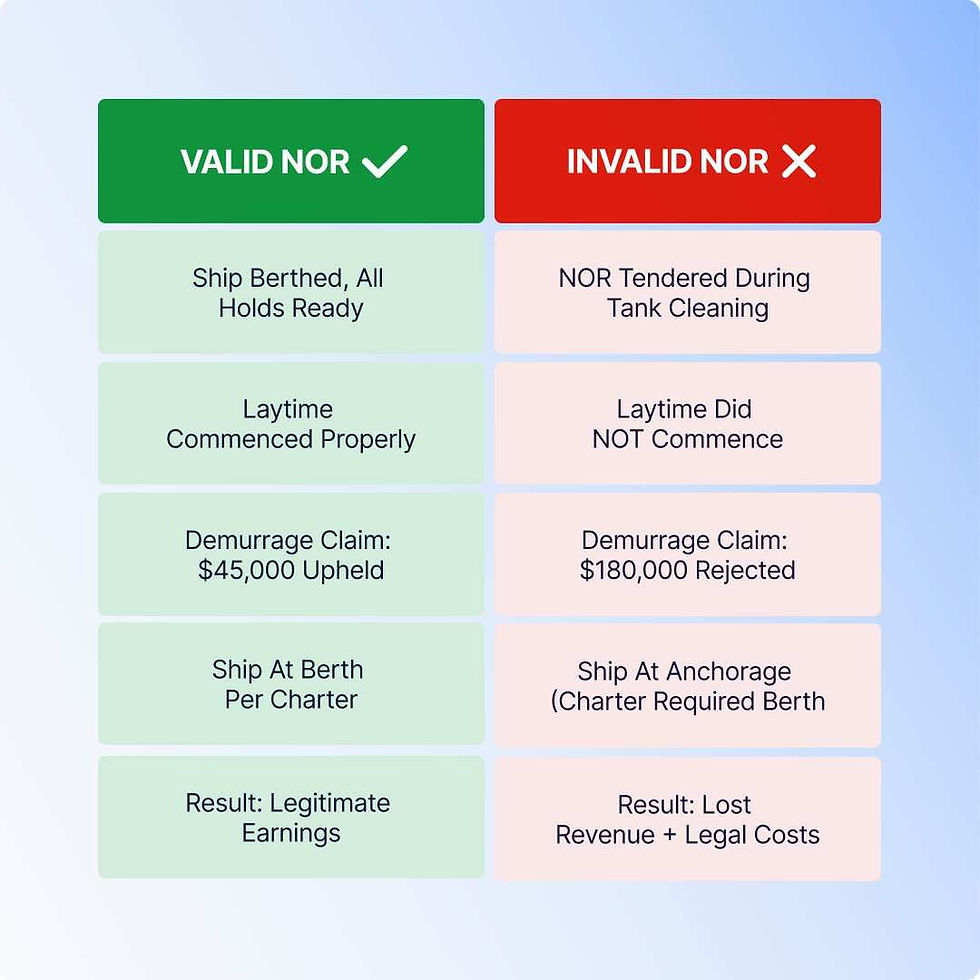
Consider a scenario where a bulk carrier arrives to load grain in Argentina. The ship berths on Monday morning, completes customs clearance by 1000 hours, and all cargo holds are clean and ready. The ship tenders Notice of Readiness at 1030 hours to the charterer's port agent. The charter specifies "at loading berth" with no restrictions on tender hours.
Loading begins Tuesday afternoon and takes longer than expected due to shore crane issues. The ship goes on demurrage for three days at ten thousand dollars per day. When the charterer disputes the thirty thousand dollar claim, arbitration upholds it because the original Notice of Readiness was valid in all respects. The ship was at the specified location, physically and legally ready, notice was tendered to the correct party, and no time restrictions applied.
Now consider a different scenario involving a product tanker arriving to load chemicals in Houston. The ship arrives at anchorage Sunday evening and immediately tenders Notice of Readiness, knowing that tank cleaning operations will complete overnight. The charter specifies "at loading berth" with no Whether In Berth Or Not clause and requires notice to be tendered during business hours. Multiple validity issues exist: the ship isn't at the specified location (still at anchorage, not berth), isn't physically ready (tanks still being cleaned), and notice was tendered outside business hours (Sunday evening). When the ship eventually berths Wednesday and disputes arise over delays, arbitration rules that the original Sunday notice was invalid.
The valid Notice of Readiness wasn't tendered until Wednesday when the ship berthed and was actually ready, eliminating several days of potential demurrage claims worth approximately sixty thousand dollars.
A third scenario involves a container ship arriving in Singapore. The charter requires the ship to be "at the designated terminal berth" before tendering Notice of Readiness. Due to terminal congestion, port authorities assign the ship to a different terminal than specified in the charter. The ship tenders Notice of Readiness at the alternate terminal and proceeds with cargo operations.
Disputes later arise about demurrage, and the charterer argues the Notice of Readiness was invalid because the ship wasn't at the specified terminal. Arbitration must interpret whether the charter party language about the "designated terminal" was merely descriptive or was a strict requirement. This case illustrates how seemingly minor location discrepancies can create major validity disputes.
Common NOR Validity Mistakes
The most frequent mistake is premature tender of Notice of Readiness before the ship is genuinely ready in all respects. Ship operators eager to start the laytime clock sometimes tender notice while tank cleaning continues, or while minor repairs affecting cargo operations remain incomplete, or before customs formalities conclude. This premature tender creates vulnerability: even if the charterer accepts the notice and proceeds with cargo operations, the invalid notice means laytime never properly commenced, potentially voiding demurrage claims.
Another common error involves location misunderstandings. Ship operators may tender Notice of Readiness at anchorage when the charter requires berthing, or at one terminal when another was specified, creating validity questions. Careful review of the exact charter party arrival and Notice of Readiness provisions prevents these expensive mistakes.
Tendering notice to the wrong party represents a third frequent problem. If the charter specifies notice should go to the charterer's operations email but the ship sends it to the port agent, questions about proper tender arise. Following the precise communication channels specified in the charter party prevents these disputes.
Timing errors create additional problems. Ships arriving late Friday afternoon sometimes tender Notice of Readiness immediately even though the charter restricts tender to business hours. When disputes arise days or weeks later, determining when Notice of Readiness became effective requires careful charter party interpretation.
How to Avoid NOR Validity Disputes
Preventing Notice of Readiness validity disputes requires systematic verification before tender. Create a checklist of the five essential requirements and confirm each one is satisfied before tendering notice. Verify the ship is at the exact location specified in the charter, confirm all cargo spaces are genuinely accessible and ready, ensure all legal formalities are complete, identify the correct party to receive notice per charter terms, and confirm tender occurs during accepted hours.
Using standardized Notice of Readiness forms helps ensure all required information is included and properly documented. Maintain detailed records showing when each readiness requirement was satisfied, creating an evidence trail if disputes later arise. Obtain written confirmation from the party receiving Notice of Readiness, establishing clear documentation of acceptance timing.
Most importantly, carefully read and understand the specific Notice of Readiness provisions in each charter party. Charter terms vary significantly, and assumptions based on previous charters can lead to costly errors. When unclear about any provision, seek clarification from the charterer before tendering notice rather than assuming interpretation.
The Impact on Ship Earnings
Proper Notice of Readiness procedures protect ship owners' ability to earn legitimate demurrage when delays occur. Ships that consistently tender invalid notices create vulnerability where charterers can successfully dispute demurrage claims, resulting in lost revenue that directly impacts earnings. Conversely, ships with rigorous Notice of Readiness protocols and documentation practices protect their earnings and build reputations as professionally managed assets.
Conclusion
Notice of Readiness validity requires satisfying five essential requirements simultaneously: correct location, physical readiness, legal readiness, proper tender party, and accepted tender timing. Missing any single requirement renders notice invalid, potentially voiding demurrage claims worth hundreds of thousands of dollars. The stakes are high, and mistakes are common, but systematic verification before tender prevents most validity disputes.
Ship operators should implement checklist-based procedures confirming all requirements before tendering Notice of Readiness. Detailed documentation of readiness timing and notice tender creates evidence supporting validity if disputes arise. Careful attention to specific charter party provisions prevents assumptions that lead to invalid tender.
Disclaimer:
This material is provided for informational purposes only and does not constitute financial, investment, or legal advice. All digital assets carry inherent risks, including potential loss of capital. Past performance is not indicative of future results. Please review the relevant offer and risk disclosures carefully before making any financial decision.
FAQS
What is Notice of Readiness (NOR) in shipping?
Notice of Readiness is a formal declaration from the ship to the charterer that the ship has arrived at the specified location, is ready in all respects for cargo operations, and is awaiting the charterer's instructions to commence loading or discharge.
When can you tender Notice of Readiness?
NOR can be tendered when the ship arrives at the place specified in the charter party (whether at berth, anchorage, or port limits), the ship is physically ready for cargo operations with all cargo spaces accessible, the ship is legally ready with all documentation complete, and tender occurs during accepted hours as specified in the charter party.
What makes a Notice of Readiness invalid?
NOR is invalid if the ship hasn't arrived at the specified location, cargo spaces aren't ready or accessible, required documentation is incomplete, the ship has defects preventing cargo operations, or NOR is tendered to the wrong party or outside accepted hours.
What happens if Notice of Readiness is invalid?
If NOR is invalid, laytime does not commence even if the charterer accepts it. This can result in the ship not earning demurrage for delays, or charterers successfully claiming they weren't properly notified, potentially leading to significant financial disputes.
REFERENCES
(1) Cooke, J., Young, T., Taylor, A., Kimball, J., Martowski, D., & Lambert, L. (2020). Voyage Charters (5th ed.). Informa Law from Routledge. https://www.routledge.com
(2) Baltic and International Maritime Council. (2024). Demurrage rates analysis: Global charter market trends. https://www.bimco.org
(3) Girvin, S., Dagley, T., & Petrinovic, R. (2021). Carriage of Goods by Sea (3rd ed.). Oxford University Press. https://www.oxfordlawtrove.com
(4) Schofield, J. (2022). Laytime and Demurrage (8th ed.). Informa Law from Routledge. https://www.routledge.com


Suraz Troy Kotakki
Founder & COO
Suraz Troy Kotakki is a visionary leader and advocate for making the trillion-dollar maritime industry accessible to everyone. He is a seasoned expert in the maritime industry, blockchain technology, and RWA tokenization. With his passion for innovation and a strong belief in financial inclusivity, Suraz is at the forefront of Shipfinex, a platform enabling individuals to own ships, democratizing the maritime space.
LinkedIn: https://www.linkedin.com/in/szka/


