SOLAS Convention: All 15 Chapters, Certificates, and 2026 Compliance Updates Explained

Updated: Jul 15

On the night of 14 April 1912, more than 1,517 people died when RMS Titanic sank in the North Atlantic. Within two years, the world's maritime nations had signed the first International Convention for the Safety of Life at Sea. That convention, now in its 1974 form, governs every commercial ship on every ocean today, covering the structural safety of vessels carrying billions of tonnes of cargo and millions of passengers annually. As of 2026, 167 contracting states representing approximately 99% of global gross tonnage are party to SOLAS.
Quick Answer: What Is SOLAS? SOLAS (International Convention for the Safety of Life at Sea) is the most important international treaty governing the safety of merchant ships. First adopted in 1914 in response to the Titanic disaster, the current version was adopted in 1974 and has been in force since 1980. It covers ship construction, fire protection, life-saving appliances, radio communications, navigation safety, cargo management, ship security, and more, across 15 regulatory chapters. Chapter V is unique in applying to every vessel on every voyage, including recreational yachts.
What Is SOLAS? Definition and Scope
SOLAS is the principal international treaty governing commercial ship safety. It is administered by the International Maritime Organization (IMO) and applies to ships engaged in international voyages, flagged to any of the 167 contracting states. Unlike most treaties, it is updated through the tacit acceptance procedure, meaning new safety requirements become binding on all contracting states unless actively opposed within a set timeframe.
Who Does SOLAS Apply To?
SOLAS applies to commercial ships on international voyages with scope varying by chapter. The primary exemptions are warships and naval auxiliaries, fishing vessels (covered by the Torremolinos Protocol), and pleasure yachts not engaged in trade — with the critical exception that Chapter V (Safety of Navigation) applies to all vessels on all voyages, regardless of size or flag.
Ship Type | SOLAS Applies? | Chapters Applicable |
Commercial cargo ships (500 GT+) | Yes | All relevant chapters |
Passenger ships (all sizes, international) | Yes | All chapters including special passenger requirements |
Fishing vessels | No | Exempt; covered by Torremolinos Protocol |
Pleasure yachts (non-trade) | Partial | Chapter V only (Safety of Navigation) |
Warships and naval auxiliaries | No | Exempt |
Offshore supply vessels / OSVs | Yes | Relevant chapters; Chapter XV mandatory from July 2024 |
The History of SOLAS: From Titanic to Today
SOLAS exists because specific disasters forced political action. Understanding this history matters for compliance professionals: the convention's structure directly reflects the tragedies that shaped each amendment cycle, and that pattern continues today.
1912 to 1914: The Titanic and the First Convention
The Titanic sank on 15 April 1912 with 1,517 fatalities, the deadliest peacetime maritime disaster of its era. The scale of the loss exposed the absence of international standards for lifeboat provision, wireless communications, and ice reporting. The first SOLAS conference was convened in London in 1913 and the original treaty signed in January 1914, covering lifeboat carriage, wireless communications for ships over 1,600 gross tonnes, and the founding of the International Ice Patrol (which continues to operate in the North Atlantic today).
1929, 1948, and 1960: Rebuilding After World Wars
The 1914 convention never entered into force due to World War I. The 1929 version was adopted and entered into force in 1933. The 1948 version established the Inter-Governmental Maritime Consultative Organization (IMCO, later renamed IMO). The 1960 version, the first adopted under IMO, reflected post-war shipping expansion and introduced structural fire protection requirements, but its amendment mechanism was slow and impractical.
1974 to Present: The Modern SOLAS
Year | Triggering Event / Context | SOLAS Response |
1974 | IMCO Diplomatic Conference | Current SOLAS adopted; tacit acceptance procedure introduced |
1988 | Herald of Free Enterprise (1987, 193 deaths) and other ro-ro losses | GMDSS amendments adopted; Chapter IV rewritten for satellite communications |
1994 | Estonia disaster (28 Sep 1994, 852 deaths) | Accelerated ISM Code adoption, embedded in SOLAS as Chapter IX from 1998 |
1999 | MV Erika sinking and series of bulk carrier losses | Chapter XII adopted (additional structural safety measures for bulk carriers) |
2002 | September 11 attacks (2001) | ISPS Code adopted, embedded as SOLAS Chapter XI-2; in force July 2004 |
2014/16 | Mis-declared container weight incidents (incl. MSC Napoli, 2007) | VGM amendment to Chapter VI Regulation 2 adopted 2014; in force 1 July 2016 |
2017 | Arctic shipping growth; Costa Concordia (2012, 32 deaths) | Polar Code mandatory under Chapter XIV from 1 January 2017 |
2024 | Offshore wind and industrial personnel sector growth | Chapter XV for ships carrying industrial personnel; IPI Code mandatory from 1 July 2024 |
How SOLAS Works: The Tacit Acceptance Procedure
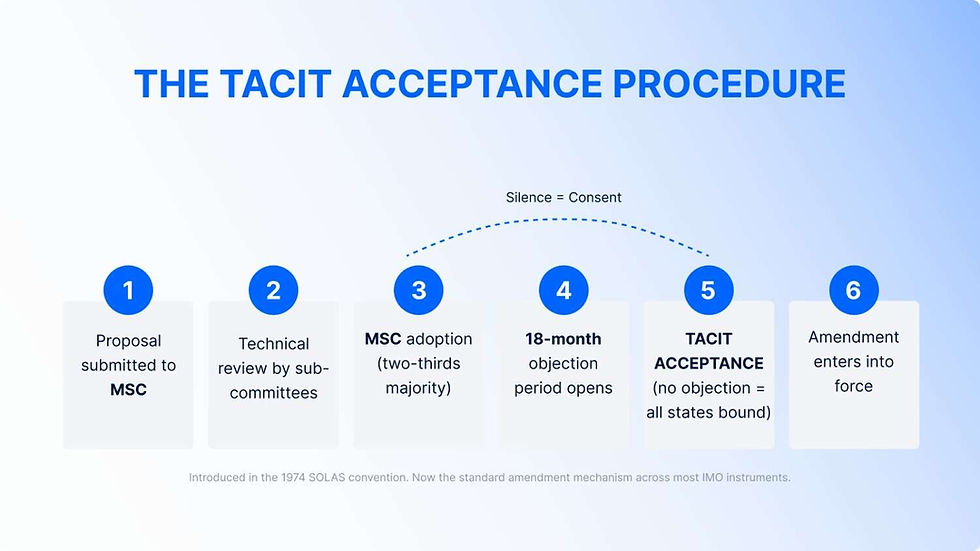
The tacit acceptance procedure, introduced with the 1974 SOLAS convention, is the legal mechanism that allows the convention to be updated efficiently without requiring every contracting state to actively ratify each amendment. It is explained clearly by the IMO as its primary amendment tool but is rarely explained in accessible terms for a non-legal audience.
The six-step process is:
Step 1: A contracting state or recognized organization submits a proposed amendment to the IMO Maritime Safety Committee (MSC).
Step 2: The MSC reviews the proposal across one or more sessions, with technical sub-committees (SSE, HTW, CCC) assessing merits.
Step 3: The MSC adopts the amendment by a two-thirds majority of member states present and voting.
Step 4: A notification period begins. Contracting states typically have 18 months to formally object.
Step 5: Tacit acceptance. If no objection is received from the required number of states within the notification period, the amendment is deemed accepted by all contracting states.
Step 6: The amendment enters into force on the agreed date. Flag states are obligated to implement it for their flagged ships.
Why Tacit Acceptance Matters
Before 1974, each SOLAS amendment required active ratification by a defined percentage of states, meaning a single large maritime nation could block a safety improvement indefinitely. The tacit acceptance procedure inverted the default: silence means consent. This made SOLAS far more adaptable and allowed the convention to respond to disasters such as the Estonia sinking within years rather than decades. The procedure is now used across most IMO convention amendments.
All 15 SOLAS Chapters Explained

The table below provides the most comprehensive plain-language chapter reference available outside the IMO's own website.
Ch. | Title | In Force | Key Requirements |
I | General Provisions | 1980 | Surveys, inspections, certificates, flag state obligations, equivalences |
II-1 | Construction: Subdivision and Stability | 1980 | Damage stability, watertight integrity, double-bottom requirements, machinery space fire safety |
II-2 | Fire Protection, Detection, and Extinction | 1980 | Structural fire protection, fire detection systems, suppression systems, fire safety plans |
III | Life-Saving Appliances and Arrangements | 1980 | Lifeboats, rescue boats, life rafts, EPIRBs, SARTs, immersion suits, MOB recovery equipment |
IV | Radiocommunications | 1992 | GMDSS: DSC radio, NAVTEX, EPIRB, INMARSAT; replaced Morse code radio in 1999 |
V | Safety of Navigation | 1980 | Applies to ALL vessels. Voyage planning, AIS carriage, VDR, ECDIS, LRIT, danger message reporting |
VI | Carriage of Cargoes | 1980 | Grain, bulk cargoes, VGM container weight verification (2016) |
VII | Carriage of Dangerous Goods | 1980 | IMDG Code compliance mandatory; dangerous cargo documentation and labelling |
VIII | Nuclear Ships | 1980 | Special requirements for nuclear-powered vessels |
IX | Management for the Safe Operation of Ships | 1998 | ISM Code mandatory: Safety Management System (SMS) for company and ship; DOC and SMC certificates |
X | Safety Measures for High-Speed Craft | 1996 | HSC Code compliance for fast ferries and hydrofoils |
XI-1 | Special Measures to Enhance Maritime Safety | 1996 | Enhanced surveys, IMO ship identification numbers, Continuous Synopsis Record (CSR) |
XI-2 | Special Measures to Enhance Maritime Security | 2004 | ISPS Code: ship security plans, Ship Security Officer, port facility security, security levels 1-3 |
XII | Additional Safety Measures for Bulk Carriers | 2002 | Structural requirements for single-skin bulk carriers, flooding detection systems |
XIII | Verification of Compliance | 2016 | IMO Member State Audit Scheme (IMSAS) mandatory for all contracting states |
XIV | Safety Measures for Ships in Polar Waters | 2017 | Polar Code mandatory: Arctic and Antarctic construction, stability, life-saving, navigation requirements |
XV | Ships Carrying Industrial Personnel | 2024 | IPI Code mandatory for vessels carrying industrial personnel to offshore installations (wind, oil, gas, aquaculture) |
SOLAS Certificates: What Every Ship Must Carry
Every commercial ship must carry the SOLAS statutory certificates relevant to its type and trading area. Port state control officers examine these on boarding. An expired or missing certificate is grounds for a formal deficiency and potential vessel detention. No maritime editorial source outside the IMO's own website provides a complete practical guide to all SOLAS certificates.
Certificate | Applies To | Validity | Issued By | Key Coverage |
Passenger Ship Safety Certificate | Passenger ships on intl. voyages | 12 months | Flag state / RO | Structure, fire, life-saving, radio, navigation — complete ship safety overview |
Cargo Ship Safety Construction Certificate | Cargo ships 500 GT+ | 5 years | Flag state / RO | Hull, machinery, subdivision, stability, damage control plans |
Cargo Ship Safety Equipment Certificate | Cargo ships 500 GT+ | 5 years | Flag state / RO | Life-saving appliances, fire detection and suppression equipment |
Cargo Ship Safety Radio Certificate | Cargo ships 300 GT+ | 5 years | Flag state / RO | GMDSS radio equipment compliance, watch requirements |
Cargo Ship Safety Certificate (combined) | Cargo ships 500 GT+ | 5 years | Flag state / RO | Replaces the three separate cargo ship certificates above; most common form in current use |
Document of Compliance (DOC) | Shipping companies | 5 years | Flag state | ISM Code compliance at company level; required for all company types managing SOLAS ships |
Safety Management Certificate (SMC) | Individual ships | 5 years | Flag state | ISM Code compliance at ship level; links each vessel to the company's certified SMS |
International Ship Security Certificate | Cargo 500 GT+; passenger ships | 5 years | Flag state / RO | ISPS Code compliance: security plan approved, security officer designated |
What Happens If a Ship Sails Without Valid Certificates
Sailing without valid SOLAS certificates constitutes a serious deficiency under port state control. The ship can be detained in port until certificates are renewed or deficiencies rectified. The flag state faces escalating scrutiny under the IMO Audit Scheme (IMSAS). Classification societies (Lloyd's Register, Bureau Veritas, DNV, ABS, ClassNK) act as Recognized Organizations (ROs) authorized by flag states to conduct surveys and issue certificates on their behalf. The survey cycle for most SOLAS certificates is five years with annual and intermediate surveys; for passenger ships, the Safety Certificate is renewed annually.
SOLAS Chapter V: Rules That Apply to Every Vessel Including Yachts
SOLAS Chapter V is unique in the entire convention: it applies to all vessels on all voyages, not only commercial ships on international routes. This creates compliance obligations that are frequently overlooked by recreational sailors, small commercial vessel operators, and coastal traders.
What Chapter V Requires for All Vessels
The seven key Chapter V obligations relevant to all vessel operators:
Voyage planning (Regulation 34): Masters of all vessels must plan voyages considering weather, tidal data, navigation hazards, and safe water depths before departure. There is no minimum size threshold.
Distress signals (Regulation 29): All vessels must carry approved distress signals. Approved types vary by national authority but typically include SOLAS-grade pyrotechnic flares or a registered EPIRB.
Danger messages (Regulation 31): Any vessel encountering dangerous ice, derelict vessels, or other navigational hazards must report to other ships and coast stations by the fastest available means.
Master's duty to render assistance (Regulation 33): Any master who receives a distress signal is legally obligated to proceed to assist at all possible speed, provided doing so does not endanger the ship or persons on board. This is one of the oldest duties in maritime law.
Misuse of distress signals (Regulation 35): Transmitting a false distress signal is a criminal offence under the domestic law of most flag states and carries significant penalties.
AIS carriage (Regulation 19): Mandatory for SOLAS vessels of 300 GT and above on international voyages. Not mandatory for most recreational yachts, but AIS Class B transponders are strongly recommended for offshore passages.
Navigational equipment standards: Gyrocompasses, echo sounders, radar, ECDIS requirements vary by ship type and gross tonnage as set out in the detailed equipment tables of Regulation 19.
SOLAS V and the Recreational Sailor: What You Actually Need to Know
A yacht skipper on an offshore passage needs to satisfy three practical obligations to comply with Chapter V: file a voyage plan (which can be as simple as a float plan left with a shore contact stating intended route, ETA, and emergency contacts), carry approved pyrotechnic distress signals, and understand the legal duty to render assistance. National coastguard authorities, including the MCA in the UK and the USCG in the United States, publish guidance translating these obligations for recreational users.
VGM: The SOLAS Container Weight Verification Rule

The 2016 Verified Gross Mass (VGM) regulation is one of the most operationally significant SOLAS amendments in recent decades for the container shipping industry, affecting every shipper, freight forwarder, and terminal operator globally. The amendment is described by the IMO as addressing a direct safety risk from misdeclared container weights, which contributed to vessel instability and cargo stack collapses in multiple incidents.
Why VGM Was Introduced
Misdeclared container weights were a documented cause of vessel instability and cargo stack collapses. The grounding of MSC Napoli in the English Channel in 2007, and a series of stack collapse incidents at sea, prompted IMO action. The VGM amendment to SOLAS Chapter VI Regulation 2 was adopted in 2014 and entered into force on 1 July 2016. It applies to all packed containers loaded onto a ship for international carriage and places the legal responsibility for accurate weight declaration on the shipper named on the Bill of Lading.
Method 1 vs. Method 2: How to Calculate VGM
| Method 1 | Method 2 |
Procedure | Weigh the packed container as a complete unit | Weigh all cargo items, packing materials, and dunnage separately, then add the container tare weight |
Equipment | Certified weighbridge or crane scale calibrated to national standards | Certified scales for individual cargo items |
Best For | Bulk cargoes, heavy machinery, mixed cargo | Retail goods, palletized cargo, e-commerce shipments |
Accuracy | High (direct single measurement) | Medium (cumulative; risk of addition error) |
Who Signs the VGM | The shipper (named on the Bill of Lading) | The shipper (named on the Bill of Lading) |
VGM Submission: Process and Responsibilities
The shipper (not the carrier, freight forwarder, or terminal) holds legal responsibility for providing a signed VGM declaration before the cargo cut-off time. Carriers transmit VGM data via EDI through systems such as VERMAS. A container without a valid VGM declaration cannot be loaded onto a vessel. If the terminal or carrier uses an incorrect VGM provided by the shipper and an incident results, the shipper bears liability. Carriers and terminal operators are legally protected once a signed VGM declaration has been received.
SOLAS and Related Conventions: ISM, ISPS, MARPOL, STCW, MLC
Ship operators must manage compliance across multiple overlapping international conventions simultaneously. The table below shows how SOLAS relates to the other major IMO frameworks that maritime professionals work with daily.
Convention | Full Name | Adopted | Administered By | Primary Focus | Relationship to SOLAS |
SOLAS | Safety of Life at Sea | 1974 | IMO | Ship safety | Parent framework; ISM and ISPS Codes are embedded within it as Chapters IX and XI-2 |
MARPOL | Marine Pollution Convention | 1973/78 | IMO | Pollution prevention | Parallel convention. SOLAS and MARPOL surveys typically conducted together by the same RO. Scrubber installations (MARPOL Annex VI) must meet SOLAS fire safety rules in Chapter II-2. |
STCW | Standards of Training, Certification and Watchkeeping | 1978 | IMO | Seafarer competency | Enables SOLAS. STCW requires seafarers to be trained and certified to operate SOLAS-mandated safety equipment: lifeboat releases, GMDSS radio, fire suppression systems. |
MLC 2006 | Maritime Labour Convention | 2006 | ILO | Seafarer welfare | Complements SOLAS. Ensures crew are fit, rested, and not under commercial pressure that could lead to safety non-compliance. |
ISM Code | International Safety Management Code | 1993 | IMO via Ch. IX | Safety management systems | Embedded within SOLAS Chapter IX. Not a standalone convention. Every company managing SOLAS ships must hold a Document of Compliance; each ship must hold a Safety Management Certificate. |
ISPS Code | International Ship and Port Facility Security Code | 2002 | IMO via Ch. XI-2 | Ship security | Embedded within SOLAS Chapter XI-2. Adopted post-9/11. Ships and port facilities must maintain security plans and operate at defined security levels (MARSEC 1, 2, or 3). |
Which Convention Takes Priority?
The conventions are designed to be complementary, not conflicting. In practice, SOLAS is the most frequently cited in port state control detentions because it covers the most safety-critical hardware and documentation. Where apparent conflicts arise (for example, a MARPOL scrubber installation affecting SOLAS fire safety arrangements), the IMO Circular system provides guidance. Flag state administrations and classification societies help operators navigate multi-convention compliance through combined survey schedules that cover multiple conventions in a single inspection visit.
Port State Control: How SOLAS Is Enforced

SOLAS enforcement at sea operates through port state control (PSC): the right of a coastal state to inspect any foreign-flagged vessel calling at its ports, verified under SOLAS Article X and the broader framework of the UN Convention on the Law of the Sea (UNCLOS). PSC officers are authorized surveyors employed by national maritime authorities. They can inspect certificates, equipment, crew documentation, and operational records. A vessel's PSC detention history directly affects its risk profile: a detained vessel is flagged in regional databases and faces increased frequency of future inspections. For maritime asset investors, PSC performance is a direct input into charter income risk and vessel valuation.
The PSC Regional Memoranda of Understanding
MOU | Region | Secretariat | Annual Inspections (approx.) |
Paris MOU | Europe and North Atlantic | Paris | ~17,000 |
Tokyo MOU | Asia-Pacific | Tokyo | ~30,000 (largest globally) |
USCG / QUALSHIP 21 | United States | Washington DC | ~8,000 |
Indian Ocean MOU | Indian Ocean | Mumbai | ~5,000 |
Mediterranean MOU | Mediterranean | Casablanca | ~3,000 |
Black Sea MOU | Black Sea | Istanbul | ~1,500 |
Riyadh MOU | Gulf States | Riyadh | ~2,000 |
Caribbean MOU | Caribbean | Trinidad | ~1,000 |
The Most Common SOLAS Deficiencies Leading to Detention
Based on Paris MOU and Tokyo MOU annual report data, the deficiency categories most frequently resulting in vessel detention are: fire safety equipment deficiencies (Chapter II-2), life-saving appliance failures (Chapter III), GMDSS equipment faults (Chapter IV), ISM Code non-conformities (Chapter IX), stability booklet and document deficiencies (Chapter II-1), structural deficiencies, ISPS Code violations (Chapter XI-2), and expired or missing certificates (Chapter I). Fire safety deficiencies and ISM non-conformities consistently rank as the two leading causes of detention across all regional MOUs.
What Happens When a Ship Is Detained
When deficiencies are serious enough to pose danger to the ship, crew, or environment, the PSC officer issues a detention order. The shipowner or manager is notified immediately. A rectification plan must be submitted to the PSC authority. All deficiencies must be corrected and confirmed by a follow-up inspection before the vessel is released. The detention is recorded permanently in the relevant PSC MOU database (THETIS for Paris MOU; APCIS for Tokyo MOU), affecting the ship's risk score and increasing the probability of priority inspection at future port calls. Flag states whose ships generate excessive detentions appear on the Paris MOU Black List, making every vessel flying that flag subject to higher inspection frequency.
SOLAS Chapter XV: Ships Carrying Industrial Personnel
Chapter XV entered into force on 1 July 2024 and is the newest SOLAS chapter. It addresses a regulatory gap that existed for decades: vessels carrying construction workers, wind turbine technicians, and platform personnel to offshore installations operated in a grey zone between SOLAS (which covers crew) and national maritime regulations (which varied widely by jurisdiction).
What Triggered Chapter XV
As offshore wind farm construction accelerated in the North Sea, East Asia, and the US East Coast, the IMO identified the need for a uniform international standard. Crew transfer vessels (CTVs) and service operation vessels (SOVs) carrying technicians to wind turbines routinely operate in conditions far more demanding than conventional coastal ferrying, with personnel transfers at sea in significant wave heights a routine operation. National regulations were inconsistent and in some cases silent.
Who Does Chapter XV Apply To
Chapter XV applies to ships carrying more than 12 industrial personnel: persons on board who are not crew members and are carried for the purpose of offshore industrial activities. This includes CTVs above the applicable size threshold, SOVs, and multi-purpose vessels servicing offshore windfarms, oil and gas platforms, and aquaculture facilities. The size and voyage range thresholds determine the specific certification tier applicable.
Key Requirements of the IPI Code
The Industrial Personnel (IPI) Code, made mandatory by Chapter XV, requires: enhanced stability requirements accounting for large numbers of non-crew passengers embarking and disembarking at sea; helicopter embarkation and muster procedures; specialized evacuation equipment including fast rescue craft and life rafts suited to offshore transfer operations; and tailored competency requirements for crew handling industrial personnel transfers. Vessels that were already operating under national certificates prior to 1 July 2024 have transitional arrangements, but new vessels built after the entry into force date must comply from the outset.
SOLAS and the Green Transition: Alternative Fuels and Autonomous Ships
No competitor page connects SOLAS to the maritime decarbonization agenda. As the IMO's GHG strategy drives changes to ship design, propulsion, and fuel systems, SOLAS is being updated to address the safety implications of new energy carriers and new vessel operating modes.
How New Fuel Types Challenge SOLAS Safety Rules
SOLAS fire protection and dangerous goods chapters (II-2 and VII) were designed for conventional oil-fueled ships. Alternative fuels including LNG, methanol, ammonia, and hydrogen introduce fire, explosion, and toxicity hazards that existing chapters do not fully address. The IMO's Sub-Committee on Carriage of Cargoes and Containers (CCC) is developing interim guidelines and permanent SOLAS amendments for each fuel type. The regulatory position as of April 2026 is set out below.
Fuel | SOLAS / Regulatory Framework | Status (2026) | Key Safety Risk | IMO Reference |
LNG | IGF Code (mandatory under SOLAS Chapter II-1) | In force | Cryogenic temperature; asphyxiation; boil-off gas | |
Methanol | IGF Code Part A-1 | In force 2024 | Low flashpoint (11°C); toxicity | |
Ammonia | Interim guidelines (MSC-MEPC.2/Circ.25) | Interim only; permanent rules under development | High toxicity (TLV 25 ppm); corrosivity | |
Hydrogen | Interim guidelines; pilot projects only | Pilot stage | Extreme flammability; hydrogen embrittlement | |
Biofuels (B100) | No specific SOLAS amendment required for blends | Drop-in for most blends | Microbial contamination; cold flow properties |
The IGF Code and Its SOLAS Connection
The International Code of Safety for Ships Using Gases or Other Low-Flashpoint Fuels (IGF Code) became mandatory under SOLAS Chapter II-1 in 2017. It sets safety requirements for ships using LNG as propulsion fuel. Part A-1, covering methanol and ethanol dual-fuel ships, entered into force in 2024. Work on permanent provisions for ammonia and hydrogen propulsion is ongoing in the CCC Sub-Committee, with interim guidelines currently filling the gap for vessels in commercial operation or trials.
Maritime Autonomous Surface Ships (MASS)
The IMO adopted interim guidelines for Maritime Autonomous Surface Ships at MSC 107 in 2023. The MASS interim guidelines define four degrees of automation, from ships with automated processes and decision-support (Degree 1) to fully autonomous ships with no crew on board (Degree 4). A regulatory scoping exercise has identified which SOLAS chapters require amendment to accommodate MASS operations, with permanent rule development expected to produce targeted SOLAS amendments from 2028 onward. This is the most structurally significant change to the SOLAS framework since the 1974 convention was adopted.
Frequently Asked Questions About SOLAS
What does SOLAS stand for?
SOLAS stands for the International Convention for the Safety of Life at Sea. It is the primary international treaty governing safety standards for merchant ships, administered by the International Maritime Organization (IMO).
When was SOLAS adopted?
The current SOLAS convention was adopted in London on 1 November 1974 and entered into force on 25 May 1980. Earlier versions were adopted in 1914 (triggered by the Titanic disaster), 1929, 1948, and 1960. Each version superseded the previous one.
How many countries have signed SOLAS?
As of 2026, 167 states are contracting parties to SOLAS, representing approximately 99% of the world's merchant shipping gross tonnage. A small number of maritime nations remain non-parties but typically apply SOLAS standards voluntarily for commercial reasons.
Does SOLAS apply to private yachts?
Most SOLAS chapters apply only to commercial ships on international voyages. However, Chapter V (Safety of Navigation) applies to all vessels on all voyages, including private recreational yachts. Chapter V requires voyage planning, carriage of distress signals, and the master's legal duty to render assistance to vessels in distress.
What is the tacit acceptance procedure in SOLAS?
The tacit acceptance procedure means that a SOLAS amendment is automatically accepted by all contracting states unless a specified number of states formally object within a set notification period (typically 18 months). This inverted the old ratification model and allows SOLAS to be updated far more quickly in response to disasters or new technology.
What is the VGM rule under SOLAS?
The Verified Gross Mass (VGM) rule, in force since 1 July 2016 under SOLAS Chapter VI, requires shippers to declare the verified weight of packed containers before they can be loaded onto a ship. The rule was introduced following incidents caused by misdeclared container weights contributing to vessel instability and cargo stack collapses. The shipper named on the Bill of Lading is legally responsible for accuracy.
What is the ISM Code and how does it relate to SOLAS?
The International Safety Management (ISM) Code is a mandatory safety management framework incorporated into SOLAS as Chapter IX. It requires every shipping company to operate a certified Safety Management System (SMS) covering all safety and pollution prevention procedures. The company holds a Document of Compliance; each ship holds a Safety Management Certificate.
What is the ISPS Code?
The International Ship and Port Facility Security Code (ISPS Code) is incorporated into SOLAS as Chapter XI-2. Adopted in December 2002 following the September 11 attacks and entering into force in July 2004, it requires ships and port facilities to maintain approved security plans, designate security officers, and operate at defined security levels (MARSEC 1, 2, or 3).
What is SOLAS Chapter XIV and the Polar Code?
Chapter XIV makes the International Code for Ships Operating in Polar Waters (Polar Code) mandatory for ships operating in Arctic and Antarctic waters. It entered into force on 1 January 2017 and covers structural requirements, stability, life-saving appliances, navigation equipment, and environmental protection specific to polar operations.
What certificates does a cargo ship need under SOLAS?
A cargo ship of 500 GT or more on international voyages must carry a Cargo Ship Safety Certificate (or the three separate certificates it replaces), a Safety Management Certificate (ISM Code compliance), and an International Ship Security Certificate (ISPS Code compliance). All have five-year renewal cycles with annual and intermediate surveys by the flag state or its Recognized Organization.
What is SOLAS Chapter XV?
Chapter XV entered into force on 1 July 2024 and applies to ships carrying industrial personnel: workers traveling to offshore installations such as wind farms, oil platforms, and aquaculture facilities. It makes the Industrial Personnel (IPI) Code mandatory, setting standards for vessel design, stability, life-saving appliances, and crew competency for this rapidly growing sector.
What happens if a ship fails a port state control inspection?
If a PSC inspector finds deficiencies posing danger to the ship, crew, or environment, the vessel is detained in port until all deficiencies are rectified and confirmed in a follow-up inspection. The detention is recorded permanently in the relevant PSC MOU database (THETIS for Paris MOU; APCIS for Tokyo MOU) and affects the vessel's risk score, increasing the likelihood of priority inspection at future port calls.
SOLAS Glossary of Key Terms
Term | Definition |
AIS | Automatic Identification System. A vessel tracking transponder required under SOLAS Chapter V for ships of 300 GT and above on international voyages; broadcasts identity, position, speed, and course to other vessels and coastal authorities. |
Cargo Ship Safety Certificate | A combined SOLAS statutory certificate covering construction, equipment, and radio requirements for cargo ships of 500 GT and above; valid for 5 years with annual and intermediate surveys. |
DOC | Document of Compliance. The ISM Code (SOLAS Chapter IX) certificate issued to a shipping company confirming that its Safety Management System has been audited and certified at company level. |
ECDIS | Electronic Chart Display and Information System. Required under SOLAS Chapter V for most large vessels; displays electronic navigational charts integrated with GPS positioning, replacing paper charts as the primary navigation reference. |
EPIRB | Emergency Position Indicating Radio Beacon. Required under SOLAS Chapters III and IV; activates manually or automatically when immersed in water, transmitting a distress signal to the COSPAS-SARSAT satellite network. |
Flag State | The country under whose national maritime authority a ship is registered; responsible for ensuring the ship complies with SOLAS and other IMO conventions, conducting or delegating surveys, and issuing statutory certificates. |
GMDSS | Global Maritime Distress and Safety System. Required under SOLAS Chapter IV for all vessels above 300 GT; replaced Morse code radio in 1999; uses satellite (INMARSAT, COSPAS-SARSAT) and digital radio (DSC, NAVTEX) communications. |
IGF Code | International Code of Safety for Ships Using Gases or Other Low-Flashpoint Fuels. Made mandatory under SOLAS Chapter II-1; sets safety requirements for ships using LNG, methanol, or other low-flashpoint fuels as propulsion fuel. |
IMSAS | IMO Member State Audit Scheme. Made mandatory under SOLAS Chapter XIII in 2016; requires all IMO member states to undergo periodic audits of their maritime administration to verify effective implementation of IMO conventions. |
IPI Code | Industrial Personnel Code. Made mandatory by SOLAS Chapter XV (2024); sets design, construction, equipment, and crew competency requirements for ships carrying industrial personnel to offshore installations. |
ISPS Code | International Ship and Port Facility Security Code. Mandatory under SOLAS Chapter XI-2; requires ships and port facilities to implement security plans, designate security officers, and operate at defined security levels to counter terrorism and piracy. |
ISM Code | International Safety Management Code. Mandatory under SOLAS Chapter IX; requires shipping companies to establish a certified Safety Management System covering all safety and pollution prevention procedures. |
LRIT | Long Range Identification and Tracking. A SOLAS Chapter V system requiring ships to transmit identity and position data at 6-hour intervals to their flag state and to any coastal state within 1,000 nautical miles. |
MASS | Maritime Autonomous Surface Ships. Vessels with automated decision-making capabilities across four defined degrees of automation (IMO interim guidelines adopted MSC 107, 2023); permanent SOLAS amendments expected from 2028. |
MOU | Memorandum of Understanding. A regional agreement between national maritime authorities to cooperate in port state control inspections. The Paris and Tokyo MOUs are the most significant, covering Europe and Asia-Pacific respectively. |
Polar Code | The International Code for Ships Operating in Polar Waters; mandatory under SOLAS Chapter XIV from 2017; covers structural, stability, life-saving, navigation, and environmental requirements for Arctic and Antarctic operations. |
PSC | Port State Control. The inspection of foreign ships in national ports to verify compliance with international conventions; authorized under SOLAS and UNCLOS; PSC officers can detain ships with serious deficiencies. |
RO | Recognized Organization. A classification society (Lloyd's Register, DNV, Bureau Veritas, ABS, ClassNK, etc.) authorized by a flag state to conduct SOLAS surveys and issue statutory certificates on behalf of the flag state administration. |
SART | Search and Rescue Transponder. Required under SOLAS Chapter III for survival craft; responds to 9 GHz radar pulses from searching vessels or aircraft with a distinctive 12-dot radar blip indicating survivor position. |
SMC | Safety Management Certificate. A SOLAS Chapter IX certificate issued to an individual ship confirming its Safety Management System complies with the ISM Code. |
SMS | Safety Management System. The documented policies, procedures, and practices required under the ISM Code (SOLAS Chapter IX) that a shipping company must implement for safe ship operation and pollution prevention. |
Tacit Acceptance | The amendment procedure adopted in the 1974 SOLAS convention; an amendment enters into force unless a defined number of contracting states formally object within a set period, replacing the old active ratification requirement. |
THETIS | The inspection database of the Paris MOU; records all PSC inspections, detentions, deficiencies, and banning orders for vessels trading in European ports; used by PSC officers to determine inspection priority. |
VDR | Voyage Data Recorder. The maritime equivalent of an aircraft flight data recorder; required under SOLAS Chapter V for most cargo ships and passenger vessels; records bridge audio, navigation data, radar images, and communications for accident investigation. |
VGM | Verified Gross Mass. The mandatory verified weight of a packed container required by SOLAS Chapter VI Regulation 2 since 1 July 2016; must be provided by the shipper before the container can be loaded onto a ship. |
VERMAS | The electronic VGM submission system used in many major ports; allows shippers to transmit verified gross mass declarations digitally ahead of cargo cut-off deadlines. |
White / Grey / Black List | Paris MOU and Tokyo MOU annual performance classifications for flag states based on their ships' detention rates; being on the Black List increases the probability of priority PSC inspection for every vessel flying that flag. |
Sources referenced throughout this article include the International Maritime Organization, Paris MOU, Tokyo MOU, USCG, MCA, and official MSC and MEPC session summaries. All regulatory dates are correct as of April 2026.


Dushyant Bisht
Expert in Maritime Industry
Dushyant Bisht is a seasoned expert in the maritime industry, marketing and business with over a decade of hands-on experience. With a deep understanding of maritime operations and marketing strategies, Dushyant has a proven track record of navigating complex business landscapes and driving growth in the maritime sector.
Email: [email protected]


