Bill of Lading: The Complete Guide for 2026

Updated: Oct 19

Key Takeaways: Bills of Lading in 2026
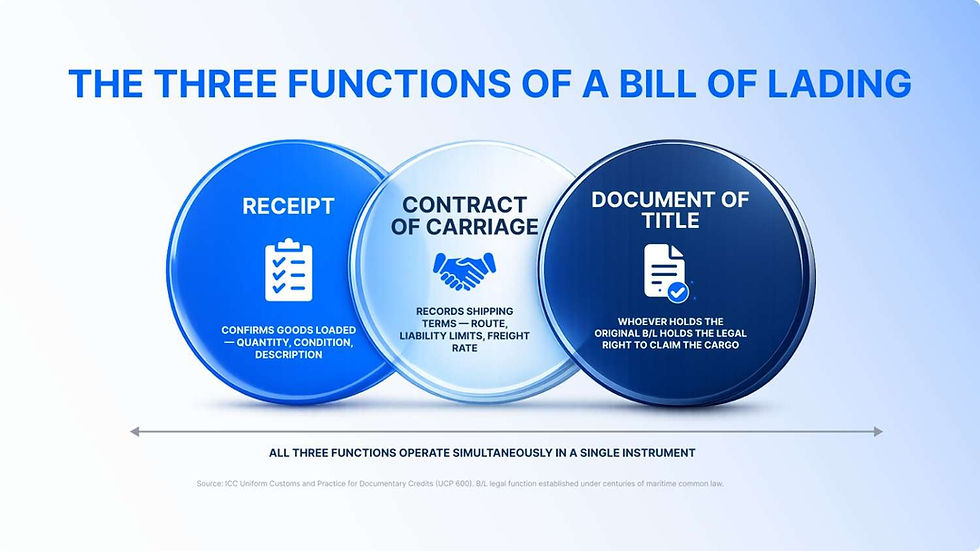
The "3-in-1" Legal Instrument: A Bill of Lading (B/L) is legally irreplaceable because it simultaneously serves three functions: a receipt of goods, a contract of carriage, and a document of title (proof of ownership).
The Backbone of Trade Finance: For shipments financed through a Letter of Credit (LC), a Negotiable (Order) B/L is required. Banks use this document as collateral. Using a non-negotiable Sea Waybill by mistake will result in instant bank refusal and payment failure.
The eBL Revolution is Here: Electronic Bills of Lading (eBLs) are replacing paper to eliminate "courier lag" and port demurrage. With interoperability solved in 2025, major ocean carriers (via the DCSA) are pushing for 100% eBL adoption by 2030.
New Legal Frameworks Support Digital Trade: Global legislation has caught up to technology. Aligning with the UNCITRAL MLETR framework, laws like India’s Bills of Lading Act, 2025 and the UK’s 2023 Act now give digital eBLs the exact same legal authority as physical paper originals.
Zero Margin for Error: Over 50% of first-presentation documents under Letters of Credit contain discrepancies. A single typo in a consignee name, a missing "Ltd.", or an incorrect HS code can trigger customs holds, severe financial penalties, and delayed cargo release.
Table of Contents
A shipment worth $2 million arrives at a port in Mumbai. The buyer is ready. The funds are in place. But without one document, nothing moves, the cargo stays locked until that single instrument confirms who owns the goods, what condition they arrived in, and who authorized their release. That document is the Bill of Lading. It is the most consequential document in international trade, and for most importers, exporters, and freight professionals, it is also the most misunderstood.
Quick Answer: What Is a Bill of Lading? A Bill of Lading (B/L) is a legal document issued by a carrier to a shipper that performs three simultaneous functions: it is a receipt confirming goods were loaded, a contract of carriage recording the terms of transport, and a title document that transfers ownership of the cargo. All three functions operate simultaneously in a single instrument, which is what makes it legally irreplaceable. The carrier issues it upon loading; whoever holds the original B/L holds the legal right to claim the goods.
What Is a Bill of Lading?
The Bill of Lading is the foundational legal instrument of international cargo shipping. The carrier issues it to the shipper upon loading, and it governs the relationship between all parties from the moment goods leave the port of origin until they reach the consignee at destination. Its authority rests on the ICC's Uniform Customs and Practice frameworks and centuries of maritime common law.
Its three core functions are distinct but inseparable. As a receipt, it confirms what was loaded, in what quantity, and in what condition. As evidence of a contract of carriage, it records the terms under which the carrier agreed to transport the goods, freight rate, routing, liability limits. As a document of title, it represents ownership of the cargo: whoever holds the original B/L holds the legal right to claim the goods at destination.
The four parties to any B/L transaction are: the shipper (the party loading the goods), the carrier (the shipping line issuing the document), the consignee (the named or to-order recipient of the cargo), and the notify party (typically the buyer's freight agent or customs broker, alerted when the ship arrives but not holding title).
Quick Facts | Detail |
Three core functions | Receipt of goods | Contract of carriage | Document of title (ownership) |
Parties involved | Shipper, carrier, consignee, notify party |
eBL adoption (2025) | |
DCSA eBL commitment | 100% electronic by 2030 across member carriers (covering ~70% of global container trade) |
McKinsey estimate (100% eBL) | $18 billion in direct ecosystem gains + $30-40 billion in trade growth |
India's 2025 legislation | Bills of Lading Act, 2025 — replaces the 1856 Act; recognizes digital B/Ls |
First interoperable eBL | Completed May 2025 (DCSA, HMM, Suzano) — first cross-platform production transaction |
Types of Bill of Lading
The B/L exists in multiple forms, each suited to different commercial relationships and financing structures. Choosing the wrong type for a given transaction is a leading cause of bank refusal under Letters of Credit and cargo release disputes at destination.
Type | Key Feature | Best Used For |
Negotiable (Order) B/L | Transfers ownership via endorsement; payable 'to order' of shipper or bank | Letters of credit, commodity trade finance, unknown counterparties |
Straight B/L | Fixed to a named consignee; non-negotiable; cannot transfer title | Prepaid shipments, intercompany transfers, trusted buyers |
Clean B/L | No cargo damage or discrepancy noted by the carrier | Standard exports; required by most Letters of Credit |
Claused B/L | Documents defects, discrepancies, or cargo condition caveats noted at loading | Insurance claims, dispute records; typically refused by banks under LC |
Multimodal / Through B/L | Covers multiple transport modes (sea, rail, road, air) in a single document | Sea-air, sea-rail combined routes; door-to-door shipments |
Master B/L (MBL) | Issued by the shipping line to a freight forwarder (who then issues a House B/L to the shipper) | Consolidation shipments via freight forwarder |
Surrendered B/L | Original surrendered at origin port; carrier issues telex or electronic release at destination | Trusted buyer relationships where courier lag must be avoided |
Sea Waybill | Not a document of title; named consignee can claim without presenting an original | Fast-release shipments, intercompany trade, known consignees |
Electronic B/L (eBL) | Digitally signed, platform-hosted; same legal force as paper original in MLETR-aligned jurisdictions | Modern digital trade; LC-compatible where legally recognized |
The most commercially significant type is the Negotiable (Order) B/L, because it enables trade finance. When a shipper presents a negotiable B/L to a bank under a Letter of Credit, the bank treats the document as the equivalent of the physical cargo, it can be discounted, endorsed, transferred, and used as collateral. This is the mechanism that funds a large proportion of global commodity trade. The ICC estimates that more than 50% of first-presentation documents under Letters of Credit contain discrepancies, most of which originate in the B/L fields.
Key Components of a Bill of Lading
Every B/L, regardless of type, must contain nine essential elements to be legally valid and commercially useful. Missing or incorrect information in any field creates customs delays, financing problems, and delivery disputes.
1. Shipper and consignee full details: Full legal names, addresses, and contact details, exactly matching what appears on the Letter of Credit or sales contract. Even a missing initial or 'Ltd' vs 'Limited' constitutes a documentary discrepancy under LC rules.
2. Notify party contact information: The party the carrier alerts upon vessel arrival. Typically the buyer's customs broker or freight forwarder. An incorrect notify party delays port notification and extends demurrage exposure.
3. Vessel name and voyage number: Identifies the specific ship and sailing on which the cargo was loaded. This field must match the Letter of Credit if one is in use.
4. Port of loading and port of discharge: Exact port names as they appear in the trade contract, not abbreviations. 'Nhava Sheva' and 'JNPT' refer to the same port but are not interchangeable on a B/L presented under an LC.
5. Description of goods: Includes HS codes (Harmonized System tariff codes), weight, number of packages, and commodity description. Incorrect HS codes trigger customs holds and duty miscalculations at destination.
6. Marks and package numbers: Identifies individual packages or containers for tracking and customs examination. Must match the packing list exactly.
7. Freight payment terms: States whether freight is prepaid (paid by shipper at origin) or collect (paid by consignee at destination). Mismatches with the sales contract create commercial disputes.
8. Date and place of issue: The B/L date determines the validity of any Letter of Credit and is the contractual reference point for all delivery timelines.
9. Carrier's authorized signature: Confirms the carrier's acceptance of the cargo and the terms stated in the document. Without this, the B/L has no legal force.
How a Bill of Lading Works: The Process Flow

Understanding the B/L lifecycle clarifies why errors at any stage create compounding problems downstream. The six-step process below covers both a standard trade transaction and an LC-financed transaction.
Step 1: The shipper books cargo space with the carrier or freight forwarder and provides cargo details.
Step 2: The carrier issues a draft B/L for the shipper's review before the vessel sails. The shipper checks every field against the sales contract and Letter of Credit.
Step 3: The shipper confirms the draft. The carrier issues the signed, original B/L — typically three originals for a paper B/L.
Step 4: The shipper sends the B/L to the consignee, directly in a non-LC transaction, or through the advising bank in an LC transaction where the bank holds the document until payment conditions are met.
Step 5 (LC transaction): The bank releases the B/L to the consignee only after the LC conditions are satisfied — typically after the issuing bank confirms payment or accepts a bill of exchange. This mechanism allows the seller to receive payment from a bank before the buyer receives the goods, with the B/L serving as the bank's collateral.
Step 6: The consignee presents the original B/L at the destination port to the carrier's agent. The agent confirms authenticity, releases the cargo, and the transfer of ownership is complete.
The B/L as a Trade Finance Instrument
Most explainers of the B/L focus on its logistics function, receipt and title. What they understate is its role as the central instrument of trade finance. A negotiable B/L under a Letter of Credit enables the seller to receive payment from a bank before the buyer receives the goods. The bank holds the B/L as collateral until the buyer pays or accepts a bill of exchange. ICC estimates place the volume of global trade flowing under Letters of Credit at approximately $10 trillion annually. Without the negotiable B/L, the financial architecture of commodity trade would require fundamentally different structures.
Bill of Lading vs. Sea Waybill: Which to Use and When

The choice between a B/L and a sea waybill is a commercial decision driven by the counterparty relationship and financing requirements. The wrong choice creates problems that cannot easily be reversed once the vessel has sailed.
Dimension | Bill of Lading | Sea Waybill |
Document of title | Yes — ownership transferable via endorsement | No — named consignee only; no title transfer possible |
Negotiability | Negotiable (order B/L) or non-negotiable (straight B/L) | Non-negotiable |
Original required at destination | Yes (for original B/L). Ship waits for document. | No. Consignee identified at booking. |
Trade finance compatibility | Full — standard instrument for Letters of Credit | None — banks will not accept under LC |
Speed of cargo release | Slower — original must physically arrive before release | Faster — no courier lag |
Risk of late document | Yes — demurrage accumulates if ship arrives before courier | None |
Suitable for unknown counterparties | Yes — bank holds document as security | Not recommended — no security mechanism |
A common and costly mistake among first-time exporters is using a sea waybill when their Letter of Credit specifies an original B/L. The bank will refuse the presentation and the payment mechanism fails entirely. Confirm the documentary requirements in the Letter of Credit before choosing document type at booking, not after the vessel has sailed.
Electronic Bill of Lading: The Industry's Digital Transition

The paper B/L has a structural problem: it takes five to seven days to courier an original document from shipper to consignee, but the vessel sometimes arrives in three. The result is cargo sitting idle in port, generating demurrage, while everyone waits for a piece of paper that has not changed fundamentally since the 19th century.
The Electronic Bill of Lading (eBL) addresses this directly. An eBL is a digitally signed, platform-hosted trade document carrying the same legal force as a paper original, enabling issuance, endorsement, and transfer to happen in minutes rather than days. As of 2025, approximately 11% of all B/Ls are issued electronically. The pace is accelerating: the DCSA eBL Standard v3.0 was published in May 2025, and the first successful standards-based, interoperable eBL transaction across two separate platforms was completed in the same month.
DCSA member carriers (covering approximately 70% of global container trade) have committed to 50% eBL issuance within five years and 100% by 2030. McKinsey estimates that universal eBL adoption across container trade could deliver approximately $18 billion in direct ecosystem savings from faster document handling and error reduction, plus $30-40 billion in incremental global trade growth from reduced friction.
Legal Recognition: The Barrier That Is Being Removed
The primary obstacle to eBL adoption has historically been legal: many jurisdictions did not formally recognize electronic trade documents as equivalent to paper originals. This is changing systematically. The UK's Electronic Trade Documents Act (2023) resolved the issue in England and Wales. India's Bills of Lading Act, 2025 did the same for one of the world's largest trading nations. Singapore, Bahrain, France, and the UAE have aligned with the UNCITRAL Model Law on Electronic Transferable Records (MLETR) frameworks. The May 2025 DCSA cross-platform pilot resolved the interoperability constraint, demonstrating that eBL transfer between competing platforms is now technically viable in production.
India and the Bill of Lading: A Market in Transition
India handles approximately 30 million B/Ls annually across its major ports. The Bills of Lading Act, 2025 represents the most significant legislative modernization of Indian trade documentation in 169 years, replacing a statute last updated in 1856. The new law explicitly validates electronic B/Ls, aligns with MLETR, and creates a digital incentive scheme (including port fee rebates and accelerated GST refunds for eBL shipments) specifically designed to encourage adoption by small and medium exporters.
The mandatory eBL milestones set by the Act are: 50% of B/Ls electronic by 2028, and 100% adoption by 2030. Analysis in maritime policy literature projects direct documentation savings exceeding $2 billion annually by 2030 if India meets these targets, with an estimated $10-15 billion in incremental trade enabled by reduced friction.
Common Mistakes and How to Avoid Them
Incorrect HS codes causing customs holds. Every commodity has a Harmonized System code determining applicable customs duty and inspection regime. Incorrect HS codes trigger holds, penalties, and potential seizure. Verify against the current WCO nomenclature before every shipment.
Mismatched consignee details between B/L and Letter of Credit. Banks examine B/L entries against LC terms character by character. A missing initial in a company name constitutes a discrepancy. The consignee name on the B/L must match the LC exactly as issued.
Not specifying clean vs. claused status. A carrier noting cargo damage on the B/L at loading issues a claused B/L. Banks typically refuse a claused B/L under a standard LC, triggering a payment dispute. Resolve any damage with the carrier before the B/L is issued, not after.
Delays in surrendering the original B/L. When shipments arrive at destination before the paper B/L does, demurrage accumulates. Either switch to a sea waybill for trusted counterparties, arrange a bank guarantee for early release, or shift to eBL to eliminate courier lag entirely.
Using a sea waybill when an LC requires a B/L. This is a fundamental document type error resulting in bank refusal of the presentation. Confirm documentary requirements in the Letter of Credit before choosing document type at booking.
Frequently Asked Questions About Bills of Lading
What is a Bill of Lading in simple terms?
A Bill of Lading is a legal document issued by a carrier that simultaneously proves cargo was loaded, records the terms of carriage, and gives its holder the right to claim the goods at destination. It is the single most important document in international trade.
What are the three types of B/L most commonly used?
The three most common types are the Negotiable (Order) B/L for trade finance and LC transactions, the Straight B/L for prepaid shipments to known consignees, and the Sea Waybill for fast-release shipments where no title transfer is needed.
What is the difference between a B/L and a sea waybill?
A Bill of Lading is a document of title, it can transfer cargo ownership and be used in Letters of Credit. A sea waybill is not negotiable and cannot transfer title. The consignee in a sea waybill transaction can claim cargo without presenting an original, making release faster but removing the financing utility.
What is an electronic Bill of Lading?
An eBL is a digitally signed, platform-hosted trade document carrying the same legal force as a paper original in jurisdictions that have enacted enabling legislation (UK, India, Singapore, UAE, France, Bahrain). DCSA member carriers have committed to 100% eBL issuance by 2030.
What happens if a Bill of Lading is lost?
If an original paper B/L is lost, the carrier can release cargo against a Letter of Indemnity (LOI) from the consignee, a bank-guaranteed undertaking to indemnify the carrier against any claims arising from cargo release without the original. The LOI is a workaround, not a solution, and carries financial risk for all parties. eBLs, which cannot be physically lost, eliminate this risk entirely.
What does 'to order' mean on a Bill of Lading?
'To order' on a negotiable B/L means the document is payable to the order of a named party (typically the shipper or the shipper's bank). The party can then endorse the B/L to a third party, effectively transferring ownership of the cargo without needing to name the ultimate buyer at the time of shipment. This is essential for commodity trading where cargo changes hands multiple times in transit.
Can a Bill of Lading be used for all types of cargo?
Yes. B/Ls are used for bulk cargo, containerized cargo, general cargo, refrigerated cargo, and hazardous materials (subject to additional IMDG Code documentation requirements). The form and contents of the B/L vary by cargo type and mode of transport, but the three core legal functions (receipt, contract, title) apply universally.
Glossary of Key Bill of Lading Terms
Term | Definition |
Bill of Lading (B/L) | A legal document issued by a carrier that serves simultaneously as a receipt of cargo, evidence of a contract of carriage, and a document of title. Whoever holds the original B/L holds the right to claim the cargo at destination. |
Carrier | The shipping line or transport company issuing the B/L and responsible for transporting the cargo under the terms stated in the document. |
Clean B/L | A B/L on which the carrier has noted no cargo damage or discrepancy at the time of loading. Required by most Letters of Credit. |
Claused B/L | A B/L on which the carrier has noted damage, discrepancy, or a condition caveat about the cargo. Typically refused by banks under a Letter of Credit. |
Consignee | The party named on the B/L as the recipient of the cargo at destination. On a negotiable B/L, ownership transfers upon endorsement; on a straight B/L, the named consignee is fixed. |
DCSA | Digital Container Shipping Association. The carrier-led body developing interoperable eBL standards; its member carriers cover approximately 70% of global container trade. |
Document of Title | A legal document representing ownership of goods. The negotiable B/L is a document of title; a sea waybill is not. Only a document of title can be used as collateral in trade finance. |
eBL | Electronic Bill of Lading. A digitally signed, platform-hosted trade document with the same legal force as a paper original in MLETR-aligned jurisdictions. |
Endorsement | The act of signing the back of a negotiable B/L to transfer ownership of the cargo to a new party. A blank endorsement transfers to any bearer; a special endorsement names the new holder. |
HS Code | Harmonized System code. A standardized numerical code used by customs authorities worldwide to classify traded goods. Required on the B/L and customs declaration for every international shipment. |
Letter of Credit (LC) | A bank guarantee of payment in international trade. The bank releases payment to the exporter upon presentation of compliant documents, with the negotiable B/L as the primary collateral instrument. |
Letter of Indemnity (LOI) | A bank-guaranteed undertaking given to a carrier by a consignee to indemnify the carrier against claims arising from releasing cargo without the original B/L. |
Master B/L (MBL) | A B/L issued by the shipping line directly to a freight forwarder, who then issues a House B/L to the actual shipper. Used in consolidation (LCL) shipments. |
MLETR | UNCITRAL Model Law on Electronic Transferable Records. The international legal framework enabling electronic trade documents to have the same legal standing as paper originals. Adopted by UK, India, Singapore, UAE, Bahrain, and France, among others. |
Negotiable B/L | A B/L made out 'to order' that can be endorsed and transferred to a new party, transferring ownership of the cargo. The instrument of commodity trade finance under Letters of Credit. |
Notify Party | A party specified on the B/L who is notified by the carrier when the vessel arrives at the discharge port. Typically the buyer's customs broker or freight forwarder. The notify party does not hold title to the cargo. |
Sea Waybill | A non-negotiable transport document. Not a document of title. The named consignee can claim cargo without presenting an original document. Used for trusted counterparties; incompatible with trade finance under Letters of Credit. |
Shipper | The party loading the goods and named on the B/L as the cargo owner at origin. The shipper is legally responsible for accurate cargo declaration, HS codes, and weight (VGM for containers). |
Straight B/L | A non-negotiable B/L made out to a specific, named consignee. Title cannot be transferred by endorsement. Used for prepaid shipments to known buyers. |
Surrendered B/L | A B/L where the shipper surrenders the original at the port of origin, allowing the carrier to release cargo at destination without presentation of an original. Common in trusted buyer relationships. |
Telex Release | An instruction from the shipper's carrier agent at origin to the carrier agent at destination to release cargo without the original B/L. Issued when originals are surrendered; functionally equivalent to a surrendered B/L. |
Sources:
All data correct as of September 2026.
Regulatory disclosure: Shipfinex FZCO holds VARA In-Principle Approval (IPA/26/01/002) for Virtual Asset Broker-Dealer Activity. This is an In-Principle Approval, not a full operational licence. Shipfinex is not authorised to commence operations or conduct virtual asset activities until it obtains final authorisation from the Virtual Assets Regulatory Authority (VARA). This article is for informational purposes only and does not constitute legal advice, regulatory guidance, or an offer or invitation to deal in virtual assets or securities.
All investments carry significant risk, including the potential for total loss. This is a high-risk asset. See the full Risk Disclosure Statement.

Capt. Anuj Chopra
Managing Director / Contributing Author
Capt. Anuj Chopra, ExC FNI FICS, is a maritime industry executive with over 40 years of experience. A former VP Americas at RightShip and co-founder of ESGplus LLC, he specialises in maritime risk, environmental compliance, and ESG. He also serves as an Adjunct Professor at the University of Houston and is a Fellow of both The Nautical Institute and the Institute of Chartered Shipbrokers.