Freight Forwarding in 2026: How It Works After DSV-Schenker

Updated: Aug 6
Key Takeaways on Freight Forwarding
The DSV-Schenker Megamerger Shifts the Market: Following its €14.3 billion acquisition of DB Schenker, DSV is now the world’s largest freight forwarder. DSV’s integration strategy explicitly aims to expand margins by transitioning customers from bundled freight mark-ups to separately billed "value-added services."
Asset-Light Orchestration: Freight forwarders do not own the ships, planes, or trucks. Their core value lies in coordinating the six stages of shipping (Booking, Export Haulage, Export Customs, Main Carriage, Import Customs, Final Delivery) and navigating complex international documentation.
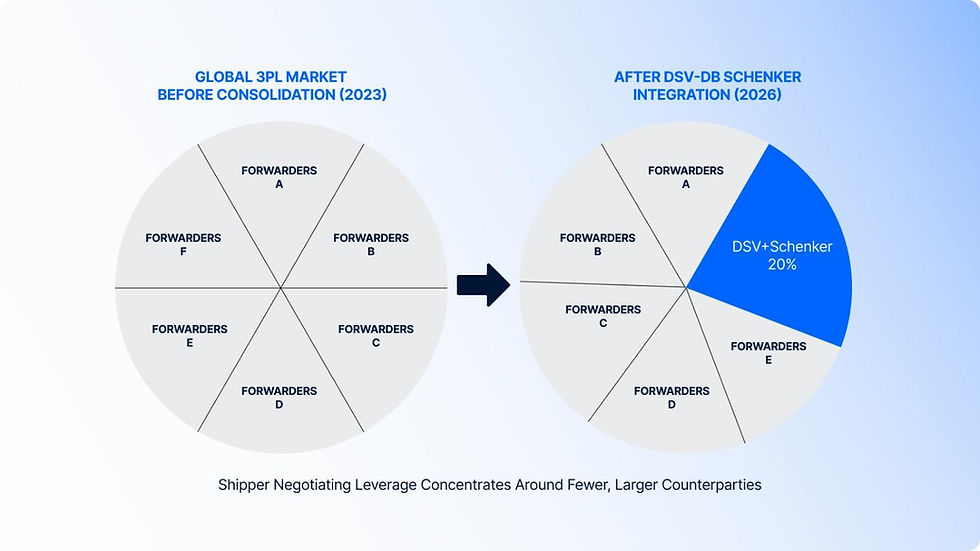
Consolidation Concentrates Risk: While trade consensus often champions scale, the DSV-Schenker merger concentrates counterparty risk. For shippers, a highly consolidated market means fewer alternatives, less negotiating leverage, and outsized supply chain disruptions if a mega-forwarder experiences technology or integration failures.
Geopolitics and Policy Increase Friction: In 2026, the core stages of forwarding are complicated by external pressures. The rollback of de minimis thresholds has drastically increased export/import customs scrutiny, while geopolitical conflicts (like Strait of Hormuz disruptions) have made main carriage routing highly volatile.
Documentation is the Ultimate Bottleneck: Five documents carry the most practical risk. Discrepancies on the commercial invoice and customs declaration (e.g., incorrect HS codes or declared values) are the overwhelming primary causes of real-world customs delays and demurrage costs.
Diligent Vetting is Mandatory: Selecting a forwarder now requires thorough financial stability checks and verifying trade-lane specific accreditations (like BIFA, IATA, or C-TPAT). A forwarder's insolvency mid-transit can leave cargo stranded indefinitely.
On 11 June 2026, DSV told analysts it had integrated 30% of DB Schenker, the German forwarding business it bought for EUR 14.3 billion in an all-cash deal that closed on 30 April 2025. CEO Jens Lund guided full-year 2026 EBIT to between DKK 23 billion and DKK 25.5 billion, USD 3.63 billion to USD 4 billion, including at least DKK 4 billion, USD 630 million, of incremental synergy impact from the merger. Source: The Loadstar, 'DSV says Schenker can deliver, as integration progresses, at a cost,' 11 June 2026.
Lund also said something more interesting than the guidance figures. He told analysts there was 'a clear tendency on ocean freight to produce significantly higher levels of value-added services' at DSV than there had been at Schenker, and that Schenker had instead 'more focus on the freight mark-up.' That is a freight forwarder's CEO explaining, in public, that the company he just bought was running on a more commoditised revenue model than the one buying it.
Freight forwarding is the coordination of international cargo movement on a shipper's behalf, covering carrier booking, documentation, customs clearance, and delivery, without the forwarder owning the ships, aircraft, or trucks that physically move the goods. The forwarder acts as an intermediary between the shipper and a network of carriers and customs authorities. As of 2026, the largest freight forwarder by combined ocean and air volume is DSV, following its 2025 acquisition of DB Schenker.
Two months earlier than the Lund quote, gross profit per unit in DSV's combined air freight business had fallen 3.6% year on year, to DKK 8,242. Ocean freight gross profit per unit fell 10.1%, to DKK 4,274. DSV attributed part of the decline to a procurement lag, Schenker's existing contracts had been negotiated for longer durations than DSV's own, so the merged entity was still working through pricing inherited from before the deal closed.
What a Freight Forwarder Actually Does
A freight forwarder does not own the ship, the aircraft, or the truck. That single fact explains almost everything else about the role.
The forwarder's job is coordination. They book space with carriers on the shipper's behalf, often at rates the shipper alone could not negotiate because the forwarder aggregates volume across many clients. They prepare and check the documentation that customs authorities, banks, and carriers all require, and which varies by trade lane, cargo type, and destination country.
They arrange the inland legs, the trucking from the factory to the port, the trucking from the port to the warehouse, that the ocean or air carrier's contract does not cover. When something goes wrong, a missed connection, a customs hold, a damaged container, the forwarder is the party the shipper calls, even though the forwarder did not cause the problem and frequently cannot fix it alone.
Evan Armstrong, CEO of Armstrong & Associates, described the direction of the role shift directly: forwarders are moving from being freight movers to strategic supply chain orchestration partners, helped along by AI, digital platforms, automation, and real-time visibility tools. Source: Logistics Management, 'Global Logistics: Freight forwarders adapt and grow in a volatile global market,' 1 May 2026.
I have relied on a forwarder's documentation accuracy in a transaction where a single incorrect HS code would have delayed customs clearance by weeks, not days. The forwarder caught it. Nobody on the shipper side would have, because nobody on the shipper side does this every day.
The Six Stages of a Freight Forwarding Shipment

Every international shipment moves through the same six stages, regardless of mode. What changes between 2024 and 2026 is not the stages themselves. It is how much friction sits inside each one.
Stage 1: Booking and Space Allocation
The forwarder books cargo space with a carrier, ocean, air, or rail, against the shipper's required ship date. In a tightening capacity environment, this stage is where forwarders earn their keep, since allocation against a carrier's confirmed bookings is not guaranteed even with a paid reservation. C.H. Robinson's June 2026 market update describes ocean conditions tightening earlier than seasonal norms, driven by earlier booking activity, carrier allocation controls, and blank sailings narrowing flexibility across major trade lanes.
Stage 2: Export Haulage and Documentation
Cargo moves from the shipper's facility to the port or airport of departure, while the forwarder prepares the commercial invoice, packing list, and any export licences the cargo requires.
Stage 3: Export Customs Clearance
The shipment clears customs in the country of origin. Trade policy volatility makes this stage materially harder in 2026 than it was three years earlier. Armstrong specifically cited the rollback of de minimis thresholds as a driver of increased activity in forwarders' compliance departments, since shipments that previously cleared with minimal scrutiny now require full documentation.
Stage 4: Main Carriage
The cargo moves on the primary leg, ocean vessel, aircraft, or rail. This is the stage most exposed to the geopolitical disruption defining 2026. J.M. Rodgers Co.'s June 2026 update states plainly that continued disruptions around the Strait of Hormuz are impacting transit times and vessel availability, compounding demand from retail preparation for the 2026 FIFA World Cup.
Stage 5: Import Customs Clearance
The shipment clears customs at destination. Errors here are the single most common cause of unplanned delay and demurrage cost, because import customs authorities have less tolerance for documentation discrepancy than export authorities typically do.
Stage 6: Final Delivery
The forwarder arranges the inland leg to the consignee's facility, closing the loop that began at Stage 2.
None of these six stages is new. What is new in 2026 is that Stages 3 and 4 now carry materially more variance than they did before the de minimis rollback and the Hormuz disruption, which is precisely why forwarder selection matters more now than it did when ocean freight ran on relatively predictable schedules.
Freight Forwarder vs Carrier vs NVOCC vs Customs Broker

These four roles get confused constantly, including by shippers who have used all four without ever needing to distinguish between them.
Role | Owns Transport Assets? | Who They Contract With | Typical Fee Structure | Issues Bill of Lading? |
Freight Forwarder | No | Shipper (client) and multiple carriers on the shipper's behalf | Service fee plus pass-through carrier costs, often with a margin embedded in the freight rate | Sometimes, via a house bill of lading if also acting as NVOCC |
Ocean Carrier | Yes (vessels) | Forwarders, NVOCCs, and shippers directly | Freight rate per container or per tonne, set by the carrier | Yes, the master bill of lading |
NVOCC | No (but acts as a carrier contractually) | Shippers, issuing its own bills of lading while booking space with actual vessel-operating carriers | Margin between what it charges shippers and what it pays the underlying carrier | Yes, a house bill of lading |
Customs Broker | No | Importer or exporter of record, sometimes via the forwarder | Flat fee or percentage of declared cargo value | No |
3PL (Third-Party Logistics Provider) | Sometimes (warehousing, trucking fleets) | Shipper, often for warehousing and distribution rather than international carriage | Contract rate, frequently volume-based | No, unless also operating as a forwarder or NVOCC |
A forwarder can also be an NVOCC. Many of the largest ones are. DSV and the legacy Schenker both operate this way on major trade lanes, issuing their own house bills of lading while contracting underlying vessel space from ocean carriers like Maersk or MSC.
The Consolidation Story: DSV, Schenker, and What It Means for Pricing
Deutsche Bahn sold DB Schenker for EUR 14.3 billion as part of a broader strategy to cut debt and reinvest in German rail infrastructure. DSV funded the acquisition through a combination of equity and debt, raising approximately DKK 75 billion, EUR 10 billion, split evenly between the two. The combined entity, based on 2024 baseline figures, handles 2.4 million tonnes of air freight, 4.5 million TEU of ocean freight, EUR 13 billion in road freight revenue, and 17.7 million square metres of contract logistics warehousing, across more than 90 countries and close to 160,000 employees. Source: Cargo Forwarder Global, 'DSV finalizes Schenker acquisition,' 30 April 2025; DSV A/S, 'DSV completes the acquisition of Schenker,' investor disclosure, 30 April 2025.
That makes DSV the largest freight forwarder in the world by several measures, surpassing Kuehne + Nagel on combined ocean and air volume.
The capital structure tells you what kind of deal this actually is. A EUR 10 billion equity-and-debt raise against a EUR 14.3 billion enterprise value is not a bolt-on acquisition. It is a bet that DSV's operating model, the one Lund described as producing 'significantly higher levels of value-added services,' can be transplanted onto Schenker's customer base and extract materially more margin per shipment than Schenker was extracting on its own.
Lund was explicit about the mechanism: 'We want to introduce our way of working and phase that in so that we, basically, do more work at origin, produce more services. But also at destination.' That is a plan to charge for services the shipper previously got bundled into a lower freight mark-up, repackaged as separately billable value-added work.
This is not necessarily bad for shippers. A forwarder that does more origin-side cargo consolidation, more destination-side customs pre-clearance, more proactive exception management, genuinely reduces a shipper's operational burden. But it is also, mechanically, a margin expansion strategy for DSV, not a cost-reduction strategy for the shipper. The DKK 4 billion synergy target has to come from somewhere, and 'somewhere' usually means a combination of headcount reduction, system consolidation, and exactly the kind of service-repricing Lund described.
The Counter-Consensus Case: Is Bigger Actually Better for Shippers?
The trade press consensus on forwarder consolidation runs in one direction: bigger means a more resilient global network, more buying power with carriers, more technology investment, and better disruption response. GoFreight's own 2026 outlook frames the DSV-Schenker combination as straightforwardly expanding the 'addressable market' through efficiency.
I take a different view, and the integration's own disclosed numbers support it.
Gross profit per unit fell in both of DSV's largest divisions during the first full year of integration, air down 3.6%, ocean down 10.1%. That is a long way from what scale efficiency is supposed to look like in year one. It looks more like what contract books with different durations get forced together faster than the underlying commercial relationships can adjust. DSV's own explanation, the 'lag effect' from Schenker's longer-dated airfreight contracts, confirms the mechanism: shippers who locked in Schenker rates before the deal closed are still benefiting from pricing the combined entity considers below market, and that benefit erodes as those contracts taper off and get re-procured at DSV's terms.
Consolidation also concentrates risk. A fragmented forwarding market means no single counterparty failure is systemic for any individual shipper's supply chain. A market where the top handful of players control a growing share of global volume means a technology migration failure, a service-quality lapse, or a financial problem at one of those players has outsized, market-wide effect. DSV's own reporting that it retained 'nearly all' Schenker customers through the transition, while framed as a success story, is also an admission that customer retention through a consolidation of this scale was not guaranteed and required deliberate, country-by-country effort. Source: Breakbulk.News, 'DSV Retains Nearly All Schenker Customers as Integration Strategy Pays Off,' 24 October 2025.
Bigger is not automatically worse. But bigger is not automatically better either, and the specific evidence from this specific integration, declining unit margins, an explicit strategy to reprice bundled services, and a customer-retention effort the company itself describes as deliberate rather than assured, argues against treating consolidation as a clean win for shippers by default.
Forwarding Modes Compared
Ocean capacity growth is decelerating sharply even as parcel rates sit near record levels, which tells you the different freight modes are not moving through 2026 in sync with each other. The mechanics of how ocean freight pricing actually forms are covered separately in Shipfinex's guide to how sea shipping works and what it costs;
This section focuses specifically on where each mode sits in the 2026 cycle.
Mode | 2026 Capacity/Rate Trend | Primary Driver | Source | Shipper Implication |
Ocean | Capacity growth slowing to 3.7% in 2026 from 7% in 2025, adding ~1.5 million TEU; 8% growth expected 2027 | New vessel deliveries continuing despite softer demand growth | Guillaume Bournisien, Geodis, via Supply Chain Dive, 29 Jan 2026 | Shippers retain negotiating leverage near-term; a Suez Canal return would release further capacity and pressure rates downward |
Air | Volatile, capacity available but routing less predictable | Middle East hub disruption from the 2026 Iran conflict and Strait of Hormuz situation | Logistics Management/Armstrong, 1 May 2026 | Booking lead times should extend; routing flexibility matters more than lowest quoted rate |
Road (LTL) | Stable but gradually tightening as freight shifts back from truckload | Pricing discipline among carriers; rising network density in select regions | C.H. Robinson Freight Market Update, June 2026 | Early booking and flexible scheduling reduce exposure to tightening capacity |
Parcel | Rates 38.9% above the index's January 2018 baseline in Q1 2026, a 5.4% year-over-year increase | Carrier rate and surcharge increases from FedEx and UPS | TD Cowen/AFS Freight Index via Supply Chain Dive, 29 Jan 2026 | Last-mile cost has become a top-five line item for shippers who never previously tracked it that closely |
How to Evaluate and Select a Freight Forwarder
Forwarder selection in a consolidating market is a different exercise than it was five years ago, because the choice is no longer simply 'which forwarder quotes the lowest rate.' It is 'which forwarder's scale, specialisation, and balance sheet actually match what my shipment needs.'
Check financial stability directly. A forwarder's insolvency mid-shipment is a worse outcome than a forwarder's high rate, and in a market still working through 2023-2024 Red Sea disruption aftereffects, financial stability checks through a public company registry are not optional diligence, they are basic counterparty risk management.
Verify professional accreditation against the specific trade lane and mode involved. BIFA membership signals adherence to UK industry standards. IATA accreditation is the relevant credential for air freight specifically. C-TPAT compliance matters specifically for US-bound cargo, since it affects how quickly shipments clear US Customs and Border Protection screening. This is the same diligence logic that applies to verifying a vessel's classification status, covered in Shipfinex's explainer on what Lloyd's Register does and why ship classification matters: third-party accreditation signals minimum standards, but it does not substitute for direct verification of the specific counterparty's current standing.
Weigh network reach against relationship depth deliberately, rather than defaulting to the largest available name. A DSV-scale forwarder offers genuine network breadth across 90-plus countries. A mid-tier specialist forwarder with deep expertise on one specific trade lane or cargo type can outperform a global generalist precisely because that lane is not a generalist's priority within a much larger network. A substantial share of global freight volume continues to move through forwarders outside the largest handful of players, and that share persists because specialisation continues to win business that scale alone does not capture.
I have seen counterparty financial diligence get skipped because a quoted rate looked attractive, and I have watched what happens next when that diligence gets skipped and the forwarder cannot meet its payment obligations to the underlying carrier mid-transit. The cargo does not move until someone pays. That someone is rarely the forwarder at that point.
Documentation That Actually Matters

Five documents carry almost all of the practical risk in a freight forwarding shipment, and they map directly onto the six stages described earlier.
Commercial invoice: prepared at Stage 2, the single most common source of customs delay when the declared value or HS code does not match the actual cargo.
Packing list: prepared at Stage 2, required for customs verification and for the consignee to confirm the shipment against the order at Stage 6.
Bill of lading: issued at Stage 4, either a master bill from the underlying carrier or a house bill from the forwarder acting as NVOCC; this document is the legal title to the cargo and its accuracy determines who can claim the goods at destination.
Certificate of origin: required at Stage 3 or Stage 5 depending on the destination country's trade agreement status; gets the most scrutiny on trade lanes affected by tariff volatility.
Customs declaration: filed at both Stage 3 and Stage 5; the document where de minimis threshold changes have had the most direct 2026 impact, since shipments that previously qualified for simplified clearance increasingly do not.
In practice, the commercial invoice and the customs declaration cause the overwhelming majority of real delays. The bill of lading matters enormously when something goes wrong, a dispute, a lost shipment, but it rarely causes the delay itself.
Counterparty Risk in a Consolidating Market
A fragmented forwarding market diversifies operational risk across many independent counterparties. A consolidating market does the opposite.
When DSV migrates Schenker's customers onto its own technology and contract systems, country by country, it is performing exactly the kind of high-stakes operational transition that, done imperfectly, disrupts service for the shippers caught inside it. DSV's own framing of its customer retention effort as deliberate, requiring 'a new country-by-country integration approach,' is itself evidence that the default outcome of a transition this size was not assumed to be smooth.
This matters beyond the immediate shipper relationship. As fewer, larger forwarders handle a growing share of global trade volume, the operational continuity of global supply chains becomes more dependent on the internal execution quality of a small number of companies, rather than distributed across a fragmented market where no single failure is systemic. That is a structural observation about concentration risk, not a prediction that DSV's integration will fail. It is the same logic explained in how net asset value in shipping is calculated: asset-specific, dated valuation is more reliable precisely because it does not depend on the aggregated execution quality of a conglomerate's internal integration decisions.
Shipfinex/MAT Section: Forwarding Risk and Asset-Level Transparency
Shipfinex FZCO, operating under VARA In-Principle Approval (IPA/26/01/002), structures Maritime Asset Tokens around a different concentration logic than the one shaping the forwarding industry. An IPA is not a full operational licence and is subject to completion of final regulatory requirements.
Maritime Asset Tokens (MATs) represent economic exposure to vessel-owning Special Purpose Vehicles, a structure explained in detail in Shipfinex's guide to maritime asset tokenisation. Each SPV holds a specific, identifiable asset, valued and reported independently, rather than economic exposure to the aggregated commercial performance of a forwarding conglomerate's internal margin and integration decisions.
Where a shipper evaluating forwarder counterparty risk has to assess the financial stability and integration execution of an entity managing dozens of acquisitions and hundreds of thousands of shipments simultaneously, a prospective MAT holder is evaluating a single, ring-fenced asset with a defined valuation methodology.
This is the structural parallel to the counterparty concentration argument made above. Concentration in the forwarding industry means a shipper's outcome increasingly depends on decisions made far upstream of any individual shipment, integration timelines, synergy targets, repricing strategies. A vessel-owning SPV structure does not eliminate risk, but it isolates it to the specific asset rather than diffusing it across a conglomerate's combined operating performance.
Where distributions are declared by the SPV, they are paid to token holders transparently and on-chain. MAT values may decline materially below purchase price if the underlying vessel's market value or operating performance deteriorates. Secondary market liquidity for MATs is limited; early exit may not be possible in the way exiting a position in a large, liquid forwarding conglomerate's public equity would be.
Frequently Asked Questions
What does a freight forwarder actually do?
A freight forwarder coordinates the movement of cargo on a shipper's behalf without owning the ships, aircraft, or trucks involved. The forwarder books space with carriers, prepares and verifies shipping documentation, arranges customs clearance at origin and destination, and coordinates inland transport at both ends of the journey. The forwarder's value lies in aggregating volume across many clients to negotiate better carrier rates, and in managing the documentation and exception-handling work that a shipper without dedicated logistics expertise would struggle to do accurately and consistently.
Is DSV the largest freight forwarder in the world?
Yes, as of 2026, DSV is the largest freight forwarder in the world by combined ocean and air freight volume, following its acquisition of DB Schenker from Deutsche Bahn. The all-cash deal, valued at EUR 14.3 billion, closed on 30 April 2025. As of June 2026, DSV reported approximately 30% integration of the combined business, with full integration targeted by the end of 2026 and guided 2026 EBIT of DKK 23 billion to DKK 25.5 billion. The combined entity surpasses Kuehne + Nagel on combined ocean and air volumes based on 2024 baseline figures.
How does freight forwarder consolidation affect shipping rates?
Consolidation's effect on rates is not straightforward in either direction. Larger forwarders can negotiate better base carrier rates through aggregated volume, which can benefit shippers. However, DSV's own disclosed integration data shows gross profit per unit falling in both air (down 3.6% year on year) and ocean (down 10.1%) during the first full year after the DB Schenker acquisition, partly attributed to repricing contracts inherited from Schenker that were negotiated on a different, lower-margin freight-mark-up model. The near-term effect of major consolidation has been pricing volatility and active repricing toward higher-margin value-added services, rather than an immediate, uniform rate reduction for shippers.
What is the difference between a freight forwarder and a carrier?
A carrier physically transports the cargo and owns or operates the vessel, aircraft, or vehicle involved. A freight forwarder does not own transport assets and instead coordinates the shipment on the shipper's behalf, booking space with one or more carriers, managing documentation, and arranging the legs of the journey the carrier's own contract does not cover, such as inland trucking. A carrier issues a master bill of lading or equivalent transport document; a forwarder issues a house bill of lading only when also acting as an NVOCC, a related but distinct role.
What is an NVOCC?
An NVOCC, Non-Vessel Operating Common Carrier, is an entity that issues its own bills of lading and acts contractually as a carrier toward the shipper, while not owning or operating any vessels itself. The NVOCC books underlying space with an actual ocean carrier and earns its margin on the difference between what it charges the shipper and what it pays the carrier. Many large freight forwarders, including DSV and the legacy Schenker, operate as NVOCCs on major trade lanes, which means the bill of lading a shipper receives may be a house bill from the forwarder rather than a master bill from the underlying ocean carrier.
How long does freight forwarding take from booking to delivery?
Transit time varies enormously by mode, trade lane, and current disruption conditions, but the six-stage process itself, booking, export haulage, export customs, main carriage, import customs, and final delivery, typically spans two to eight weeks for ocean freight on major trade lanes under normal conditions, and three to ten days for air freight. In 2026, Strait of Hormuz-related disruptions and continued Red Sea rerouting via the Cape of Good Hope are extending ocean transit times on affected lanes beyond historical norms, while compliance-driven delays at export and import customs clearance, linked to de minimis threshold rollbacks, have added unplanned time at Stages 3 and 5 specifically.
What documents does a freight forwarder need?
The core document set includes the commercial invoice, packing list, bill of lading, certificate of origin, and customs declaration. The commercial invoice and customs declaration cause the large majority of real-world shipment delays when their details, declared value, HS code, country of origin, do not precisely match the physical cargo. The bill of lading functions as legal title to the cargo and matters most when a dispute or claim arises rather than as a routine source of delay. Certificate of origin requirements have grown more consequential on trade lanes affected by tariff volatility, since incorrect origin documentation can trigger materially different duty treatment.
How do I check if a freight forwarder is financially stable?
Direct verification through a public company registry, such as Companies House in the UK or the equivalent corporate registry in the forwarder's jurisdiction of incorporation, provides visibility into filed accounts, credit history, and any insolvency proceedings. Professional accreditation, BIFA membership in the UK, IATA accreditation for air freight specifically, and C-TPAT compliance for US-bound cargo, signals adherence to industry standards but does not substitute for direct financial diligence. In a consolidating market with rising counterparty concentration risk, financial stability checks matter more, not less, since a forwarder's failure mid-shipment can leave cargo stranded until payment obligations to the underlying carrier are resolved by another party.
Glossary
Freight Forwarder: an intermediary coordinating international cargo movement on a shipper's behalf, without owning the transport assets used.
NVOCC (Non-Vessel Operating Common Carrier): an entity issuing its own bills of lading and acting as a carrier toward the shipper while booking underlying space with an actual vessel-operating carrier.
Bill of Lading: the legal transport document and title to cargo, issued either by the carrier (master bill) or by an NVOCC/forwarder (house bill).
Customs Broker: a licensed specialist managing customs clearance and duty calculation, distinct from a freight forwarder though often engaged through one.
Incoterms: standardised international trade terms defining which party bears cost and risk at each stage of a shipment's journey.
FCL (Full Container Load): an ocean shipment occupying an entire container, booked and billed as a single unit.
LCL (Less than Container Load): an ocean shipment sharing container space with other shippers' cargo, consolidated by the forwarder.
De Minimis Threshold: the value below which imported goods are exempt from duties and simplified customs procedures; recent rollbacks have increased compliance complexity for low-value shipments.
Value-Added Services: forwarder services beyond basic freight movement, such as cargo consolidation, customs pre-clearance, and supply chain visibility tools, increasingly billed separately rather than bundled into the freight rate.
3PL (Third-Party Logistics Provider): a logistics company managing warehousing, distribution, or fulfilment, sometimes alongside forwarding services but distinct from international freight coordination specifically.
DISCLAIMER: Vivek Seth is Chairman of Shipfinex, a maritime asset tokenisation platform operating under VARA In-Principle Approval (IPA/26/01/002) in Dubai. This article is for informational and educational purposes only and does not constitute investment advice or a financial promotion. Maritime Asset Tokens are VARA-regulated virtual assets backed by physical maritime assets held through ring-fenced SPVs. MAT values may decline materially below purchase price. In extreme scenarios (e.g. vessel total loss), residual scrap and salvage value provides a floor, but material capital impairment is possible. Distributions are not guaranteed. Secondary market liquidity is limited; early exit may not be possible.


Vivek Seth
Chairman, Shipfinex Board
Vivek Seth is Chairman of Shipfinex. As former Senior Vice President of Marine Services at ADNOC Logistics and Services, one of the world's largest maritime operators, he has direct experience across tanker operations, LNG carrier markets, and marine asset management. His career spans fleet management, LNG project logistics, and maritime strategy across the Middle East and Asia.


