OPEX vs CAPEX on Ships: What Costs Exist and Why They Spike

Updated: Nov 17

Key Takeaways
OPEX represents recurring expenditure required to keep a vessel crewed, maintained, insured and operational. Actual costs vary by vessel type, age, technical condition, management arrangements and operating profile.
Crew wages and associated expenses are important components of vessel OPEX. Their percentage share is not universal and should be supported by a vessel-specific or clearly defined industry dataset.
CAPEX occurs at irregular intervals and can equal or exceed annual OPEX during major drydocking, special surveys, equipment replacement or regulatory retrofit periods.
Bunker fuel is generally a voyage cost, not vessel OPEX. The party responsible for paying for it depends on the charterparty.
Cost increases can arise from crew-market conditions, insurance renewals, repairs, spare parts, drydocking scope and regulatory requirements. Bunker-price volatility should be analysed separately as a voyage-cost driver.
Charter type determines how operating expenses, voyage expenses and capital responsibilities are allocated between owners and charterers.
Older ships may require more maintenance and capital work, but vessel age alone does not establish a fixed increase in expenditure.
Table of Contents
Introduction to OPEX and CAPEX on Ships
Ship ownership requires substantial capital to acquire the asset, but the purchase price represents only the beginning of the financial commitment. Operating a ship involves recurring expenditure as well as major periodic investments. Both categories affect vessel economics, cash flow, operating availability and the financial performance of a ship-owning entity.
Operating Expenditures (OPEX) cover the recurring costs of keeping a ship crewed, maintained, insured and ready for operation. Capital Expenditures (CAPEX) fund major investments such as drydocking, equipment replacement, life-extension work and regulatory upgrades.
The distinction is important when assessing vessel operating performance. A ship may have relatively stable monthly OPEX but face a substantial capital requirement during a special survey or drydocking period. Conversely, a vessel may experience rising operating costs because of higher manning, insurance, repair or maintenance expenses without requiring a major capital project.
A further distinction is necessary: voyage costs should not automatically be included in vessel OPEX. Bunker fuel, port charges, canal dues and other voyage-specific expenses are generally treated separately. The party responsible for paying them depends on the charterparty.
Understanding these categories helps shipowners, operators, lenders and other maritime finance participants evaluate the cost base supporting a vessel's commercial operations.
What are Operating Expenditures (OPEX)?

OPEX represents the recurring costs required to operate a ship commercially. These expenses are generally incurred throughout the year, including periods when the ship is not generating revenue, although the actual cost profile depends on the vessel's operating status and contractual arrangements.
Typical vessel OPEX categories include crew wages and associated expenses, repairs and maintenance, spares, lubricants, stores, insurance, registration, administration and technical management fees.
Important distinction: Bunker fuel is generally a voyage cost, not routine vessel OPEX. Under a time charter, the charterer generally pays for bunkers; under a voyage charter, the owner generally bears bunker and other voyage costs. Under a bareboat charter, the charterer generally assumes both operating and voyage costs. Specific charterparty clauses may vary these allocations.
Crewing Costs
Crew costs are a significant part of vessel OPEX. Qualified seafarers operate machinery, navigate, manage cargo operations and maintain the ship around the clock.
Crew numbers and composition depend on vessel type, flag requirements, operating profile, automation, trading pattern and safe-manning documentation.
Crewing costs include:
Wages for officers and ratings
Overtime, bonuses, leave pay and allowances
Crew travel and repatriation
Training and certification
Insurance, social contributions and benefits
Manning agency fees
Provisions and welfare expenses
Nationality, rank composition, experience, employment terms, travel requirements and applicable labour standards all influence the manning budget.
Crew wages should not be stated as a universal 35–40% share of OPEX without specifying the vessel category, reporting period, dataset and calculation method.
For historical context, the Moore Maritime Index 2024 reported FY2023 average daily crew wages of approximately US$2,344 for Handysize bulk carriers and US$4,641 for VLCCs. Provisions and other crew expenses were reported separately. These are vessel-category averages, not current wage quotations or universal cost ratios.
For a more recent reference, Drewry's Manning Annual Review and Forecast 2026/27, published in June 2026, covers seafarer wages, employment terms and crew-cost benchmarks across vessel types.
Maintenance & Spares
Ships require regular maintenance to reduce equipment failures, operational disruption and costly downtime. Expenditure includes planned servicing and repairs arising from machinery wear, corrosion, defects and unexpected failures.
Key categories include:
Engine servicing and machinery upkeep
Deck equipment and navigation-system testing
Hull preservation and corrosion prevention
Electrical, propulsion and auxiliary machinery repairs
Main and auxiliary engine spare parts
Fire-fighting and life-saving equipment maintenance
Communication, HVAC, valve and pipe-system maintenance
Costs depend on vessel age, equipment condition, operating hours, maintenance strategy, trading environment and spare-parts availability.
Older ships may need more frequent repairs and replacement components, but age alone does not establish a fixed maintenance-cost premium. A well-maintained older vessel may have a different cost profile from a younger vessel with deferred maintenance or intensive utilization.
The Moore Maritime Index reports repairs and maintenance separately from spares. Its FY2023 Handysize averages were approximately US$341 per day for repairs and maintenance and US$355 per day for spares. These are historical benchmarks, not individual vessel budgets.
Insurance Requirements
Marine insurance protects against defined physical damage and liability risks, subject to policy wording, exclusions, deductibles and coverage limits.
Common categories include:
Hull & Machinery (H&M): Covers insured physical damage to the vessel and machinery.
Protection & Indemnity (P&I): Covers specified third-party liabilities, subject to club rules or policy terms.
War risk cover: May be required depending on trading area and exposure.
Other marine insurance: Additional cover may be needed based on vessel characteristics, ownership arrangements and contractual requirements.
Premiums depend on vessel value, age, type, flag, classification status, claims history, trading routes, insured limits, deductibles and market conditions.
A fixed claim that insurance represents 15–20% of OPEX should not be applied across the fleet without a dated, vessel-specific source.
The Moore Maritime Index reported FY2023 average daily insurance costs of approximately US$505 for Handysize bulk carriers and US$789 for VLCCs. These are historical category benchmarks, not current premium quotations.
Renewal terms can increase the cost base even when a vessel's operating pattern remains unchanged. Actual premium movements should be established from insurance quotations and renewal terms, not assumed from general market percentages.
Management Fees & Administration
Shipowners may use in-house teams or third-party managers for technical, crew, insurance and administrative services.
These costs can include:
Technical and crew management fees
Insurance-arrangement costs
Flag-state and vessel registration fees
Classification and statutory administration
Communications and general administration
Legal and professional services
Other non-voyage administrative expenses
Fees depend on the services provided, vessel type and size, technical requirements, management agreement and service-provider arrangements.
Avoid using a universal daily management-fee range without identifying the service scope, vessel category, location and reporting period.
The Moore Maritime Index includes management fees and administration in its administrative cost category. Its methodology covers in-house and outsourced management services, subject to the index's stated definitions and exclusions.
Stores & Consumables
Ships consume lubricating oils, hydraulic fluids, cleaning supplies, paints, provisions and other operational materials.
Common items include:
Lubricating oils and greases
Hydraulic fluids
Engine and deck stores
Cleaning and cabin supplies
Paints and chemicals
Fresh water and provisions
Medical and safety supplies
Other consumables and equipment
Lubricants are generally included in vessel operating-cost benchmarks. Propulsion bunker fuel is generally treated separately as a voyage cost.
Consumption depends on vessel type, machinery, operating hours, maintenance condition and management practices. Annual lubricant expenditure should be based on actual consumption and procurement records rather than a generic estimate.
Typical Daily OPEX by Vessel Type
The following figures are from the Moore Maritime Index 2024 and relate to financial year 2023. They provide historical benchmarks for two vessel categories.
Vessel category | DWT range | Average daily OPEX |
Handysize bulk carrier | 10,000–39,999 | US$5,853 |
VLCC | 180,000–319,999 | US$10,523 |
These are historical benchmarks, not container-ship rates. They should not be used to validate estimates for feeder, Panamax, Post-Panamax or ultra-large container ships.
The Moore Index calculates total OPEX and individual cost-category averages independently. Consequently, the category averages may not add up to the reported total; observation counts can also differ between categories.
Latest available trend update as at 31 October 2026: Moore published its 2025 results on 29 October 2026, drawing on audited financial statements from more than 1,500 vessels. Its dry-bulk data showed higher total operating expenses, with stores costs increasing by approximately 4–19% and administration by 4–14% across reported categories. Insurance costs declined by approximately 6–16%. For Aframax, Suezmax and VLCC tankers, total OPEX increased by approximately 5–8%. Suezmax repairs and maintenance increased by approximately 29%.
These are year-on-year findings for the specified vessel categories. They should not be generalised to every ship type or treated as forecasts.
For broader vessel coverage, Drewry's Ship Operating Costs Annual Review and Forecast 2025/26, published in November 2025, examines 47 vessel types and sizes across container, dry bulk, oil, chemical, LNG, LPG, general cargo, reefer, Ro-Ro and car-carrier sectors. Its cost categories include manning, insurance, stores and spares, lubricants, repairs and maintenance, drydocking, and management and administration.
Worked Example: Daily OPEX for a Handysize and a VLCC
Vessel size and operating requirements influence the daily cost of maintaining a commercial ship. The Moore Maritime Index 2024 provides a historical comparison between Handysize bulk carriers and Very Large Crude Carriers.
Metric | Handysize | VLCC |
DWT range | 10,000–39,999 | 180,000–319,999 |
Reported average daily OPEX | US$5,853 | US$10,523 |
Illustrative 30-day OPEX | US$175,590 | US$315,690 |
Illustrative 365-day OPEX | US$2,136,345 | US$3,840,895 |
Monthly and annual amounts are calculated by multiplying the reported daily averages by 30 and 365 days respectively.
Handysize: US$5,853 × 30 = US$175,590.
Handysize: US$5,853 × 365 = US$2,136,345.
VLCC: US$10,523 × 30 = US$315,690.
VLCC: US$10,523 × 365 = US$3,840,895.
These calculations illustrate historical run rates; they are not forecasts or audited budgets for individual ships.
The reported VLCC daily OPEX is higher than the Handysize benchmark, but this does not directly measure operating efficiency. Vessel type, age, crew complement, machinery, technical condition, insurance profile and management arrangements all affect expenditure.
The figures exclude voyage costs such as bunker fuel, port charges and canal dues. They should not be treated as a complete estimate of the cash required for a particular voyage.
What are Capital Expenditures (CAPEX)?
CAPEX represents large, infrequent investments that maintain ship condition, extend operational life, replace significant equipment or ensure regulatory compliance.
Unlike recurring OPEX, CAPEX occurs at irregular intervals and may involve substantial individual expenses. The amount depends on vessel age, condition, survey schedule, equipment lifecycle, trading requirements, classification recommendations and regulatory obligations.
Drydocking & Special Surveys
Classification societies require ships to undergo detailed inspections at specified intervals under applicable classification and statutory requirements.
The scope and timing of work depend on the vessel's survey cycle, class requirements, technical condition and findings during inspection.
Drydocking work may include:
Hull inspection, cleaning and painting
Propeller inspection and polishing
Sea chest and underwater fitting inspection
Tank examinations and structural repairs
Machinery and equipment inspection
Steel renewal and corrosion-related work
Testing and certification of relevant systems
Special survey work is generally associated with the five-year classification cycle, with intermediate surveys occurring between special surveys. Actual timing and scope depend on the applicable classification and statutory requirements.
Drydocking costs vary substantially by vessel type, size, age, shipyard location, steelwork, machinery requirements and scope of work. A single US$2 million–US$5 million estimate should not be applied to every container ship without a dated source and defined vessel specification.
Final costs may exceed the initial budget when inspections reveal additional corrosion, steel renewal, machinery defects or other work not identified during initial planning.
A drydocking budget should distinguish planned work, mandatory class work, additional repairs discovered during inspection, owner-requested upgrades, yard-related delays and off-hire exposure.
Equipment Upgrades
Ships require periodic equipment replacement as technology advances and existing systems reach the end of their service life.
Examples include:
Navigation equipment and communication systems
Main and auxiliary engine components
Electrical and automation systems
Pumps, valves and machinery
Safety and fire-fighting equipment
Energy-efficiency equipment
The distinction between routine maintenance and CAPEX depends on the nature, scale and accounting treatment of the work. Routine servicing is generally an operating cost, while a major replacement or improvement may be capitalized under the applicable accounting policy.
There is no universal equipment-upgrade budget for all ships. A vessel-specific estimate should identify the equipment, scope, expected service life, installation requirements, downtime and accounting treatment.
Regulatory Compliance Retrofits
International maritime regulations evolve continuously and can create additional technical, operational or capital requirements for existing ships.
Relevant examples include:
Ballast Water Management Convention requirements, where applicable
MARPOL Annex VI requirements
Energy Efficiency Existing Ship Index (EEXI)
Carbon Intensity Indicator (CII)
Other applicable safety, environmental and flag-state requirements
The IMO states that EEXI and CII requirements entered into force on 1 January 2023. EEXI addresses technical energy efficiency, while CII measures operational carbon intensity.
Compliance does not automatically mean every vessel requires a scrubber, ballast-water system replacement or a particular retrofit. Some ships may use operational measures, while others may need equipment changes or a different compliance strategy.
The actual capital requirement depends on vessel characteristics, existing equipment, trading profile, applicable rules and the compliance option selected.
Regulatory CAPEX should therefore be assessed through a vessel-specific technical review, applicable regulation, selected compliance plan, installation cost, downtime and associated operating-cost impact.
Life Extension Investments
Ships approaching the later stages of their expected service life may require substantial investment to continue operating safely and commercially.
A life-extension decision should consider technical condition, remaining useful life, survey requirements, expected earnings, financing obligations and future regulatory requirements.
Potential work can include:
Main-engine or auxiliary-engine overhauls
Generator and machinery replacement
Structural steel renewal
Hull and coating work
Navigation and communication upgrades
Safety and environmental equipment improvements
A life-extension project may involve substantial capital expenditure, but no single cost range can be applied to all vessel types. The scope should be supported by condition surveys, class recommendations, shipyard quotations and an assessment of the expected remaining operating period.
Why Ship Operating Costs Spike
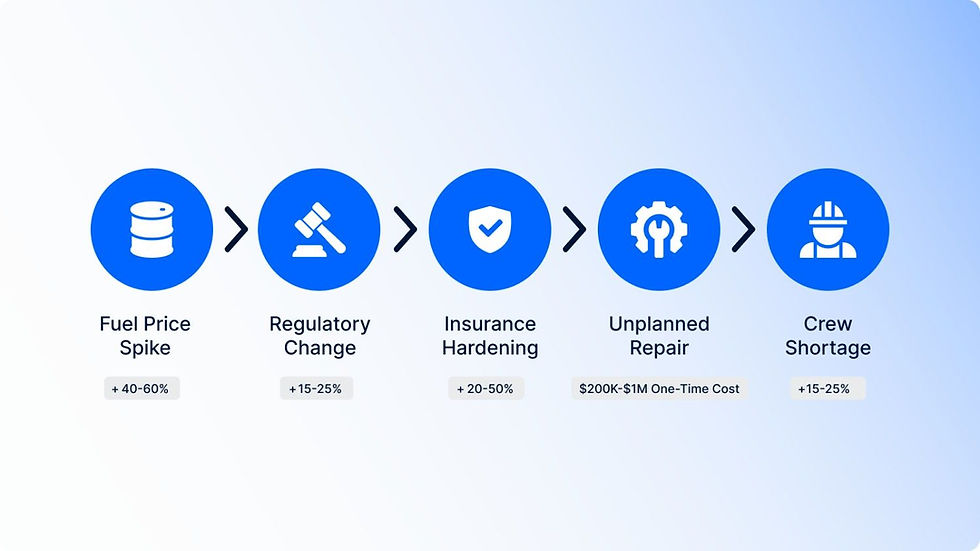
Shipowners face several factors that can cause sudden cost increases, disrupt budgets and reduce operating margins. These factors should be separated because they affect different cost categories and may be borne by different parties under the charterparty.
Bunker Price Volatility
Marine fuel oil prices fluctuate based on crude oil markets, refining capacity, fuel specifications, regional supply and demand, and geopolitical conditions.
Bunker fuel is generally a voyage cost rather than vessel OPEX. Its financial impact depends on the vessel's employment:
Under a time charter, the charterer generally pays for bunkers.
Under a voyage charter, the owner generally bears bunker costs as part of voyage expenses.
Under a bareboat charter, the charterer generally pays for bunkers alongside operating costs.
A change in bunker prices can materially affect voyage economics. The impact depends on daily consumption, voyage duration, fuel grade, route, speed and procurement location.
For example, consider a vessel consuming 50 tonnes of fuel per day over a 20-day voyage. Total consumption would be 1,000 tonnes. A US$50-per-tonne change in bunker price would change the fuel bill by US$50,000, assuming consumption and procurement quantity remain constant.
This is an illustrative calculation, not a historical price movement or forecast. It demonstrates why bunker-price volatility should be analysed separately from vessel OPEX.
Regulatory Changes Requiring Retrofits
New environmental regulations create technical, operational and sometimes capital requirements for existing ships.
The IMO 2020 sulphur limit required ships to comply with the applicable fuel-sulphur limits. Owners could use compliant low-sulphur fuel, approved exhaust-gas cleaning systems or other permitted compliance approaches.
EEXI and CII requirements introduced from 1 January 2023 also affect vessel efficiency and carbon-intensity management. Their financial effects depend on the ship's characteristics, technical configuration, operating profile and compliance approach.
Some measures require capital investment, while others involve operational changes, monitoring or additional management. A regulatory cost estimate should identify the specific rule and vessel-specific compliance plan rather than assume a fixed retrofit cost.
Insurance Market Hardening
Marine insurance markets experience periods of changing premium levels and underwriting conditions. Premiums can rise when insurers reassess claims experience, vessel exposure, trading areas, asset values, reinsurance costs and market capacity.
The actual premium depends on vessel value, age, claims record, coverage, deductible, insured limits and renewal terms.
A general 20–50% premium increase should not be presented as a standard market outcome without a dated source and defined vessel or insurance category.
For owners, higher insurance premiums increase recurring vessel OPEX. Under typical time and voyage charters, the owner generally remains responsible for vessel insurance. Under a bareboat charter, insurance responsibility is generally transferred to the charterer, subject to the contract.
Technical Failures
Unplanned equipment failures create emergency repair costs and lost revenue during downtime.
Examples include:
Main-engine failure
Auxiliary machinery breakdown
Propulsion or steering-system defects
Generator failure
Pump or cargo-handling equipment malfunction
Electrical or automation-system failure
The financial impact may include repair invoices, spare parts, specialist attendance, towage, survey costs, off-hire and lost earning opportunities.
These are distinct financial effects. A repair invoice should not be combined with hypothetical lost charter revenue and presented as a single industry-standard failure cost.
A vessel-level assessment should record the failure, repair scope, downtime, contractual off-hire provisions and actual lost earnings.
Crew Wage Inflation
Global seafarer supply and demand, officer availability, experience requirements, employment conditions and crew changes can influence manning expenditure.
Crew-cost changes may arise from:
Wage adjustments
Officer and rating availability
Training and certification requirements
Travel and crew-change expenses
Employment terms and leave arrangements
Manning agency fees and associated expenses
Drewry's Manning Annual Review and Forecast 2026/27, published in June 2026, examines seafarer wage rates, availability and crew costs across multiple vessel types and sizes.
The relevant measure for an owner is the total cost of manning the specific vessel, including wages, provisions, travel, crew agency fees, leave and associated employment expenses. A general 15–25% wage increase should not be applied to all vessels without a specific market, rank and reporting period.
Drydocking Scope Creep
Drydocking budgets may prove inadequate when inspections reveal additional work requirements. Corrosion discovered during tank inspections, steel renewal, equipment failures or machinery defects can increase the original scope.
A drydocking budget should distinguish:
Planned work identified before the vessel enters the yard
Class- or statutory-required work
Additional repairs discovered during inspection
Owner-requested upgrades
Yard-related delays and additional services
Off-hire and lost earning time
A budget overrun should be measured against the original approved scope and supported by final yard accounts, survey records and change orders. A universal 20–40% overrun assumption should not be used without a defined dataset.
OPEX vs CAPEX in Charter Contracts

Charter contract structure determines which party bears different cost categories. The allocation of operating expenses, voyage expenses and capital responsibilities differs between bareboat, time and voyage charters.
Cost Allocation by Charter Type
Cost or responsibility | Bareboat charter | Time charter | Voyage charter |
Crew and manning | Charterer | Owner | Owner |
Technical management | Charterer | Owner | Owner |
Routine repairs and maintenance | Charterer | Owner | Owner |
Hull & Machinery insurance | Generally charterer, subject to terms | Generally owner | Generally owner |
P&I insurance | Generally charterer, subject to terms | Generally owner | Generally owner |
Bunker fuel | Charterer | Charterer | Owner |
Port charges | Charterer | Charterer | Generally owner |
Canal dues and voyage expenses | Charterer | Charterer | Generally owner |
Major capital expenditure | Depends on charterparty; major owner obligations may remain with registered owner | Generally owner | Generally owner |
Commercial employment | Charterer controls operation within contract | Charterer directs commercial employment within agreed limits | Owner undertakes agreed voyage |
Payment to owner | Bareboat hire | Time-charter hire | Voyage freight |
Important: This table describes the usual commercial allocation, not an unconditional rule. The charterparty may contain negotiated exceptions, cost-sharing provisions, maintenance obligations, insurance clauses, off-hire provisions and other terms that change the allocation.
Time Charter
Under a time charter, the owner generally retains responsibility for the vessel's technical operation, crew, maintenance and insurance. The charterer pays hire for the vessel's use and generally bears voyage expenses, including bunkers, port charges, pilotage, towage and canal dues, subject to the contract.
Owner generally pays:
Crew wages and associated expenses
Vessel maintenance and repairs
Hull & Machinery and P&I insurance
Stores, lubricants and technical management
Charterer generally pays:
Port charges and agency expenses
Canal dues and pilotage
Other voyage-related costs allocated under the contract
Owner generally retains: Responsibility for major vessel capital expenditure, subject to the charterparty.
If the vessel becomes unavailable for reasons covered by an off-hire clause, hire may be suspended for the relevant period. The precise result depends on the contract.
Bareboat Charter
Under a bareboat charter, the charterer obtains possession and operational control of the vessel for the charter period. The charterer generally assumes responsibility for crewing, technical management, maintenance, repairs, insurance, fuel and other operating and voyage expenses.
Charterer generally pays:
Crew and manning expenses
Technical management
Repairs and maintenance
Hull & Machinery and P&I insurance
Stores and lubricants
Bunker fuel and voyage expenses
Owner generally receives: Contractual bareboat hire.
Capital responsibilities: The charterparty determines the parties' obligations for major capital work, surveys, structural repairs and other expenditure. These obligations should not be assumed from the hire payment alone.
BIMCO's BARECON 2017 form describes the bareboat charter as a lease agreement in which the charterer obtains possession and full control of the ship along with the legal and financial responsibility specified by the contract.
Spot/Voyage Charter
Under a voyage charter, the owner agrees to carry cargo between specified ports for an agreed freight rate. The owner generally operates the vessel and pays its vessel operating and voyage expenses, including crew, maintenance, insurance, bunkers and relevant port and canal costs, subject to the charterparty.
Owner generally pays:
Crew and manning expenses
Vessel maintenance and insurance
Bunker fuel
Port and canal costs generally allocated to the owner
Other voyage expenses under the contract
Charterer generally pays: Agreed freight and any additional amounts expressly allocated under the charterparty.
Owner remains exposed to: Changes in vessel OPEX and voyage costs, including bunker-price movements, subject to contractual terms.
The charterparty also governs laytime, demurrage, despatch, cargo handling and other voyage-specific responsibilities. These provisions can materially affect the financial result of a voyage.
Conclusion
Ship operating costs divide into recurring operational expenditures and major capital investments, each following different patterns and requiring distinct financial planning approaches. OPEX provides relatively predictable monthly costs, though inflation and market conditions create variability. CAPEX concentrates in irregular intervals when drydocking or regulatory compliance demands substantial investment.
Successful ship operations require adequate reserves for both categories. Ships generating strong charter revenue during favorable periods must set aside funds for future drydocking, regulatory retrofits, and operational cost increases.
Frequently Asked Questions
What is OPEX in shipping?
OPEX (Operating Expenditure) refers to the recurring costs of running a ship, including crew wages and associated expenses, maintenance, insurance, management fees, stores, lubricants and spares. Actual daily expenditure varies by vessel type, age, technical condition and management arrangements. Bunker fuel is generally treated separately as a voyage cost.
What is CAPEX for ships?
CAPEX (Capital Expenditure) refers to major investments in a vessel, including drydocking, special-survey work, equipment replacement, structural repairs, life-extension projects and regulatory upgrades. The timing and cost depend on the vessel's condition, age, classification requirements, equipment and applicable regulations.
Why do ship operating costs spike?
Ship OPEX can increase because of higher crew costs, insurance renewals, repairs, spare parts, maintenance requirements and management expenses. Capital expenditure may rise when drydocking or survey inspections reveal additional work or when a vessel needs major equipment upgrades. Bunker-price volatility can increase voyage costs, but bunkers should not automatically be included in vessel OPEX.
How much does it cost to operate a container ship per day?
Daily OPEX varies by vessel type, size, age, technical condition, management arrangements and reporting period. The Moore Maritime Index 2024 reported financial-year 2023 average daily OPEX of approximately US$5,853 for Handysize bulk carriers and US$10,523 for VLCCs. These are historical category benchmarks, not current quotations or estimates for every ship.
Is bunker fuel included in ship OPEX?
Bunker fuel is generally classified as a voyage cost rather than vessel OPEX. Under a time charter, the charterer generally pays for bunkers. Under a voyage charter, the owner generally pays for bunkers as part of voyage expenses. Under a bareboat charter, the charterer generally assumes bunker costs alongside operating expenses. The actual allocation depends on the charterparty.
Who pays OPEX under a time charter?
Under a typical time charter, the shipowner pays vessel operating expenses such as crew, maintenance, repairs, insurance, stores, lubricants and technical management. The charterer generally pays voyage costs, including bunkers, port charges and canal dues. Specific charterparty terms may vary.
Who pays OPEX under a bareboat charter?
Under a typical bareboat charter, the charterer takes possession and operational control of the vessel and generally pays crew, technical management, maintenance, repairs, insurance, bunkers and other operating and voyage expenses. The detailed responsibilities for major capital work and surveys depend on the charterparty.
What is the difference between OPEX and CAPEX in shipping?
OPEX consists of recurring expenses required to keep the vessel operational, such as crew, maintenance, insurance and management. CAPEX consists of major investments such as drydocking, equipment replacement, structural work, life-extension projects and regulatory upgrades. OPEX is generally budgeted as a recurring cost, while CAPEX is often irregular and project-based.
Do older ships have higher operating costs?
Older ships may require more frequent repairs, replacement parts, maintenance and capital work. However, age alone does not determine the cost. Technical condition, maintenance history, machinery, trading pattern, utilisation and management practices all affect the vessel's cost profile.
References
Moore Maritime Index 2025 Results (published 29 October 2026): https://www.moore-greece.gr/el/moore-maritime-index-mmi-2025-results-shipping-operating-costs-and-tce-rates/
Moore Maritime Index 2025 brochure: https://greeceweb.moore-global.com/MediaLibsAndFiles/media/greeceweb.moorestephens.com2020/Documents/MMI-Brochure-2025-Final.pdf
Moore Maritime Index 2024 Results: https://www.moore-greece.gr/el/moore-maritime-index-mmi-2024/
Moore Maritime Index methodology and cost categories: https://moore-index.com/static/project
Moore Maritime Index FAQs and calculation methodology: https://moore-index.com/static/faqs
Moore Maritime Index 2024 brochure (FY2023 benchmarks): https://greeceweb.moore-global.com/MediaLibsAndFiles/media/greeceweb.moorestephens.com2020/Documents/MMI-Brochure-2024-Final_4.pdf
Drewry — Ship Operating Costs Annual Review and Forecast 2025/26: https://www.drewry.co.uk/maritime-research-products/ship-operating-costs-annual-review-and-forecast-202526
Drewry — Manning Annual Review and Forecast 2026/27: https://www.drewry.co.uk/maritime-research-products/manning-annual-review-and-forecast-202627
Baltic Exchange — Chartering Guide: https://www.balticexchange.com/en/who-we-are/guide-to-modern-shipping/chartering-.html
BIMCO — BARECON 2017: https://www.bimco.org/contractual-affairs/bimco-contracts/contracts/barecon-2017
IMO — EEXI and CII Frequently Asked Questions: https://www.imo.org/en/mediacentre/hottopics/pages/eexi-cii-faq.aspx
IMO — Improving the Energy Efficiency of Ships: https://www.imo.org/en/ourwork/environment/pages/improving%20the%20energy%20efficiency%20of%20ships.aspx
IMO — Ballast Water Management Convention: https://www.imo.org/en/mediacentre/hottopics/pages/implementing-the-bwm-convention.aspx
IMO — 2020 Global Sulphur Limit: https://www.imo.org/en/mediacentre/pressbriefings/pages/02-imo-2020.aspx
Regulatory disclosure: Shipfinex FZCO holds VARA In-Principle Approval (IPA/26/01/002) for Virtual Asset Broker-Dealer Activity. This is an In-Principle Approval, not a full operational licence. Shipfinex is not authorised to commence operations or conduct virtual asset activities until it obtains final authorisation from the Virtual Assets Regulatory Authority (VARA). This article is for informational purposes only and does not constitute legal advice, regulatory guidance, or an offer or invitation to deal in virtual assets or securities. All investments carry significant risk, including the potential for total loss. This is a high-risk asset. See the full Risk Disclosure Statement.

Suraz Troy Kottakki
Founder & COO
Suraz Troy Kottakki is the Founder and Chief Operating Officer of Shipfinex. His work focuses on maritime finance, digital asset infrastructure and structures through which Maritime Asset Tokens may represent specified economic exposure linked to vessel-owning Special Purpose Vehicles (SPVs). The rights and obligations associated with any MAT are determined by the relevant legal and offering documents.
LinkedIn: https://www.linkedin.com/in/szka


