Passenger Ships Types: Everything You Need to Know

Updated: Aug 19
Table of Contents

Key Takeaways
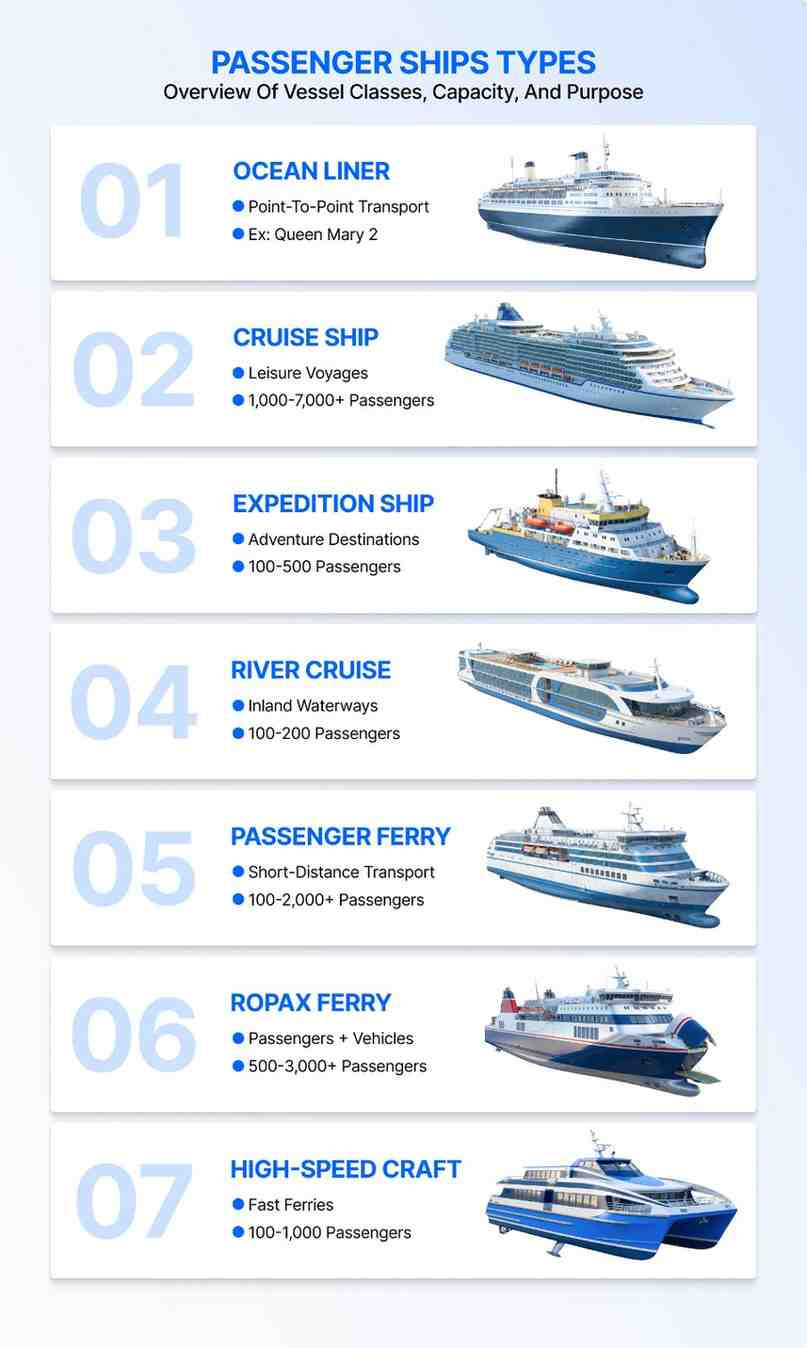
Passenger ships fall into seven main types: ocean liners, cruise ships, expedition ships, river cruise ships, passenger ferries, RoPax ships, and high-speed craft.
Ships are classified in two ways, by what they do (their route and function) and by the safety rules they must follow (their regulatory class).
Ocean liners and cruise ships look similar but serve completely different purposes. One is built to get you somewhere fast. The other is built to keep you entertained along the way.
Cruise ships have grown more than 600% in size since the 1980s, from around 40,000 gross tons to over 250,000 gross tons today.
Passenger ships follow the strictest safety rules in shipping, set out in the International Convention for the Safety of Life at Sea (SOLAS).
Before a passenger ship can carry anyone, it has to be checked and approved by a classification society, an independent body like ABS, DNV, or Lloyd's Register.
Introduction
Not all ships are built to carry cargo. Some are built to carry people, and that changes almost everything about how they're designed, regulated, and operated.
Passenger ships cover a lot more ground than most people realize. Yes, there are cruise ships. But there are also ferries that get commuters to work, expedition ships that sail to Antarctica, and river boats that glide past castles on the Rhine. Each one is built for a different job, follows different rules, and makes money in a different way.
This guide walks through all of it: what counts as a passenger ship, how they're classified, the seven main types, how they're designed, and the safety rules that govern them.
What Is a Passenger Ship?
A passenger ship is a vessel built and certified mainly to carry people, not cargo. That single purpose shapes everything about it, from the number of lifeboats it carries to the strength of its hull to the fire safety systems built into every deck.
You'll often see the terms "passenger ship" and "passenger vessel" used interchangeably, including in official maritime rules. They mean the same thing. The key difference to remember is with cargo ships: a cargo ship is designed to move goods safely and efficiently, while a passenger ship is designed first and foremost to keep people safe and comfortable.
How Passenger Ships Are Classified
There are two ways the shipping industry sorts passenger ships, and it helps to know both.
By function and route. This is the most common way people think about passenger ships, what job the ship actually does. Is it crossing an ocean on a schedule? Sailing a leisure loop with stops at island ports? Carrying commuters across a harbor? This is the classification most of this guide focuses on, and it breaks down into seven types.
By regulatory class. This is a more technical classification based on safety rules. Depending on a ship's size, how many passengers it carries, and the waters it sails in, it falls under different SOLAS passenger ship classes, each with its own safety requirements. A small harbor ferry and a 7,000-passenger mega-ship are both "passenger ships," but they're held to very different standards.
So, how many types of passenger ships are there? By function, there are seven:
Ocean liners
Cruise ships
Expedition cruise ships
River cruise ships
Passenger ferries
RoPax ships
High-speed passenger craft
Let's go through each one.
Types of Passenger Ships
Ocean Liners
Ocean liners were built for one job: getting people across an ocean, on schedule, no matter the weather. That means reinforced hulls that can handle rough seas, and speeds of 30 knots or more to keep to a timetable.
Today, there's really only one true ocean liner still sailing, the Queen Mary 2, run by Cunard Line, which still makes scheduled crossings between Southampton and New York. Airplanes made ocean liners pointless as a way to actually get somewhere, so the category has mostly disappeared, kept alive only for travelers who want the experience of a classic transatlantic crossing.
Cruise Ships
Cruise ships flip the ocean liner idea on its head. Instead of getting somewhere fast, the whole point is the journey itself, restaurants, shows, pools, and a string of port stops along a circular route.
Cruise ships come in four general sizes:
Small — under 1,000 passengers
Mid-size — 1,000 to 2,500 passengers
Large — 2,500 to 4,000 passengers
Mega — 4,000 to 7,000+ passengers
Before COVID-19, the global cruise industry carried around 30 million passengers a year, according to the Cruise Lines International Association. Cruise ships also move around the world with the seasons, and operators can and do change routes at short notice because of weather or other factors.
Expedition Cruise Ships
Expedition ships are built for adventure, not buffets. They carry far fewer passengers, usually between 100 and 500, and head to places regular cruise ships can't go, like Antarctica, the Arctic, and the Galápagos Islands.
To handle those environments, they're built with ice-strengthened hulls, shallow drafts that let them get close to the coast, and small inflatable Zodiac boats for landing passengers on shore. The whole experience is built around learning and exploring, with naturalist guides and lectures replacing the stage shows and casinos of a typical cruise ship.
River Cruise Ships
River cruise ships have to squeeze through locks and under bridges, so their entire shape is dictated by the waterway they sail on. They're long, narrow, and low, usually carrying 100 to 200 passengers, almost all in cabins with outward-facing views.
You'll find them on rivers like the Rhine, the Danube, the Seine, the Mekong, the Yangtze, and the Mississippi. Unlike ocean cruise ships, the focus here is on what's outside the ship, river cruises dock right in city centers, and the highlight is usually a guided tour on land rather than entertainment on board.
Passenger Ferries
Ferries are the workhorses of passenger shipping. They run scheduled short and medium trips, often connecting islands or coastal towns that don't have a bridge or a direct road. In a lot of places, a ferry is simply public transport.
Ferries themselves come in a few different forms:
Conventional ferries — the standard type, cruising at 15 to 25 knots
High-speed catamaran ferries — twin-hulled boats built for speed, reaching 30 to 50 knots
Hydrofoils — ferries that lift partly out of the water at speed, cutting crossing times even further
You can see all three types in action around the world, Greek island ferries, Washington State ferries, and Hong Kong's Star Ferry are all well-known examples.
RoPax Ships (Roll-on/Roll-off Passenger)
RoPax ships do two jobs at once: carry vehicles and carry people. Cars, trucks, and trailers drive straight on and off through ramps on the lower decks, while the upper decks hold cabins, restaurants, and lounges for passengers.
These ships typically carry 500 to 3,000 passengers along with hundreds of vehicles, and they're a big deal on routes like the Baltic Sea crossings, Mediterranean island services, and connections between the UK and mainland Europe. Companies like Tallink, Stena Line, and Color Line run large overnight RoPax networks where passengers can sleep in a cabin while their car rides along below.
High-Speed Passenger Craft
High-speed craft use advanced hull technologies - catamarans, wave-piercing designs, hydrofoils to achieve 30–60 knots, reducing journey times by 50% or more on appropriate routes. Operational limitations include weather sensitivity, higher fuel consumption, and elevated maintenance costs. These craft compete where time savings justify the premium over conventional ferry services.
Types of Cruise Lines (by Market Tier)
Here's where things can get confusing: a "type of cruise ship" (what we just covered) is different from a "type of cruise line." Cruise ship types are about the ship itself, its design and purpose. Cruise line tiers are about the brand and the price point.
Cruise lines are generally grouped into four tiers:
Contemporary or mainstream — the largest, most affordable segment, including brands like Carnival, Royal Caribbean, and MSC. Big ships, lots of activities, family-friendly pricing.
Premium — a step up in service and smaller ship sizes, with brands like Celebrity, Holland America, and Princess.
Luxury — smaller ships, all-suite cabins, and included extras, from brands like Regent Seven Seas, Silversea, and Seabourn.
Ultra-luxury and expedition-luxury — the highest tier, combining luxury service with adventurous itineraries, such as Ponant and Lindblad Expeditions–National Geographic.
Generally, the higher the tier, the smaller the ship, the higher the staff-to-passenger ratio, and the higher the price.
Passenger Ship Design Principles
Designing a passenger ship is a different challenge from designing a cargo ship, because the "cargo" can complain, panic, or need to be rescued.
Stability comes first. Passenger ships must stay upright and afloat even if part of the hull is damaged. That's why they're built with watertight subdivisions — the hull is split into separate sealed compartments, so if one floods, the rest of the ship stays dry enough to keep it stable.
Speed versus comfort. Ocean liners are built like tanks for speed and rough seas, with narrow, deep hulls that cut through waves. Cruise ships take the opposite approach, with wider, more stable hulls that reduce rocking so passengers can enjoy the pool without spilling their drinks.
Weight and balance. A passenger ship's weight sits mostly above the waterline — cabins, restaurants, and decks stacked high — unlike a cargo ship, which carries most of its weight low and out of sight. Naval architects have to carefully balance this top-heavy structure so the ship stays stable in rough water.
Comfort engineering. Modern passenger ships also invest heavily in reducing noise and vibration, since passengers are living on board for hours or days, not just riding along as freight.
Specialized hulls for specialized jobs. As covered earlier, some passenger ships need extra features for their environment — ice-strengthened hulls for expedition ships heading into polar waters, and shallow drafts for river cruise ships navigating narrow waterways.
Cruise Ship Size Evolution
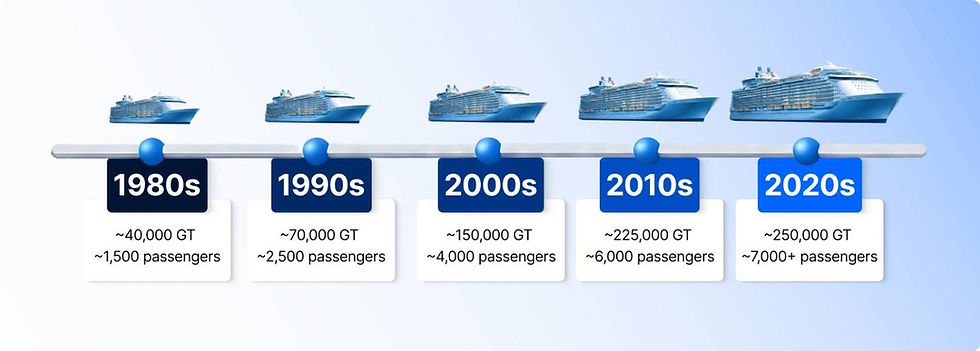
Cruise ships have gotten dramatically bigger since the 1980s. Back then, a large cruise ship measured around 40,000 gross tons. Today, ships like Royal Caribbean's Icon-class exceed 250,000 gross tons and carry more than 7,000 passengers, roughly a sixfold increase.
The logic is simple: bigger ships spread their operating costs across more passengers, making each trip cheaper to run per person. The trade-off is that mega-ships need deeper ports, larger docking infrastructure, and careful management of their environmental impact at each stop.
Here's how the size categories break down by passenger capacity:
Category | Passenger capacity | Example |
Small | Under 1,000 | Expedition ships |
Mid-size | 1,000–2,500 | Classic ocean-going cruise ships |
Large | 2,500–4,000 | Contemporary mainstream ships |
Mega | 4,000–7,000+ | Icon-class, Oasis-class |
Safety and Regulatory Framework
Passenger ships follow the strictest safety rules in the shipping world. The main rulebook is SOLAS — the International Convention for the Safety of Life at Sea, which sets requirements for watertight compartments, stability if the hull is damaged, fire detection and suppression systems, and enough life-saving equipment for every single person on board.
Classification Society Approval
Before any passenger ship can legally carry a single passenger, it has to be checked and approved by a classification society. These are independent organizations, names like ABS, DNV, Lloyd's Register, ClassNK, and RINA, that review a ship's design, inspect it during construction, and continue checking it throughout its working life.
For passenger ships, this process is even more rigorous than it is for cargo vessels, simply because the stakes are higher when the "cargo" is people. This class approval isn't just a technical formality, it's also something that matters a great deal to anyone evaluating a passenger ship as an asset, since a valid, up-to-date class certificate is proof the ship meets internationally recognized safety standards.
From the Helm: Asset Context
While Shipfinex focuses mainly on cargo and bulk shipping assets, understanding how passenger ships operate adds useful context to the bigger picture of maritime assets. Passenger ships run under different rules, different safety standards, and different business models than cargo ships. Together, they show just how wide the range of maritime assets really is, from essential public transport like ferries, to luxury experiences like cruise ships, each with its own risks, rewards, and purpose.
Conclusion
Passenger ships aren't one thing, they're seven different tools built for seven different jobs, held to strict safety standards, and, increasingly, engineered with real precision. Ocean liners are built for speed and reliability. Cruise ships are built for the experience. Expedition ships open up places most ships can't reach. Ferries and RoPax ships keep people and vehicles moving where roads and bridges can't. Understanding how they're classified, designed, and regulated makes it a lot easier to see why no single type beats the others, each one exists because it does something the rest can't.
Explore maritime asset ownership opportunities on Shipfinex, where transparency meets opportunity.
Disclaimer: This material is provided for informational purposes only and does not constitute financial, investment, or legal advice. All digital assets carry inherent risks, including potential loss of capital. Past performance is not indicative of future results. Please review the relevant offer and risk disclosures carefully before making any financial decision.
FAQS
What are the main types of passenger ships?
The main types are cruise ships (for leisure voyages), ocean liners (for point-to-point transport), ferries (for short-distance passenger and vehicle transport), RoPax ships (combined roll-on/roll-off and passenger), expedition cruise ships (for adventure destinations), and river cruise ships (for inland waterway tourism).
How many types of passenger ships are there?
There are seven main types: ocean liners, cruise ships, expedition cruise ships, river cruise ships, passenger ferries, RoPax ships, and high-speed passenger craft.
What's the difference between a cruise ship and an ocean liner?
Cruise ships are built for leisure trips, with round-trip routes, lots of onboard entertainment, and multiple port stops. Ocean liners are built to get from one point to another across an ocean, with stronger hulls for rough seas, higher speeds, and far fewer entertainment features. The Queen Mary 2 is a modern ocean liner, while ships from Carnival or Royal Caribbean are cruise ships.
What is a passenger ship called in maritime terms?
It's officially called a "passenger vessel," a term used interchangeably with "passenger ship" in maritime regulations like SOLAS.
What is the largest cruise ship in the world?
As of 2024, the largest cruise ships are Royal Caribbean's Icon-class ships, which exceed 250,000 gross tons and carry more than 7,000 passengers. These mega cruise ships include multiple restaurants, entertainment venues, water parks, and resort-style amenities.
What are RoPax ships?
RoPax ships (roll-on/roll-off passenger ships) combine vehicle transport with passenger accommodations. Cars, trucks, and buses drive directly on board, while passengers enjoy cabins, lounges, and dining facilities. They're common on routes like the Baltic Sea crossings and Mediterranean island services.
What classification society approval do passenger ships need?
Passenger ships must be reviewed and certified by an independent classification society, such as ABS, DNV, Lloyd's Register, ClassNK, or RINA. This process checks the ship's design, oversees its construction, and continues throughout its operating life to confirm it meets international safety standards a more rigorous process than what's required for cargo ships.
What's the difference between a cruise line and a cruise ship type?
A cruise ship type describes the vessel itself, for example, an expedition ship or a mega cruise ship. A cruise line type describes the brand's market tier, such as contemporary, premium, luxury, or ultra-luxury, which affects the level of service, ship size, and price rather than the ship's physical design.


Dushyant Bisht
Expert in Maritime Industry
Dushyant Bisht is a seasoned expert in the maritime industry, marketing and business with over a decade of hands-on experience. With a deep understanding of maritime operations and marketing strategies, Dushyant has a proven track record of navigating complex business landscapes and driving growth in the maritime sector.
Email: [email protected]


