Top 10 Biggest Ports in the World 2026

Updated: 4 days ago

Key Takeaways
Shanghai is the world's busiest port, handling over 55.06 million TEU annually, followed by Singapore and Ningbo-Zhoushan.
China dominates global port rankings with seven of the top 10 busiest container ports worldwide.
Ports facilitate 80% of global trade by volume and 70% by value, serving as economic arteries.
Future port development focuses on automation, AI-powered operations, and sustainable green technologies.
Major ports invest in expansion projects like Singapore's Tuas terminal targeting 65 million TEU by 2040.
Table of Contents
Shipping ports are vital gateways to the global economy, connecting countries, continents, and international supply chains. Beyond serving as docking facilities for vessels, these maritime hubs play a critical role in cargo handling, trade connectivity, and the movement of goods worldwide. Ports facilitate approximately 80% of global trade by volume and 70% by value, making them essential to international commerce. Their efficiency influences supply chain performance, transportation costs, and the economic competitiveness of nations.
This article explores the biggest ports in the world, examining their functions, the countries leading global container port activity, and the factors that make these maritime hubs strategically important. Using full-year 2025 throughput data from the 2026 ranking, we present a detailed overview of the top 10 busiest container ports in the world.
By exploring these leading ports and their role in global trade, readers can better understand the maritime infrastructure and logistics networks that keep international commerce moving.
What Is a Shipping Port?
A shipping port is a maritime facility strategically located with wharves or loading areas where ships dock to load and discharge cargo and passengers. These critical hubs can be found on coastlines, estuaries, or even inland, connected to the sea via rivers or canals.
The various types of shipping ports each serve a distinct purpose:

Seaports are located on coastlines, directly accessing the sea for large-scale international trade.
Inland Ports are situated on rivers or canals, linking to the sea via connecting waterways, such as the Port of Hamburg in Germany.
Fishing Ports are designed specifically for fishing vessels, supporting local and international seafood trade.
Cruise Ports cater to passenger cruise ships, acting as a primary driver for a region's tourism economy, such as Nassau in the Bahamas.
Cargo Ports specialize in handling specific types of goods, including containerized, bulk (e.g., oil, coal), or breakbulk cargo (e.g., machinery).
Every port relies on key components to function efficiently. This includes berths where ships dock, terminals for cargo handling and storage, navigation channels to ensure safe ship entry and exit, and a vast network of supporting infrastructure like warehouses, cranes, and transport links (roads, railways).
What Are Shipping Ports Used For?
Shipping ports serve a variety of critical functions that are essential for global commerce.
Their primary functions revolve around:
Cargo Handling: This involves the highly organized and efficient process of managing the loading and unloading of containers, bulk cargo, and other goods.
Passenger Transport: Ports also act as gateways for tourism and travel, supporting a thriving cruise ship and ferry industry.
In international trade, ports are indispensable. They are the gateways for importing and exporting goods, seamlessly connecting global supply chains. Ports also facilitate transshipment, a process where cargo is transferred between ships for further transport, serving as a critical node in a larger logistical network.
According to industry reports, approximately 70% of global merchandise trade by value passes through ports, underscoring their profound economic impact. Beyond trade, some ports also serve as military ports for naval operations, support fishing industries, or handle raw materials for industrial sectors like oil, gas, and manufacturing.
What Country Has The World's Largest Shipping Ports?
China is the leading country in global container port activity. Supported by its extensive manufacturing base, high export volumes, and strategic location along key international trade routes, China hosts many of the world's busiest container ports. In 2025, Chinese ports collectively handled approximately 354 million TEU, the highest national container throughput worldwide. China was also home to six of the world's 10 busiest container ports by throughput.
The top ports in China alone rank among the world's busiest:
Port of Shanghai: The world’s busiest port, handling over 55.06 million TEU in 2025.
Port of Ningbo-Zhoushan: Known for deep-water facilities, handling 43.87 million TEU in 2025.
Port of Shenzhen: A key hub for electronics exports, processing 35.41 million TEU in 2025.
Port of Guangzhou: Vital for southern China’s trade, handling 28.05 million TEU in 2025.
Port of Tianjin: Serves northern China, with 24.03 million TEU in 2025.
These statistics highlight China’s critical role in global commerce and its investment in world-class port infrastructure.
The Complete List of the Top 10 Biggest Ports in the World
Rank | Container Port | Country / Region | Throughput (2025) |
1 | Port of Shanghai | China | 55.06 million TEU |
2 | Port of Singapore | Singapore | 44.66 million TEU |
3 | Port of Ningbo-Zhoushan | China | 43.87 million TEU |
4 | Port of Shenzhen | China | 35.41 million TEU |
5 | Port of Qingdao | China | 32.89 million TEU |
6 | Port of Guangzhou | China | 28.05 million TEU |
7 | Port of Busan | South Korea | 24.88 million TEU |
8 | Port of Tianjin | China | 24.03 million TEU |
9 | Jebel Ali Port | United Arab Emirates | 15.55 million TEU |
10 | Port Klang | Malaysia | 15.14 million TEU |
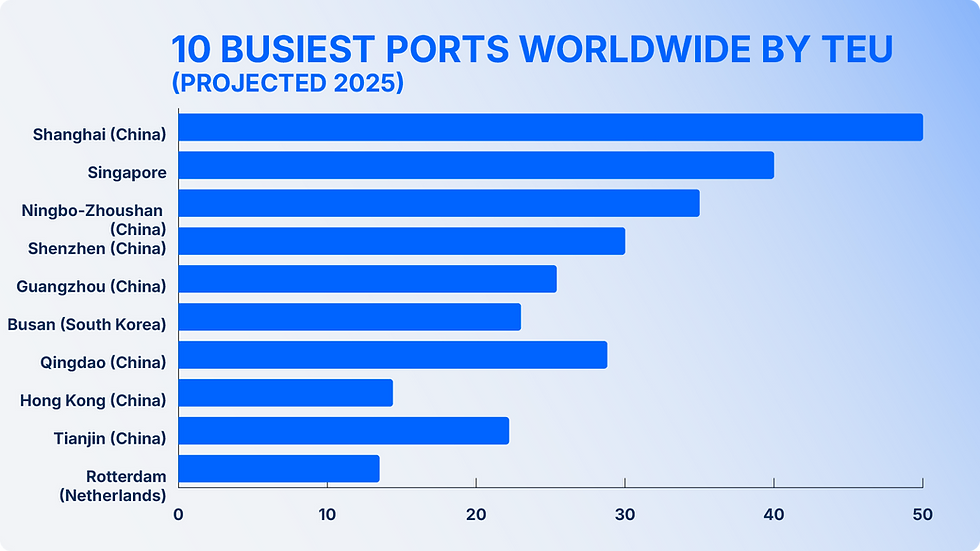
Global maritime trade relies heavily on the world's busiest container ports, which serve as critical gateways for international commerce. These logistics hubs handle millions of containers annually, facilitating the movement of goods across global supply chains. Based on the latest available full-year data for 2025, the following ranking identifies the top 10 busiest container ports in the world, measured by container throughput in Twenty-foot Equivalent Units (TEU).
1. Shanghai, China

The Port of Shanghai retained its position as the world’s busiest container port in 2025, handling approximately 55.06 million TEU. Located in the Yangtze River Delta, Shanghai serves as a major gateway connecting China’s manufacturing regions with international markets. Its extensive terminal infrastructure, including the Yangshan Deep-Water Port, supports large-scale container operations, advanced automation, and high-volume maritime trade across global shipping networks.
2. Singapore, Port

The Port of Singapore ranked second globally, processing approximately 44.66 million TEU in 2025. Positioned along the strategic Strait of Malacca and major East–West shipping routes, Singapore is one of the world’s leading transshipment hubs. Its extensive connectivity, modern terminals, digital port systems, and advanced cargo-handling capabilities enable it to efficiently transfer containers between vessels serving Asia, Europe, the Middle East, and other global markets.
3. Ningbo-Zhoushan, China

The Port of Ningbo-Zhoushan handled approximately 43.87 million TEU in 2025, ranking third worldwide. Located in Zhejiang Province, it is recognized for its deep-water facilities and strategic access to China’s manufacturing and export industries. The port combines extensive container terminal infrastructure with strong rail, road, and maritime connections. Its large-scale operations also make it a major global hub for cargo handled by total tonnage.
4. Shenzhen, China

The Port of Shenzhen processed approximately 35.41 million TEU in 2025, making it the world’s fourth-busiest container port. Located in the Pearl River Delta, Shenzhen supports China’s electronics, technology, and manufacturing export sectors. Its major terminals provide connections to international shipping routes and nearby Hong Kong. Investments in terminal modernization, digitalization, and container-handling infrastructure help the port manage substantial volumes of global trade.
5. Qingdao, China

The Port of Qingdao handled approximately 32.89 million TEU in 2025, ranking fifth globally. Located in Shandong Province, Qingdao is an important maritime gateway for northern China and a major hub connecting domestic manufacturing regions with international markets. Its modern container terminals, advanced cargo-handling systems, and extensive logistics infrastructure support large-scale shipping operations. The port also plays a significant role in China’s international maritime trade network.
6. Guangzhou Harbor, China

The Port of Guangzhou processed approximately 28.05 million TEU in 2025, placing it sixth among the world’s busiest container ports. Situated in the Pearl River Delta, Guangzhou serves as a major gateway for southern China’s manufacturing and export economy. Its container terminals connect industrial centers with regional and international shipping routes. The port’s extensive logistics infrastructure supports containerized cargo movement throughout Asia and other global markets.
7. Busan, South Korea

The Port of Busan handled approximately 24.88 million TEU in 2025, ranking seventh worldwide. Located on South Korea’s southeastern coast, Busan is a major transshipment hub in Northeast Asia. Its strategic position provides connections between Asian markets and major Pacific shipping routes. The port’s container terminals, logistics facilities, and international shipping connections support South Korea’s export economy and the movement of cargo across regional and global supply chains.
8. Tianjin, China

The Port of Tianjin processed approximately 24.03 million TEU in 2025, ranking eighth among the world’s busiest container ports. Located near Beijing, Tianjin serves as a major maritime gateway for northern China’s industrial and commercial regions. Its extensive container terminals, specialized cargo facilities, and inland transportation links support international trade. The port plays an important role in connecting northern China with global shipping networks.
9. Jebel Ali, Dubai, United Arab Emirates

Jebel Ali Port handled approximately 15.55 million TEU in 2025, ranking ninth globally. Located in Dubai, the port is one of the Middle East’s major container gateways and transshipment hubs. Its strategic position connects shipping routes between Asia, Europe, and Africa. Modern terminals, logistics infrastructure, and access to regional markets make Jebel Ali an important center for international cargo movement and trade across the Gulf region.
Port Klang, Malaysia

Port Klang handled approximately 15.14 million TEU in 2025, placing it tenth among the world’s busiest container ports. Located along the Strait of Malacca, Port Klang serves as Malaysia’s principal maritime gateway and a major transshipment hub. Its strategic location supports regional and international shipping connections. The port’s container terminals and logistics infrastructure facilitate cargo movement between Southeast Asia and major global markets.
The Future of Ports in a Changing World
Shipping ports will remain critical nodes in the global economy, but their role is evolving. The future of these facilities is centered on technology, sustainability, and expansion to meet the demands of a rapidly changing world.
Future Trends:
Increasing Automation and Digitization: Ports are investing heavily in technologies like AI, robotics, and smart port systems to optimize operations, reduce human error, and improve efficiency. Shanghai’s Yangshan Deep Water Port, the world's largest automated container port, is a prime example of this trend.
Sustainability: There's a growing emphasis on green initiatives, including the adoption of cleaner fuels, electrification of port equipment, and adherence to programs like the World Port Sustainability Program to reduce environmental impact.
Expansion and Modernization: Ports are continuously expanding to accommodate ever-larger vessels and increasing trade volumes, a trend exemplified by Singapore’s Tuas terminal, which is being developed to handle up to 65 million TEU annually by 2040.
As the arteries of global trade, shipping ports will continue to evolve, becoming smarter, greener, and more efficient. Understanding the crucial functions and scale of these global hubs provides invaluable insight into the health of the world economy.
FAQs for Busiest Port in world
What is the busiest container port in the world?
The Port of Shanghai in China is the world’s busiest container port. It handled approximately 55.06 million TEUs in 2025, retaining the top position in the 2026 Lloyd’s List One Hundred Container Ports ranking. Its extensive terminal network and connections to China’s manufacturing regions make it a major gateway for global trade.
Why is the Port of Singapore one of the busiest in the world?
The Port of Singapore handled approximately 44.66 million TEUs in 2025, ranking second globally. Its location along the Strait of Malacca and major East–West shipping routes makes it a strategic transshipment hub. Singapore’s extensive shipping connectivity, modern terminals, and cargo-handling infrastructure support the transfer of containers between vessels serving Asia, Europe, the Middle East, and other markets.
Which is the largest port in Asia?
The Port of Shanghai in China is Asia’s largest container port by throughput. It handled approximately 55.06 million TEUs in 2025. Singapore and Ningbo-Zhoushan are also among Asia’s largest container ports, with 2025 throughput of approximately 44.66 million and 43.87 million TEUs, respectively.
Which is the largest seaport?
“Largest seaport” can mean different things, such as area, cargo tonnage, or container volume. By container traffic, Shanghai is often called the largest seaport. By total cargo handled, ports like Ningbo-Zhoushan and Singapore also rank extremely high. All of these ports have massive facilities that can serve the biggest modern ships.
Which is the largest seaport in the world?
The term “largest seaport” depends on the measurement used. By container throughput, the Port of Shanghai ranked first in 2025 with approximately 55.06 million TEUs. By total cargo tonnage, ports such as Ningbo-Zhoushan are leading contenders. Port rankings should therefore specify whether they measure container volume, total cargo tonnage, port area, or another metric.
Which is the world’s deepest seaport?
There is no single universally accepted ranking of the world’s deepest seaports because reported depth can refer to the approach channel, harbor basin, or individual berth. The Port of Sines in Portugal is frequently cited among the world’s deepest ports, with reported depths of up to 28 meters. The Yangshan Deep-Water Port in China is also cited for depths of up to 27 meters, while Rotterdam’s Maasvlakte 2 facilities are reported at approximately 24 meters.
Sources
Lloyd’s List – One Hundred Container Ports 2026: https://www.lloydslist.com/one-hundred-container-ports-2026
Visual Capitalist – World’s Busiest Container Ports: https://www.visualcapitalist.com/ranked-the-worlds-busiest-container-ports/
Yahoo Finance – World’s 30 Busiest Ports: https://finance.yahoo.com/economy/articles/ranked-world-30-busiest-ports-154558505.html
Lloyd’s List – One Hundred Ports Archive: https://www.lloydslist.com/one-hundred-ports-archive
Shanghai Municipal Government – Port Statistics: https://english.shanghai.gov.cn/en-ShanghaiinNumbers/20260205/b19d86fb23684b58b53b94cb604ff2d5.html
Shanghai International Port Group: https://en.portshanghai.com.cn/LatestNews/4941.jhtml
Maritime and Port Authority of Singapore: https://www.mpa.gov.sg/media-centre/details/singapore-posts-record-port-performance-in-2025-and-develops-future-readiness-through-industry-collaborations-for-2026
Ningbo-Zhoushan Port – 2025 Records: https://www.ezhejiang.gov.cn/zhoushan/2026-01/06/c_1153055.htm
Shenzhen Municipal Transport Bureau: https://jtys.sz.gov.cn/zwgk/sjfb/yssj/hyl_179719/content/post_12673236.html
UNCTAD – Review of Maritime Transport 2017: https://unctad.org/publication/review-maritime-transport-2017
UNCTAD – Review of Maritime Transport 2018: https://unctad.org/publication/review-maritime-transport-2018
Singapore MPA – Port of the Future: https://www.mpa.gov.sg/maritime-singapore/port-of-the-future
Singapore Ministry of Transport – Global Maritime Hub: https://www.mot.gov.sg/what-we-do/maritime/global-maritime-hub/
China Government – Port Statistics 2025: https://english.www.gov.cn/archive/statistics/202606/30/content_WS6a43bc0fc6d00ca5f9a0bf02.html
World Ports Organization – Ningbo-Zhoushan Cargo Throughput: https://www.worldports.org/ningbo-zhoushan-ports-cargo-throughput-exceeded-1-4-billion-tons-in-2025/
Port of Sines – Investment Factsheet: https://www.sines.pt/cmsines/uploads/document/file/9340/invest_in_sines___english__2021_.pdf
Lloyd’s List – Ningbo-Zhoushan Port Profile: https://www.lloydslist.com/LL1157876/03-NingboZhoushan-China
Regulatory disclosure: Shipfinex FZCO holds VARA In-Principle Approval (IPA/26/01/002) for Virtual Asset Broker-Dealer Activity. This is an In-Principle Approval, not a full operational licence. Shipfinex is not authorised to commence operations or conduct virtual asset activities until it obtains final authorisation from the Virtual Assets Regulatory Authority (VARA). This article is for informational purposes only and does not constitute legal advice, regulatory guidance, or an offer or invitation to deal in virtual assets or securities. All investments carry significant risk, including the potential for total loss. This is a high-risk asset. See the full Risk Disclosure Statement.

Ravi Shankar
Co-Founder & CCO, Shipfinex
Ravi Shankar FICS is Co-Founder and Chief Commercial Officer of Shipfinex, and General Secretary of the ICS Middle East Branch. A Fellow of the Institute of Chartered Shipbrokers with extensive experience in ship sale and purchase, chartering, and maritime consultancy, he has previously held senior roles at Maersk Broker and Eastgate Shipping DMCC. His day-to-day commercial work spans dry bulk and tanker market analysis, SnP transactions, and shipbroking advisory.


