Inside a Modern Container Ship: A Complete Guide to Crew Roles & Hierarchy

Updated: Apr 14

Picture this: a massive container ship sails into port at dawn. Stacked on its deck are over 20,000 containers carrying everything from smartphones to sneakers, cargo worth billions of dollars. Yet this floating city, this marvel of modern engineering, is operated by a crew smaller than what you'd find in a typical restaurant kitchen.
While millions of products cross oceans daily on container ships, connecting factories in Asia to stores in America and beyond, few people understand the complex human machinery that makes global trade possible. Who are the people running these maritime giants? How does a crew of just 20-25 highly trained professionals manage ships that can stretch over 1,300 feet long?
This comprehensive guide pulls back the curtain on maritime hierarchy, revealing the specialized roles, daily responsibilities, and career paths of those who spend months at sea keeping global commerce flowing. From the captain's strategic command on the bridge to the engineers monitoring massive engines below deck, we'll explore how this tight-knit crew works together to safely transport 90% of the world's goods across thousands of miles of open ocean.
The Bridge of Command: Deck Department

At the top of the ship's hierarchy stands the Master or Captain, who holds ultimate authority and legal responsibility for the ship, crew, cargo, and environmental compliance. This isn't just a title, captains make critical decisions about navigation routes, weather responses, port operations, and emergency protocols. With typically over a decade of maritime experience and a Class 1 Master Mariner license, captains possess both technical expertise and leadership skills honed through years at sea. Here's a surprising fact: under maritime law, captains can legally perform marriages and even make arrests aboard their ships.
The Chief Officer, also known as the Chief Mate, serves as second-in-command and oversees the practical daily operations that keep cargo moving safely. This role involves complex cargo planning, stability calculations to prevent the ship from listing or capsizing, crew scheduling, and maintenance coordination. The Chief Officer essentially runs the ship's operations while the Captain focuses on navigation and strategic decisions. Reaching this position typically requires four to six years as a junior officer, demonstrating both technical competence and leadership ability.
The Second Officer specializes in navigation, maintaining charts, navigation equipment, and passage planning. Working the 12-to-4 watch schedule, midnight to 4 AM and noon to 4 PM, this officer ensures the ship stays on course using GPS, radar, ECDIS (Electronic Chart Display and Information Systems), and meteorological forecasting tools. In an age of advanced technology, the Second Officer must be both a traditional navigator and a tech-savvy operator.
Meanwhile, the Third Officer serves as the ship's safety officer, managing lifesaving equipment, firefighting gear, and conducting regular emergency drills. Working the 8-to-12 and 4-to-8 watches, this entry-level officer position is often the first role for maritime academy graduates, providing crucial hands-on experience in ship operations and crew management.
Supporting the officers are Deck Cadets or junior officers in training positions, learning practical seamanship while pursuing their certifications through supervised bridge watch-keeping and cargo operations assistance.
The Bosun (pronounced "bo-sun," short for Boatswain) serves as the crucial bridge between officers and crew, supervising the able-bodied seamen in maintenance and deck operations. With practical skills in rigging, painting, deck repairs, and mooring operations, the Bosun ensures the ship's deck remains safe and operational.
At the foundation of the deck department are the Able-Bodied Seamen (ABs), who perform general deck work including mooring, maintenance, watch-keeping, and cargo gear operation. Becoming an AB requires a minimum of 18 months of sea time and certification, representing a significant commitment to the maritime profession.
The Heart of the Ship: Engine Department

Deep in the ship's belly, where the constant thrum of machinery never stops, the engine department keeps the ship's mechanical heart beating. The Chief Engineer holds mechanical authority parallel to the Captain's navigational command, with independent authority over all machinery, systems, and the engineering crew. This role encompasses oversight of the main engine, generators, pumps, HVAC systems, desalination equipment, and propulsion systems. The Chief Engineer also manages budgets for spare parts, fuel efficiency optimization, and maintenance scheduling, critical responsibilities when a single breakdown at sea can cost hundreds of thousands of dollars per day.
The Second Engineer coordinates maintenance, planning and executing repair schedules while managing the ship's workshops. This officer handles major overhauls and complex troubleshooting, often during assigned watch responsibilities overseeing engine operations. When something breaks down far from any port, the Second Engineer's expertise becomes invaluable.
The Third Engineer typically specializes in fuel systems, purifiers, and auxiliary machinery, monitoring performance, conducting routine maintenance, and meticulously logging parameters. The Fourth Engineer, as a junior engineering officer, rotates through different machinery areas for comprehensive training while learning all systems and handling specific equipment.
Engine Cadets gain the sea time required for their engineering certifications, working alongside experienced engineers on real-world systems where mistakes can have serious consequences. Supporting the engineering officers, Motormen and Oilers assist with routine maintenance, perform lubrication, cleaning, and minor repairs during their watch-keeping shifts, hands-on work essential for keeping massive engines running 24/7.
The Fitter/Electrician handles electrical systems, electronics, and precision repairs, a role of increasing importance as ships become more automated and technologically sophisticated. To put the scale in perspective: modern container ship engines are 13-story tall diesel behemoths producing over 100,000 horsepower, equivalent to 300 Lamborghinis running simultaneously.
Life Support Systems: The Steward Department
While the deck and engine departments keep the ship moving, the steward department keeps the crew functioning. The Chief Steward serves as hospitality manager, overseeing food service, accommodations, and crew welfare. This includes provisioning, planning and ordering supplies for voyages that can last months, while managing food costs and maintaining quality and variety that keeps crew morale high.
The Chief Cook prepares three meals daily for a diverse international crew, facing unique challenges: limited fresh ingredients after weeks at sea, various dietary restrictions, and cultural food preferences. The ability to create appealing, nutritious meals from shelf-stable ingredients requires both culinary skill and creativity.
Steward Assistants or Messmen provide support through cleaning, serving, galley assistance, and laundry services. Though often entry-level positions serving as gateways to maritime careers, these roles significantly impact crew wellbeing. On voyages lasting two to three months, the quality of food and living spaces directly affects crew performance, safety, and mental health, making the steward department far more critical than might initially appear.
Modern Additions: Specialized Roles
Today's container ships require additional specialized expertise. The Electrician/Electronics Technician maintains communication systems, navigation electronics, and automation equipment, a role of growing importance as ships become increasingly digital. Some ships employ a Pumpman who manages pumping systems for ballast and liquid cargo operations, while Ratings and General Purpose Crew perform various multi-skilled tasks across departments.
Industry evolution tells a striking story: automation has reduced crew sizes from 40-50 members in the 1980s to just 20-25 today. This dramatic reduction makes remaining crew members more multi-skilled, technology-proficient, and valuable than ever before.
The Hierarchy in Action: How It All Works
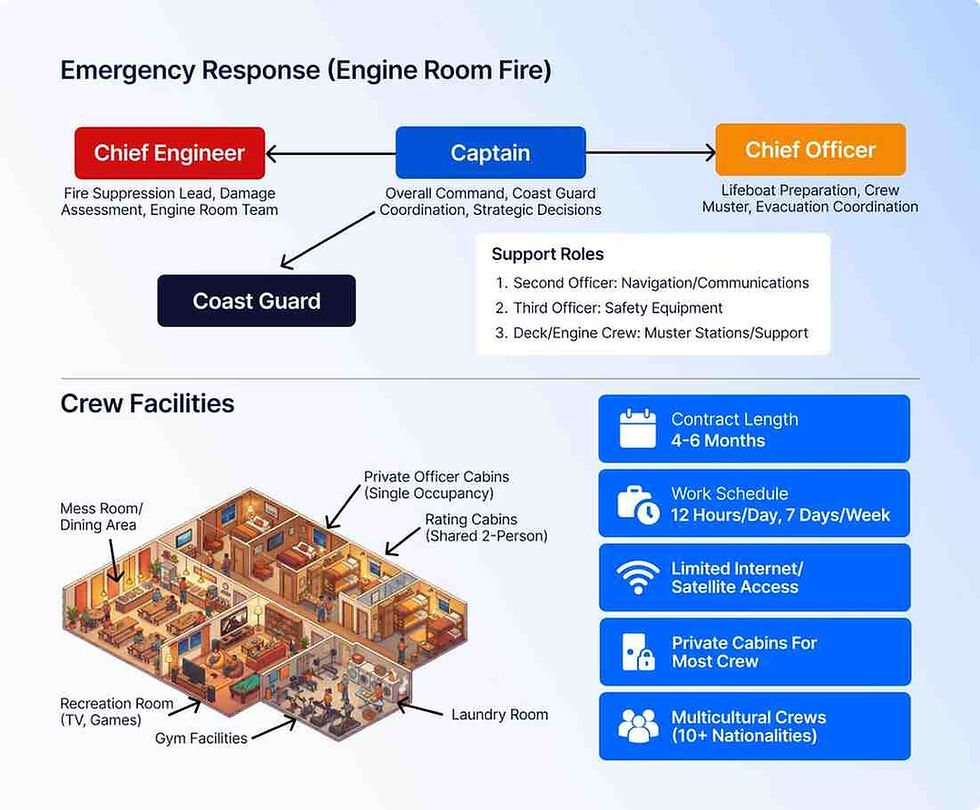
Understanding roles is one thing; seeing how they function together is another. Container ships operate on a watch system requiring 24/7 monitoring. Officers and ratings rotate through four-hour or six-hour watch schedules, ensuring continuous oversight while allowing adequate rest. The deck and engine departments operate independently yet communicate constantly, particularly during critical operations.
The chain of command provides clear structure essential for safety, especially during emergencies. Rank reflects years of training and sea time, with international standards established by STCW (Standards of Training, Certification and Watchkeeping) ensuring global consistency in crew qualifications and procedures.
Consider a real-world emergency scenario: during an engine room fire, the Chief Engineer leads suppression efforts while the Chief Officer prepares lifeboats and the Captain coordinates with coast guard authorities. Each exercises authority within their domain while following the overall command structure, a precisely choreographed response developed through regular drills including fire response, abandon ship procedures, man overboard recovery, and piracy response protocols.
Life at Sea: The Human Side
Behind the technical details and hierarchical structures are real people living unique lives. Modern container ships offer private cabins for most crew members, along with common areas like mess rooms, recreation spaces, and sometimes gym facilities. However, connectivity remains challenging with limited internet access and expensive satellite communications, a reality that can make months at sea feel isolating.
Work-life balance in maritime careers differs dramatically from shore jobs. Crew members typically work contracts of four to six months aboard ship followed by two to three months off. During contracts, 12-hour work days are standard, extending during port operations, with work continuing seven days a week without weekends or holidays.
The multicultural environment adds both richness and complexity. International crews, perhaps Philippine officers working alongside Indian engine crew, must navigate language challenges despite English being the official maritime language. Cultural adaptation and learning to work across different backgrounds and traditions becomes essential for effective teamwork in such confined spaces.
Mental health considerations have gained increasing attention in the maritime industry. The isolation of months away from family and friends, combined with the monotony of long stretches on open ocean with similar daily routines, can take a toll. Modern shipping companies increasingly emphasize crew welfare and mental health resources, recognizing that happy, healthy crew members are safer and more effective.
Career Paths and Qualifications
For those intrigued by maritime careers, several pathways exist. Maritime academies offer four-year degree programs combining academics with required sea time. Cadet programs provide entry-level training while working aboard ships. The ratings pathway allows starting as an ordinary seaman and progressing through experience, while specialized training in welding, electrical work, or HVAC systems opens technical roles.
STCW standards provide the international framework for all maritime certifications, with progressive licensing requiring years of sea time between rank advancements. Continuous learning through regular refresher courses and safety training remains mandatory throughout maritime careers.
Salary expectations vary widely, from $30,000 to over $150,000 annually depending on rank and ship type. Many positions qualify for foreign earned income tax exclusion, and senior officers earn significantly more than entry-level positions. A Third Officer starting at $55,000 can progress to Chief Officer earning $100,000+ within six to eight years, potentially reaching Captain at $150,000+ with 12-15 years of experience.
The industry outlook remains strong. With 90% of world trade moving by sea, demand for qualified mariners continues. Many maritime nations face critical officer shortages, while technology shifts create a growing need for tech-savvy officers familiar with automation and digital systems.
Conclusion
The orchestrated hierarchy aboard modern container ships represents maritime expertise refined over centuries. From the Captain's strategic command to the Oiler's engine room vigilance, each crew member plays an irreplaceable role in moving $14 trillion worth of goods across oceans annually.
Behind every product in your home that traveled by sea, which is nearly everything, stands a small, highly trained crew working in coordinated precision, often in challenging conditions far from home. As global trade grows and ships become larger and more sophisticated, understanding these roles helps us appreciate the human element that remains central to maritime commerce, even in an age of increasing automation.
Next time you see a container ship on the horizon or purchase something shipped from overseas, take a moment to consider the dedicated professionals aboard, navigating, engineering, and maintaining these floating cities that connect our global economy.
Could you spend six months at sea, working 12-hour days in a close-knit community of 25 people, knowing your expertise keeps billions of dollars in cargo safe? The maritime profession isn't for everyone, but for those called to the sea, it offers unique rewards and adventures unavailable in shore-based careers.
Disclaimer:
This material is provided for informational purposes only and does not constitute financial, investment, or legal advice. All digital assets carry inherent risks, including potential loss of capital. Past performance is not indicative of future results. Please review the relevant offer and risk disclosures carefully before making any financial decision.


Dushyant Bisht
Expert in Maritime Industry
Dushyant Bisht is a seasoned expert in the maritime industry, marketing and business with over a decade of hands-on experience. With a deep understanding of maritime operations and marketing strategies, Dushyant has a proven track record of navigating complex business landscapes and driving growth in the maritime sector.
Email: [email protected]


