OPEX vs CAPEX on Ships: What Costs Exist and Why They Spike

Updated: Aug 24

Table of Contents
Key Takeaways
OPEX represents 35-45% of ship operational costs on an annual basis, with crewing as the largest single category at 35-40% of OPEX
CAPEX occurs in irregular intervals but can equal or exceed annual OPEX during drydocking years
Cost spikes stem from multiple sources including bunker volatility, regulatory changes, insurance hardening, technical failures, and crew market conditions
Charter type determines cost allocation between owners and charterers, significantly affecting each party's exposure
Older ships face higher costs across both OPEX (increased maintenance) and CAPEX (more extensive drydocking work)
Regulatory compliance drives unpredictable CAPEX as international standards evolve and require expensive retrofits
Introduction to OPEX and CAPEX on Ships
Ship ownership requires substantial capital to acquire the asset, but the purchase price represents only the beginning of financial commitment. Operating a ship involves two distinct cost categories that directly affect profitability and cash flow.
Operating Expenditures (OPEX) cover the day-to-day costs of keeping a ship running. Capital Expenditures (CAPEX) fund major investments in maintenance, upgrades, and regulatory compliance. Understanding both categories helps evaluate ship economics and recognize why costs sometimes spike unexpectedly.
What are Operating Expenditures (OPEX)?

OPEX represents the recurring costs required to operate a ship commercially. These expenses occur monthly or annually regardless of whether the ship generates revenue.
Crewing Costs
Crew wages typically represent 35 to 40 percent of total OPEX, making this the largest single expense category (1). A commercial ship requires 15 to 25 seafarers operating in rotating shifts to maintain 24-hour operations.
Crewing costs include:
Base wages for officers and ratings
Travel expenses when crew join or leave the ship
Training and certification maintenance
Crew insurance and benefits packages
Crew nationality significantly affects costs. European officers command higher wages than Asian officers, creating a USD 200,000 to USD 400,000 annual difference for the same positions on identical ships (2).
Maintenance & Spares
Ships require continuous maintenance to prevent equipment failures that could cause expensive downtime. Maintenance costs typically range from 20 to 25 percent of total OPEX.
Key maintenance categories:
Engine servicing and machinery upkeep
Deck equipment and navigation systems testing
Hull preservation and corrosion prevention
Spare parts inventory (USD 500,000 to USD 1 million)
Older ships require higher maintenance spending. A 15-year-old ship might spend 30 to 40 percent more on maintenance than an identical 5-year-old ship (3).
Insurance Requirements
Ship insurance is divided into Hull & Machinery (H&M) covering physical damage and Protection & Indemnity (P&I) covering third-party liabilities. Insurance typically represents 15 to 20 percent of OPEX. A container ship valued at USD 80 million might pay USD 800,000 to USD 1.2 million annually for combined coverage (4).
Management Fees & Administration
Most ship owners contract technical management to specialized companies. Management fees typically range from USD 800 to USD 1,500 per day depending on ship type. Administrative costs include flag state fees, classification society fees, and general administration, representing 10 to 15 percent of total OPEX.
Stores & Consumables
Ships consume lubricating oils, hydraulic fluids, cleaning supplies, paints, and provisions. Engine lubrication oil alone can cost USD 100,000 to USD 200,000 annually for large ships.
Typical Daily OPEX by Container Ship Type:
Small Feeder (1,000): USD 4,000 - USD 6,000
Panamax (5,000): USD 8,000 - USD 10,000
Post-Panamax (13,000): USD 12,000 - USD 15,000
Ultra Large (20,000+): USD 15,000 - USD 20,000
These figures exclude fuel costs, which vary based on charter type.
What are Capital Expenditures (CAPEX)?
CAPEX represents large, infrequent investments that maintain ship condition, extend operational life, or ensure regulatory compliance. Unlike OPEX's predictable monthly patterns, CAPEX occurs in irregular intervals with substantial individual expenses.
Drydocking & Special Surveys
Classification societies require ships to undergo detailed inspections at specified intervals. The Special Survey occurs every five years and involves comprehensive hull inspection, tank examinations, and structural assessments.
Drydocking work includes:
Hull cleaning and painting
Propeller polishing and sea chest inspection
Tank examinations and structural assessments
Equipment testing and certification
Special Survey drydocking typically costs USD 2 million to USD 5 million for container ships (5). An Intermediate Survey occurs at the 2.5-year mark. Final costs can exceed budgets by 20 to 40 percent when unexpected work emerges during inspection.
Equipment Upgrades
Ships require periodic equipment replacement as technology advances and existing systems reach end-of-life. Navigation equipment, communication systems, and engine components all eventually need replacement. Ships might invest USD 500,000 to USD 2 million in equipment upgrades every few years.
Regulatory Compliance Retrofits
International maritime regulations evolve continuously, often requiring expensive retrofits to existing ships.
Recent regulatory CAPEX examples:
Ballast Water Treatment Systems: USD 1 million to USD 3 million (6)
Scrubbers for sulfur compliance: USD 2 million to USD 5 million
EEXI/CII compliance modifications: Variable costs
Regulatory retrofits represent unpredictable CAPEX with limited notice before compliance deadlines.
Life Extension Investments
Ships approaching 15 to 20 years old may require substantial investment to extend operational life another 5 to 10 years. This can include major engine overhauls, generator replacements, and structural reinforcement. These investments can reach USD 5 million to USD 10 million (7).
Why Ship Operating Costs Spike
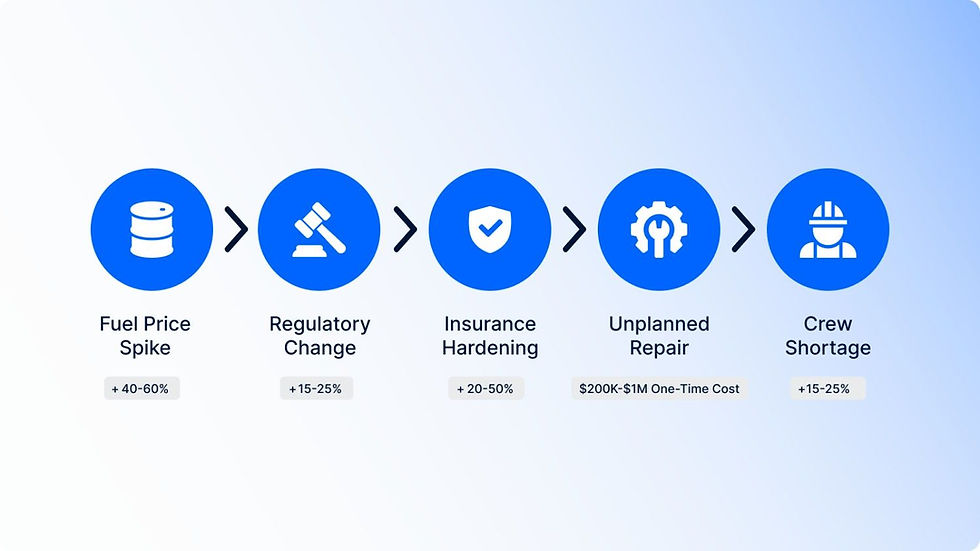
Ship owners face multiple triggers that can cause sudden cost increases disrupting budgets and reducing profitability.
Bunker Price Volatility
Marine fuel oil prices fluctuate based on crude oil markets, refining capacity, and regional supply dynamics. Bunker prices can swing 40 to 60 percent within a single year. During 2020, low-sulfur fuel oil traded between USD 200 and USD 600 per tonne (8). For a large container ship consuming 150 tonnes daily, this represents a USD 60,000 daily cost variance.
Regulatory Changes Requiring Retrofits
New environmental regulations create sudden capital requirements. The IMO 2020 sulfur cap forced ship owners to install scrubbers, switch to expensive low-sulfur fuel, or convert to alternative fuels. Upcoming regulations addressing greenhouse gas emissions may require additional retrofits in the 2025 to 2030 period.
Insurance Market Hardening
Marine insurance markets cycle between soft markets (competitive pricing) and hard markets (rising premiums). Premium increases of 20 to 50 percent can occur within a single renewal period during hard markets. A ship paying USD 1 million annually might face USD 1.5 million the following year with no change in operations.
Technical Failures
Unplanned equipment failures create emergency repair costs and lost revenue during downtime. A main engine failure might require USD 500,000 in emergency repairs plus USD 1 million in lost charter revenue during repair time.
Crew Wage Inflation
Global seafarer supply and demand imbalances can drive rapid wage increases. Following COVID-19, crew shortages drove officers' wages up 15 to 25 percent in certain markets within two years (9).
Drydocking Scope Creep
Drydocking budgets often prove inadequate when inspections reveal additional work requirements. Corrosion discovered during tank inspections or equipment failures identified during testing add unplanned costs. A drydocking budgeted at USD 3 million might reach USD 4.5 million after unexpected repairs.
OPEX vs CAPEX in Charter Contracts

Charter contract structure determines which party bears different cost categories.
Time Charter:
Owner pays: All OPEX (crew, maintenance, insurance, management)
Charterer pays: Voyage costs (fuel, port charges, canal fees)
Owner retains: All CAPEX responsibility
Bareboat Charter:
Charterer pays: Most OPEX and all voyage costs
Owner receives: Bareboat hire covering capital costs
Owner retains: CAPEX responsibility for major investments
Spot/Voyage Charter:
Owner pays: All OPEX and voyage costs
Owner receives: Voyage freight
Owner vulnerable to: Both OPEX volatility and bunker price swings
Conclusion
Ship operating costs divide into recurring operational expenditures and major capital investments, each following different patterns and requiring distinct financial planning approaches. OPEX provides relatively predictable monthly costs, though inflation and market conditions create variability. CAPEX concentrates in irregular intervals when drydocking or regulatory compliance demands substantial investment.
Successful ship operations require adequate reserves for both categories. Ships generating strong charter revenue during favorable periods must set aside funds for future drydocking, regulatory retrofits, and operational cost increases.
Frequently Asked Questions
What is OPEX in shipping?
OPEX (Operating Expenditures) refers to the day-to-day costs of running a ship, including crew wages, maintenance, insurance, management fees, and consumables. These are recurring expenses typically ranging from USD 4,000 to USD 20,000 daily depending on ship size and type.
What is CAPEX for ships?
CAPEX (Capital Expenditures) refers to major investments in ship maintenance and upgrades, including drydocking every 2.5 to 5 years, equipment replacements, and regulatory compliance retrofits. A typical drydocking costs USD 2 million to USD 5 million for container ships.
Why do ship operating costs spike?
Ship costs spike due to fuel price volatility (40-60% annual swings), unexpected regulatory requirements, insurance market hardening (20-50% premium increases), unplanned technical failures, crew wage inflation, and drydocking scope exceeding budgets by 20-40%.
How much does it cost to operate a container ship per day?
Daily operating costs (OPEX only, excluding fuel) vary by ship size: Small feeders USD 4,000-6,000, Panamax USD 8,000-10,000, Post-Panamax USD 12,000-15,000, and Ultra Large Container Ships USD 15,000-20,000.
COMPLIANCE DISCLAIMER: This content is for informational and educational purposes only. It does not constitute financial, investment, or operational advice. Ship operating costs vary significantly by ship type, age, and market conditions. All maritime operations carry operational and financial risks. Readers should consult qualified maritime, financial, and legal professionals for specific decisions.


Suraz Troy Kotakki
Founder & COO
Suraz Troy Kotakki is a visionary leader and advocate for making the trillion-dollar maritime industry accessible to everyone. He is a seasoned expert in the maritime industry, blockchain technology, and RWA tokenization. With his passion for innovation and a strong belief in financial inclusivity, Suraz is at the forefront of Shipfinex, a platform enabling individuals to own ships, democratizing the maritime space.
LinkedIn: https://www.linkedin.com/in/szka/


