Freight Insurance: What It Protects, Who Needs It, and How It Differs from Cargo Insurance

Key Takeaways
Fundamentally Different Interests: Freight insurance protects a carrier’s or forwarder’s revenue (the income stream from transporting goods). Cargo insurance protects the shipper’s physical merchandise (the value of the goods themselves). They are completely separate policies.
The Hague-Visby Trap: Carriers have a strict legal liability cap (approximately USD 2.70 per kilogramme) under the Hague-Visby Rules. A carrier's freight insurance does not compensate the shipper for lost goods, making dedicated cargo insurance mandatory to avoid catastrophic financial losses.
The Advance Freight Danger: Advance freight payments are generally non-refundable. If a vessel sinks, the shipper loses both the goods and the prepaid freight. Shippers (especially under FOB or CFR terms) must explicitly include the advance freight cost in their cargo's total insured value to avoid this double exposure.
Who Buys Freight Insurance: It is primarily purchased by shipowners operating on voyage charters (where freight is earned only upon delivery) and NVOCCs/freight forwarders who issue their own bills of lading and carry freight revenue risk.
Relevance to Asset Tokenization: For investors holding Maritime Asset Tokens (MATs) tied to vessels on voyage charters, adequate freight insurance is a critical risk management tool. It protects the Special Purpose Vehicle's (SPV) expected cash flow, and consequently, the token holders' yield, if a voyage cannot be completed.
QUICK ANSWER: Freight insurance protects the transportation revenue that a carrier, shipowner, or freight forwarder expects to earn from delivering cargo. If goods are lost or damaged and the carrier loses the right to freight payment, freight insurance indemnifies that lost income. It is distinct from cargo insurance, which covers the value of the goods themselves. The two policies protect different commercial interests and are typically purchased by different parties. The distinction matters because the carrier’s liability under the Hague-Visby Rules is capped at SDR 666.67 per package or SDR 2 per kilogramme, far below commercial cargo values in most trades.
What Freight Insurance Covers and Who Buys It
Freight insurance is a marine insurance product that protects the insured’s financial interest in freight charges when those charges are lost because cargo cannot be delivered as contracted. The “freight” being insured is the income stream from transporting cargo. It is not the cargo itself.
Who purchases freight insurance depends on who bears the freight risk under the charter or contract of carriage. Under a voyage charter, freight is typically earned on delivery of cargo in good order and condition at the destination. If the cargo is lost, the owner loses the right to collect freight. Under a time charter, hire continues regardless of whether cargo is delivered. Freight insurance is therefore relevant primarily to voyage charter owners and to freight forwarders who have issued their own bills of lading and committed to freight revenue.
I have spent time on both sides of this commercial distinction: as a commercial operator structuring charterparties and as an adviser to charterers evaluating their insurance exposure. The number of experienced shipping professionals who confuse freight insurance with cargo insurance is higher than it should be, and the cost of that confusion under a voyage charter with advance freight provisions can be substantial.
Who Insures | What Is Protected | When Freight Is Lost | Policy Structure |
Shipowner (voyage charter) | Freight earned on delivery of cargo | Cargo lost or vessel total loss before delivery | Part of hull policy suite or standalone freight policy |
Charterer | Advance freight paid or freight at risk | Goods lost; freight not earned back | Standalone freight policy or cargo policy extension |
Freight forwarder or NVOCC | Transportation charges forwarder expected to earn | Cargo cannot be delivered; charges not recoverable | Freight forwarder’s liability policy or specific freight interest cover |
Cargo seller (CIF terms) | Freight element in CIF invoice value | Loss of cargo before delivery; freight charged but goods not received | Included in CIF cargo insurance value (conventionally 110% of invoice) |
The Core Distinction: Freight Insurance Is Not Cargo Insurance

The confusion between freight insurance and cargo insurance is understandable because both arise from the same shipping transaction and both may be triggered by the same casualty. The distinction is who holds what insurable interest.
Cargo insurance protects the cargo owner against loss or damage to the physical goods. It is valued at the commercial invoice value of the goods, typically plus 10% for CIF shipments per standard market practice. The cargo owner is the insured, and the policy responds to physical loss or damage to the goods.
Freight insurance protects the party entitled to receive freight against loss of that income. The insured amount is the freight charge, not the cargo value. The party entitled to freight is typically the carrier, but can be the charterer depending on the charterparty and the applicable Incoterms.
Under CIF Incoterms, the seller arranges and pays for cargo insurance to the point of discharge. The conventionally insured value is 110% of the invoice value, with the freight element included in the invoice. The additional 10% represents anticipated profit and absorbs both the freight and insurance premium elements. Under FOB terms, the buyer bears the risk from the point of loading and should arrange their own insurance.
Factor | Cargo Insurance | Freight Insurance |
What is insured | The physical goods in transit | The transportation income; freight charges |
Who typically insures | Cargo owner; importer; or exporter | Carrier; shipowner; or freight forwarder |
Insured amount | Commercial invoice value (typically + 10%) | The freight earned or at risk on the voyage |
What triggers a claim | Physical loss or damage to goods | Loss of right to receive freight due to casualty |
Governing clauses | Institute Cargo Clauses (A), (B), or (C) | Institute Freight Clauses or policy-specific wording |
Carrier liability convention cap | Not applicable; pays actual loss up to sum insured | Hague-Visby: SDR 666.67 per package or SDR 2/kg |
The Hague-Visby Limit: Why Freight Insurance Does Not Substitute for Cargo Insurance
This is where smaller shippers lose the most money, so it deserves direct treatment.
The Hague-Visby Rules, incorporated into most international bills of lading by operation of the Carriage of Goods by Sea Act 1971 (UK) and equivalent national legislation, impose a liability cap on the carrier of SDR 666.67 per unit of cargo or SDR 2 per kilogramme gross weight, whichever is higher. At current SDR values, SDR 2/kg equates to approximately USD 2.70 per kilogramme.
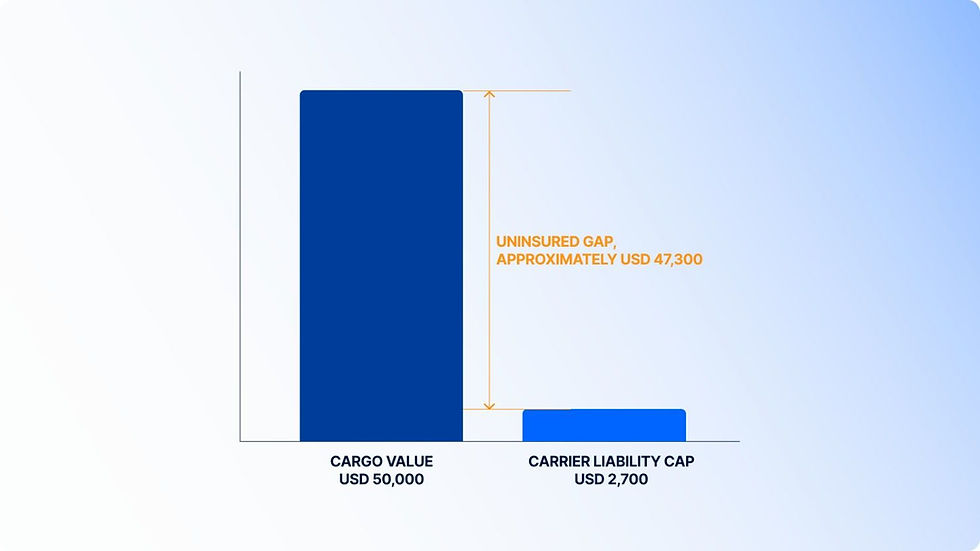
For a one-tonne shipment of industrial machinery worth USD 50,000, the carrier’s maximum liability at SDR 2/kg is approximately USD 2,700 at current SDR rates. A cargo owner without cargo insurance receives USD 2,700. The uninsured loss is approximately USD 47,300 on that one tonne.
Freight insurance does not fill this gap. Freight insurance reimburses the carrier for lost freight revenue. It does not pay the cargo owner for the value of their goods. The two policies are not substitutes; they cover complementary but distinct commercial interests.
Party | Interest | Loss | Policy Responding | Recovery |
Cargo owner with cargo insurance | USD 50,000 machinery | Goods lost overboard | Cargo insurance: ICC(A) | Up to USD 50,000 (less deductible) |
Carrier (voyage charter) | USD 3,200 freight for shipment | Right to freight lost | Freight insurance | Up to USD 3,200 freight value |
Cargo owner with no insurance | USD 50,000 machinery | Goods lost overboard | Carrier liability only (Hague-Visby) | Approximately USD 2,700 (SDR 2/kg at current rates) |
The cargo owner in the third row is underinsured by approximately USD 47,300 per tonne. At 20 tonnes of machinery, the uninsured loss is approximately USD 940,000. This is not hypothetical; uninsured cargo loss at this scale is routine in international trade.
Counter-Consensus: Advance Freight Provisions Are More Dangerous Than Most Shippers Realise
The standard treatment of advance freight in shipping textbooks focuses on the question of whether advance freight is refundable if the cargo is lost. The answer under English maritime law is generally no: advance freight once paid is irrecoverable by the cargo owner unless the charterparty specifically provides otherwise.
What the textbooks do not adequately emphasise is the compounding effect. A cargo owner who pays advance freight on goods that are subsequently lost has a double exposure: they lose the goods and they lose the freight they prepaid, and neither loss is covered by the carrier’s Hague-Visby liability.
The cargo insurance response to this is to insure at 110% of CIF invoice value, where the freight element is embedded in the CIF price. But cargo owners shipping under FOB or CFR terms, where they arrange their own insurance separately from the freight arrangement, often do not reflect the advance freight element in their insured value at all. I have reviewed cargo insurance programmes where this gap was present and material, and in each case it was discovered in the context of a claim, not in routine programme review.
The practical fix is straightforward: where advance freight is paid and non-refundable, the insurance value should reflect the total amount at risk, which is the goods value plus the advance freight amount, not the goods value alone.
Charter Types and Their Freight Insurance Implications

Commercial chartering operates through structures that allocate freight risk differently. I know the practical consequences of this misalignment from time spent reviewing claims that arose specifically from misclassified charter structures. The insurance implications follow directly from the charter structure.
Under a time charter, the shipowner receives hire regardless of whether cargo is delivered successfully. Hire is not freight in the technical sense; it is a charge for the use of the vessel. The owner on a time charter does not carry freight risk in the traditional sense. The charterer on a time charter carries the commercial risk of the cargo operation but does not carry freight risk in the same way as a voyage charter owner.
Under a voyage charter, freight is earned on delivery. The owner’s freight exposure, the income at risk if cargo is not delivered, is the standard subject of freight insurance for shipowners. BIMCO’s standard GENCON 94 form contains the standard freight payment and demurrage provisions from which the freight insurance exposure can be calculated.
Under a bareboat charter, the bareboat charterer is effectively the operator of the vessel and assumes the role equivalent to a shipowner for insurance purposes. BARECON 2017 is the BIMCO standard form. Bareboat charterers who operate vessels on voyage charter arrangements carry freight risk and should structure freight insurance accordingly.
A Worked Example: Advance Freight Loss Under FOB Terms

The following is illustrative and does not represent any specific transaction or Shipfinex activity.
Item | Amount (USD) |
Value of goods (industrial pumps; 10 tonnes; FOB export port) | 80,000 |
Advance freight paid by buyer under voyage charter arrangement (non-refundable) | 8,500 |
Cargo insurance arranged by buyer (FOB; insured value = goods only) | 80,000 |
Event: vessel lost at sea before cargo discharged | |
Cargo insurance payout (goods value) | 80,000 |
Advance freight: recoverable from carrier (Hague-Visby rules do not cover) | 0 |
Advance freight: recoverable from carrier’s freight insurance | 0 (carrier’s policy; not buyer’s) |
Net loss to buyer (uninsured advance freight) | 8,500 |
Correct insurance value (goods + advance freight) | 88,500 |
Correct insurance value as % above goods value | 10.6% above goods value |
Note: This example illustrates why the convention of insuring at 110% of invoice value exists for CIF terms, and why FOB shippers who pay advance freight arrangements should specifically include that advance freight in their insured value.
Freight Insurance and Maritime Asset Tokens
Shipfinex FZCO, operating under VARA In-Principle Approval (IPA/26/01/002), structures Maritime Asset Tokens (MATs) that represent economic exposure to vessel-owning Special Purpose Vehicles. An IPA is not a full operational licence and is subject to completion of final regulatory requirements.
A vessel-owning SPV operating on voyage charter terms carries freight risk that should be covered by freight insurance as part of the vessel’s operational insurance programme. The presence and adequacy of freight insurance is one component of the risk management framework around the SPV that affects its net cash flow.
Where distributions are declared by the SPV, they are paid to token holders transparently and on-chain. MAT values may decline materially below purchase price. Secondary market liquidity for MATs is limited; early exit may not be possible.
Frequently Asked Questions
What is freight insurance and who needs it?
Freight insurance protects the transportation income that a carrier, shipowner, or freight forwarder expects to receive for delivering cargo. The party who needs it is the party who bears the risk of losing freight income if cargo cannot be delivered, typically shipowners operating on voyage charter terms, freight forwarders who have issued their own bills of lading, or cargo sellers who have paid non-refundable advance freight.
How does freight insurance differ from cargo insurance?
Cargo insurance protects the value of the goods in transit. Freight insurance protects the transportation income from carrying those goods. They are purchased by different parties: cargo owners purchase cargo insurance; carriers and freight forwarders purchase freight insurance. The two policies respond to the same casualty but pay to different parties and for different amounts.
What is the Hague-Visby limit and why does it matter for cargo owners?
The Hague-Visby Rules cap a carrier’s maximum liability for cargo loss at SDR 666.67 per package or SDR 2 per kilogramme gross weight, whichever is higher. At current SDR values, SDR 2/kg equates to approximately USD 2.70 per kilogramme. For cargo worth more than this per kilogramme, which covers virtually all manufactured goods, machinery, and electronics, the carrier’s liability falls far short of actual commercial loss. The only route to recovering full commercial value is through a cargo insurance policy, not through a freight insurance claim.
What happens to freight if cargo is lost at sea?
Under standard English maritime law and most charterparty terms, freight payable on delivery is not earned if cargo is never delivered. The carrier loses the right to collect freight. Advance freight already paid is generally not recoverable by the cargo owner unless the charterparty specifically provides otherwise. A cargo owner who paid advance freight has a double loss: goods lost and freight prepaid. Cargo insurance at 110% of invoice value is designed to cover this combined loss where the freight element is reflected in the insured value.
What is advance freight and why is it significant for insurance?
Advance freight is freight paid at the commencement of the voyage, before cargo delivery, and is generally irrecoverable by the cargo owner if the goods are subsequently lost. It is an insurable exposure. Cargo owners shipping under FOB or CFR terms, who arrange their own insurance separately from the freight arrangement, should specifically include advance freight paid in their insured value. Failure to do so leaves the advance freight amount as an uninsured loss in the event of total cargo loss.
Does freight insurance cover containers lost overboard?
Freight insurance covers the carrier’s or shipowner’s lost freight income on cargo that cannot be delivered. If containers are lost overboard and the carrier cannot deliver the cargo and collect freight, the freight insurance responds to indemnify the lost freight income. It does not cover the value of the lost containers’ contents; that is covered by the cargo owner’s cargo insurance policy.
What is demurrage and how does it relate to freight insurance?
Demurrage is compensation paid to the vessel owner when cargo operations at port exceed the agreed laytime in a voyage charter. It is not directly related to freight insurance but arises from the same voyage charter structure that generates the freight insurance exposure. BIMCO standard forms such as GENCON 94 contain demurrage provisions. A vessel owner’s freight insurance covers lost freight; separate demurrage claims are pursued contractually against the charterer.
Can freight insurance and cargo insurance be held by the same party?
Yes. A seller shipping goods CIF who also charters the vessel has insurable interests in both the cargo value and the freight. They can hold separate policies covering each interest. Large commodity traders and integrated shipping operators typically structure their insurance programmes to cover all their insurable maritime interests through a combination of marine cargo policies, freight interest cover, hull and machinery insurance, and P&I entry.
What conventions govern carrier liability beyond sea transport?
For road cargo in Europe and the Middle East, the CMR Convention (Convention on the Contract for the International Carriage of Goods by Road) applies, with a maximum carrier liability of SDR 8.33 per kilogramme. For air cargo, the Montreal Convention applies, with limits per kilogramme. For rail cargo under the CIM Uniform Rules, separate liability caps apply. In all modes, the convention caps fall below the commercial value of most manufactured goods, making independent cargo insurance the only reliable route to full-value recovery.
What is an NVOCC and what freight insurance exposure does it carry?
An NVOCC (Non-Vessel Operating Common Carrier) is a freight forwarder that issues its own bills of lading but does not operate vessels. It occupies the legal position of carrier to the cargo owner and shipper to the vessel operator. An NVOCC carries freight insurance exposure: if cargo is lost or damaged, the NVOCC may lose the right to collect its transportation charges from the shipper while remaining liable to the cargo owner for any shortfall between Hague-Visby limits and actual cargo value. NVOCCs typically manage this through freight forwarder’s liability policies.
Glossary
Freight: The consideration paid for carriage of goods by sea. Also used to describe the cargo itself in some contexts.
Advance freight: Freight paid at voyage commencement; generally non-refundable if cargo is subsequently lost.
Freight on delivery: Freight earned only on actual delivery of cargo in good order and condition at destination.
Hague-Visby Rules: International convention governing carrier liability under bills of lading; limits liability to SDR 666.67 per package or SDR 2 per kilogramme.
CMR Convention: Convention on the Contract for the International Carriage of Goods by Road; maximum carrier liability SDR 8.33 per kilogramme.
NVOCC: Non-Vessel Operating Common Carrier. Freight forwarder that issues its own bills of lading without operating vessels.
SDR: Special Drawing Rights. International Monetary Fund accounting unit; value fluctuates against major currencies.
P&I Insurance: Protection and Indemnity insurance. Covers vessel operator’s third-party liabilities including cargo damage claims from cargo owners.
Lump sum freight: Freight fixed as a total agreed amount regardless of actual cargo quantity shipped.
CIF: Incoterms trade term: Cost, Insurance, Freight. Seller pays freight and insurance to port of discharge; insured value conventionally 110% of invoice.
GENCON 94: BIMCO standard voyage charterparty form in widest use for dry cargo; contains standard freight payment and demurrage provisions.


Ravi Shanker
Co-Founder & CCO, Shipfinex
Ravi Shankar FICS is Co-Founder and Chief Commercial Officer of Shipfinex, and General Secretary of the ICS Middle East Branch. A Fellow of the Institute of Chartered Shipbrokers with extensive experience in ship sale and purchase, chartering, and maritime consultancy, he has previously held senior roles at Maersk Broker and Eastgate Shipping DMCC. His day-to-day commercial work spans dry bulk and tanker market analysis, SnP transactions, and shipbroking advisory.


